
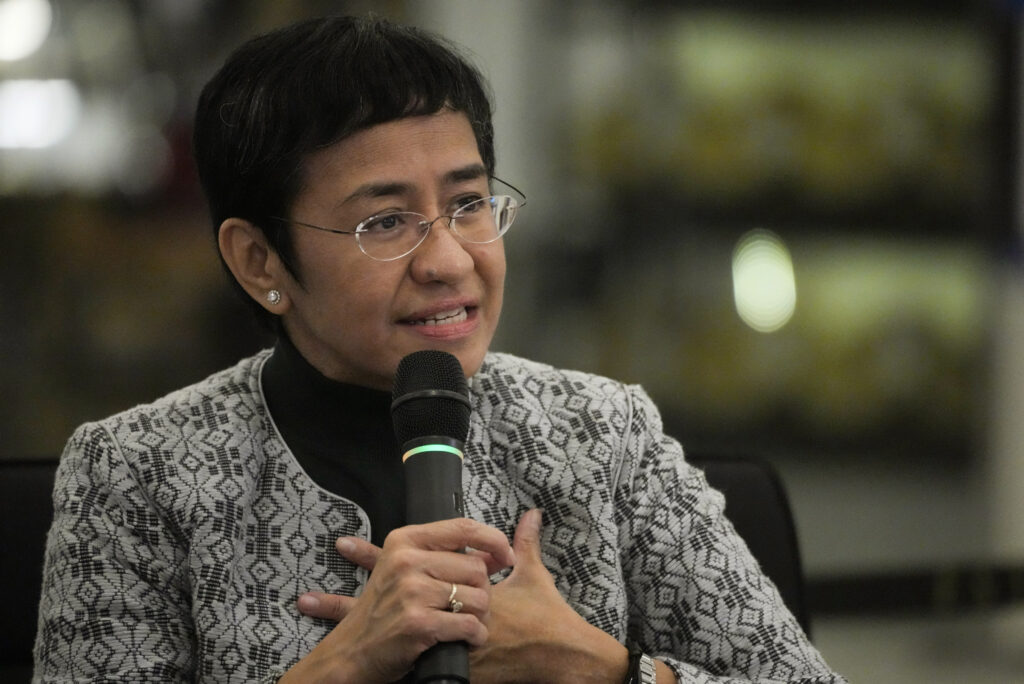
For nearly four decades, Maria Ressa has worked as a journalist and served as the CEO of the online news organization Rappler, building a reputation by reporting on human rights abuses in the Philippines under the authoritarian leadership of then-President Rodrigo Duterte. For these outstanding accomplishments, she was awarded the “prestigious” Nobel Peace Prize in 2021.
One must note that she shares this “esteemed” award with other “undeniable titans of freedom,” such as Yasser Arafat. As the leader of the Palestine Liberation Organization (PLO), Arafat oversaw a regime that utilized terror as a primary diplomatic tool. Under his leadership, the PLO orchestrated the 1970 Dawson’s Field hijackings, wherein terrorists hijacked multiple commercial jetliners, diverted them to the Jordanian desert, and held over 300 innocent hostages before spectacularly blowing the aircraft to pieces. Not content with mere aviation terrorism, Arafat’s PLO also directed horrific civilian massacres. These included the 1970 Avivim school bus massacre, which left 12 Israelis dead—including 9 children— and the 1978 Coastal Road massacre, a slaughter that killed 38 civilians, 13 of whom were children, while leaving 71 others wounded. One can easily come to the conclusion that the Nobel Peace Prize has nothing to do with merit, but more so serves as a “feel-good” for the awardees who absolve their guilt of being born into privilege by awarding the “wretched” and elevating them into their own circles.
Taking the stage as the keynote speaker for this year’s Dartmouth Social Justice Awards ceremony in the Hanover Inn Grand Ballroom, Ressa did not disappoint. She promptly started her speech off with a barrage of nonsensical clichés, whose only apparent utility was to make her address longer while signaling the correct institutional virtues.
The largest gem that stood out from this rhetorical padding was her uniquely tailored definition of her subject matter: “Social justice is the deliberate work of making sure that every person counts in the shared reality we are living in. That every person has access to the same facts, the same dignity, the same protection of the law.”
It is a definition that sounds profound until one actually examines its premises. The concept of “access to the same facts” served as the pivot for her central thesis: that artificial intelligence is fundamentally threatening democracies and social justice itself. According to Ressa, with the advent of AI, the cost of finding a fact has gone up, while the cost of producing a lie has dropped exponentially. Lies, she lamented, are spreading much faster than ever before. Unsurprisingly, she brought up the transition of Twitter to X, blaming the platform’s restructuring for accelerating this spread of misinformation.
In an even more unsurprising twist, as is always the case with the “current bad thing”, she brought up studies arguing that the marginalized are disproportionately affected by this informational chaos, particularly women. “For women, and this is a study we just rolled out last December,” she stated, “women activists, judges, and lawmakers, they’re targeted with coordinated information operations that are designed to silence them.” She also managed to predictably squeeze in a couple of lines criticizing Donald Trump and his alleged “erosion of institutions,” boldly asserting that America is currently in the process of “Filipinoization”—a descent into strongman rule.
According to Ressa, AI poses an existential threat to democracy because “with repetition lies replace the facts.” It is a chilling assertion, not least because the quote is eerily close to the infamous maxim often attributed to Nazi propaganda minister Joseph Goebbels: “If you tell a lie big enough and keep repeating it, people will eventually come to believe it.” She expanded on this bleak view of the electorate, noting, “When they don’t know what the difference is between fact and fiction, they begin to believe whoever shouts loudest. And when that happens, the strong man wins.” She ultimately concluded her speech with the absolutist point that you cannot have social justice without informational integrity.
However, beneath the banner of defending democracy, her speech operated as a covert case for an autocratic crackdown against artificial intelligence and the uncurated bounds of free speech. “This is free speech pounding you to silence,” she claimed.
First, it is clearly implied by her rhetoric that she genuinely believes there are vast swaths of the populace who simply cannot distinguish lies from reality in the news. To her, this is the fatal flaw in the democratic process. Consequently, this implies that the masses are entirely dependent on a source of authority, she presumably would not if it were legacy media, to form their political opinions for them. She was perfectly fine living in a world where the epistemological standard mirrored the logic of Alfred Tarski: The sentence “snow is white” is true if, and only if, CNN says so.
But Ressa firmly believes it is not a democracy if the sentence “snow is white” is true if, and only if, AI says so. Her proposed solution to this technological democratization of information is essentially to ban or heavily restrict free speech, so that the institutional gatekeepers can return to the original status quo.
In other words, the underlying topic of her speech is a tale as old as time: I liked it better earlier when I had more power, so we must go back to the way things were, no matter what it takes. It is the lament of an institutional elite realizing that its monopoly on narrative creation has been irreparably eroded.
This brings us to the financial reality of such grandstanding. While her speaking fee for this Dartmouth appearance was not explicitly disclosed, according to AAE Speakers, Ressa’s live event fees range from $100,000 to $200,000. That is a staggering amount of money for a speech lamenting her own decline in power, which could have easily been spent on securing better Greenkey performers, or perhaps reinvested into actual academic rigor.
Following the keynote, the ceremony shifted to its primary purpose: the presentation of the 2026 Social Justice Awards, recognizing Dartmouth community members for their commitments to various causes.
The Emerging Leadership Award was given to Sarah Kelly, a Lecturer and Research Associate in Geography and Co-Founder of the Energy Justice Clinic. A human-environment geographer specializing in participatory methods, her work focuses on ensuring marginalized communities in New England and southern Chile are not left behind in the global energy transition.
The Ongoing Commitment Award recognized two alumni. Jodi Guinn ’09, an Associate Director at the Harvard Education Law Clinic, was honored for her extensive legal advocacy representing low-income families in Massachusetts in special education cases, particularly for students who have experienced trauma. Carmen Lopez ’97, Executive Director of College Horizons and a citizen of the Navajo Nation, was awarded for her longtime leadership of the New Mexico-based nonprofit that supports the college and graduate school aspirations of Native American students.
The Student Organization Award went to Tuck Community Consulting. Co-chaired by José Caraveo, Maddy Hinesley, and Ethan Mulvey (all Tuck ’26), the student-managed group provides free consulting services to local nonprofits and small businesses, bridging the gap between Tuck’s business acumen and Upper Valley community needs.
The Holly Fell Sateia Award was presented to Bala Chaudhary, an Associate Professor of Environmental Studies. An expert in fungal ecology, she was recognized not only for her scientific achievements—including an NSF CAREER award—but for her advocacy as the founder of WOCinEEB, an organization supporting racial and gender minorities in ecology and evolutionary biology.
The Upper Valley Community Award honored Martha Tecca ’87, the Board Chair of Supporting and Helping Asylees and Refugees (SHARe). Her leadership of the volunteer-based nonprofit has been instrumental in assisting newcomers with housing, employment, and healthcare as they settle into the Upper Valley.
The Lifetime Achievement Award was bestowed upon Charles R. Thomas Jr. ’79, Chair and Professor of Radiation Oncology at the Geisel School of Medicine. With a career spanning nearly four decades and over 380 published articles, he was celebrated for his foundational medical contributions and his enduring dedication to mentoring underrepresented students and early-career physicians.
Finally, the Lester B. Granger ’18 Award went to Cathleen Caron ’92, the Founding Director of Justice in Motion. With over two decades of human rights experience, her nonprofit work focuses heavily on protecting migrant rights across international borders.
These awards highlight the localized, tangible efforts of individuals within the Dartmouth sphere. Yet, the juxtaposition of these ground-level efforts against a celebration against a 7-figure ceremony whose pricetag alone could have helped local efforts more than all these efforts combined, left a sour taste in our mouth.

Be the first to comment on "The Gatekeepers’ Lament: Maria Ressa at Dartmouth"