
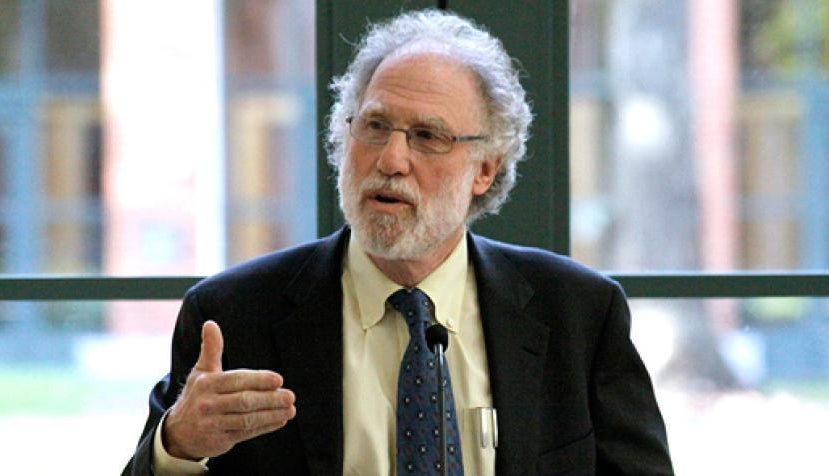
On Wednesday, May 20th, Bob Bauer and Jack Goldsmith spoke at Dartmouth about The Presidency, Executive Power, Donald Trump, and American Democracy. This was a conversation that could be described as a discussion between two of the nation’s most influential legal minds. Bob Bauer, former White House counsel to Barack Obama and now a professor of practice at New York University School of Law, and Harvard’s Jack Goldsmith, former head of the Office of Legal Counsel and a scholar whose work has shaped the modern understanding of the unitary‑executive doctrine. Their dialogue was more than a lecture; it was a master class in the constitutional history of the presidency, a forensic appraisal of Donald Trump’s assault on presidential norms, and a forward‑looking blueprint for preserving American democracy as the country approaches its 250th anniversary.
Bauer opened by reminding the audience that the framers did not imagine an executive who could, with a single stroke of a pen, redraw the nation’s legal map. Yet over the past half‑century, the presidency has accumulated a lot of power. Signing statements, national‑emergency proclamations, and a flood of executive orders now function as a quasi‑legislative arsenal, each wielded on the premise that the president possesses vested authority under the Constitution. Goldsmith noted that the unitary‑executive theory, which holds that a single mind must control the entire executive branch lest chaos erupt, has translated into an ever‑widening sphere of unilateral action: the Defense Production Act, the power to suspend tariffs, and the authority to redirect federal funds without explicit congressional approval. The speakers agreed that this legal growth is not, by itself, a constitutional violation. What distinguishes legal from normative power, as both men emphasized, is the expectation that a president will temper statutory reach with the court of public opinion, with institutional deference, and with an unwritten covenant that the office is custodial rather than sovereign. That covenant, however, is precisely what Trump dared to test.
Goldsmith was the first to label the Trump years a stress test for the American system. The former president routinely issued memoranda that, while legally defensible, flouted longstanding norms: publicly berating judges, refusing to concede a contested election, and treating the Office of Legal Counsel as a political think‑tank rather than an apolitical legal office. The speakers stressed a crucial distinction: legal authority can survive the loss of normative restraint, but democratic health cannot. When Trump ordered the separation of families at the border, the courts repeatedly struck down the policy, proving that the judiciary retains the power to check the president’s reach. Yet the reputational damage, an erosion of faith in the rule of law, was palpable. The episode revealed how fragile norms are: once a president demonstrates that the “off‑record” rulebook can be discarded at will, subsequent office‑holders inherit a playbook that lacks any moral friction.
Bauer described the modern presidency as a set of card-signing statements, emergency powers, and so forth shuffled at the discretion of the incumbent. Trump, he argued, simply rearranged the deck and played his hand without regard for the unwritten rule that the game be played fairly. The result was a temporary, though alarming, amplification of executive power that nevertheless attracted a cascade of institutional counter‑moves. If the presidency is the engine, the Constitution supplies the brakes. Both scholars underscored the triad of checks that kept Trump’s engine from derailing the whole system: the courts, Congress, and an informed public.
The judiciary remains the primary legal brake. Even when the Supreme Court chooses a narrow path, citing justiciability concerns or deferring to political questions, the lower courts have repeatedly invalidated overreaches such as the travel ban and the family‑separation policy. However, the Court’s willingness to intervene hinges on standing and jurisdiction, both of which presidents can attempt to curtail via pre‑emptive legal maneuvers. Congress possesses the budgetary and legislative levers to rein in the president, but partisan alignment often dulls this. Bauer pointed out that a modest clause in the 2019 National Defense Authorization Act aimed at restricting the president’s emergency powers was swiftly watered down in committee. The lesson, he warned, is that the legislative check is only as robust as the political will behind it. The public sphere, media, civil society, and ordinary voters have historically supplied the normative friction that the other two pillars cannot enforce alone. The flood of protests, the surge in voter registration, and the unprecedented level of civic engagement that followed the 2020 election helped restore a measure of equilibrium, reminding both the president and his advisors that power exercised without consent is ultimately unsustainable.
The conversation turned, almost reluctantly, to optimism. Despite the turbulence, both men insisted that American democracy proved remarkably resilient. The constitutional system possesses an auto‑repair mechanism: courts can strike down illegal actions, Congress can conduct investigations, and the electorate can replace leaders. The real danger, however, lies in polarization and the attendant erosion of public trust. Goldsmith warned that when the electorate becomes compartmentalized into echo chambers, the shared belief in the rule of law frays. In that environment, a president’s unilateral actions may go unchallenged simply because the opposing side refuses to recognize the legitimacy of the institutional response. Bauer added that civic education, the knowledge of how the executive branch actually functions, is the antidote to that malaise. If citizens can’t articulate the difference between a signing statement and a statute, they are powerless to hold the president accountable.
A point that was interesting to me was when they started speaking on education. It was stated that Donald Trump was the largest threat to education since the McCarthy Era. After doing some research, the McCarthy era spread fear of communism and created an environment of fear and suspicion. I can not speak for a lot of institutions, but I do not see much suspension or fear. Goldsmith also stated that universities depend on public funding and have been politicized and replaced with other things. After these bold statements, he went on and explained that Harvard, in particular, has had some positive effects, including raising the standard that is expected at a school like Harvard. How can you say something is fully bad but then only state positive outcomes?
Both scholars suggested that the United States’ 250th anniversary should not be a mere milestone but a prompt for constitutional recalibration. Proposals floated on the table included clearer statutory definitions of emergency powers, a more independent Office of Legal Counsel insulated from political appointments, and perhaps even a constitutional amendment that explicitly limits the president’s ability to unilaterally suspend fundamental rights during a declared emergency. While none of these ideas enjoys bipartisan consensus today, the discussion made clear that a proactive approach, rather than a reactive one, will be essential to future‑proof the republic.
What set this event apart from a dry legal symposium was the moments of levity that punctuated the heavy doctrinal discourse. Goldsmith’s Star Wars analogy, “the president can’t be both the Jedi and the Sith at the same time,” elicited a ripple of laughter while crystallizing the conflict between the president’s lawful authority and his political ambitions. Bauer’s board‑game metaphor, complete with a mental image of cards labeled executive order and dice marked national emergency, made abstract constitutional language understandable.
For Dartmouth students, and for any citizen concerned about the future of American democracy, the takeaways are clear. First, keep a close eye on the legal evolution of executive authority. Second, recognize that norms are the soft‑law guardrails that prevent the authority from becoming tyrannical. Third, understand that institutional resilience rests on an engaged electorate that values civics as much as it values policy. As the United States approaches its quarter‑century mark, the conversation offers both a warning and a roadmap. Without a renewed commitment to the unwritten rules of democracy, even a constitutionally legitimate president can erode the very institutions that give his office legitimacy.
Be the first to comment on "Executive Summary: Bob Bauer and Jack Goldsmith on the Presidency"