
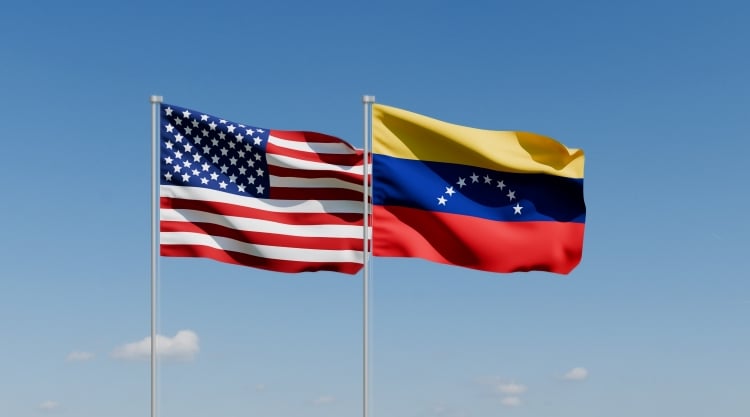
On Tuesday, January 20, Guest Professor Alejandro Velasco from NYU came to Dartmouth to speak on Venezuela, the appropriately named “Donroe Doctrine,” and the history behind the movement. Given that I also attended Prof. DeShazo’s talk on the same events in Venezuela, I feel well-equipped to certify myself as an expert on Venezuela and thereby sufficiently credentialed to critique both events. Whereas Prof. DeShazo offered a fairly nuanced and empirical analysis of the recent events in Venezuela, Prof. Velasco’s discussion was, to put it bluntly, not that. For all the times that Prof. Velasco stressed the importance of “nuance” in his talk, I found that, unfortunately, his discussion points contained relatively little of it. While Prof. Velasco made some concessions to the problems of the dictatorial Chávez–Maduro regime, his remarks emphasized the role of U.S. sanctions and gave comparatively less attention to policy choices and governance failures under Chávez and Maduro.
Velasco’s talk included a rather vague yet bold critique of what he perceives as an oversimplified narrative of Venezuela’s economic collapse over the last several decades. He argued that the common narrative framed Venezuela’s issues as due to the implementation of socialism under Chávez. To his credit, he points out that the Chávez–Maduro regime has become increasingly focused on preserving the government, in contradiction to its alleged well-intentioned socialist efforts in its early years. Beyond this brief concession, Velasco offered limited direct criticism of Chávez’s or Maduro’s presidency, focusing instead on external constraints like sanctions. Velasco appears to frame these sanctions as intended to target the population, such that violent revolution would be carried out.
At the risk of being sidetracked into a discussion of sanctions, I will be the first to acknowledge that the successful application of sanctions against other countries has, at best, mixed results. Velasco is correct that the imposition of sanctions is most effective at gaining domestic electoral success, but it is not certain to bring about the revolutionary regime change that the nation imposing them might hope for. With that being said, I would contend that Cuba’s problems did not begin with the imposition of sanctions by the U.S.
Interestingly, Velasco acknowledged that Venezuela’s government has seen a significant consolidation of power under the Chávez–Maduro regime, but refused to attribute that consolidation to Chavismo socialism. I would argue that this is the largest blind spot in his talk, given that it is reasonable to argue that the consolidation of economic power paves the way for the consolidation of all governmental power, yet this point was left unsubstantiated. This unwarranted bifurcation of the private economy and other aspects of government is something that I wish had been more thoroughly explained.
Velasco acknowledged, somewhat begrudgingly, that Maduro’s government lost its most recent elections against the opposition, yet Maduro did not leave office. I got the sense that Velasco was reluctant to place Maduro’s policies as the chief reason for his electoral failures, arguing that the election ought to be understood in the broader context of U.S. actions toward Venezuela.
Velasco spent a lot of time criticizing U.S. sanctions as the chief cause of Venezuela’s economic collapse, noting that the U.S. imposed sanctions in the early 2000s, and these have remained in place ever since, with varying degrees of intensity. Velasco ardently criticized U.S. sanctions, arguing that they are imposed for the failed intention of inducing revolution among the public in response to economic problems. The natural response to this fairly reasonable critique of sanctions is that the sanctions were first imposed on the Chávez–Maduro regime due to a lack of cooperation on the part of the new government on issues like narcotics trafficking and counterterrorism efforts, not some vague anti-socialism crusade. The U.S. itself is a self-interested actor; it has no desire to see the Venezuelan oil sector fall.
The main issue I have with Prof. Velasco’s talk is methodological. Key counterarguments were acknowledged only briefly, and several claims would have benefited from clearer evidence and engagement with competing explanations. I listened to the questions asked by the moderators and members of the wider Dartmouth community, and nearly all of them seemed in broad alignment with Prof. Velasco’s points, asking merely surface-level questions that treated Velasco’s statements as axiomatic truths.
The lesson I would take away from this is that I encourage Dartmouth students to attend the talks of those with whom they disagree. Not to interrupt, not to shut them down, but to ask them to explain themselves. Academics who have spent their lives studying a particular topic have an obligation to justify their beliefs rather than treat them as gospel. That, more than anything, is what will restore rigorous academic discussion to our institutions. With that being said, I appreciated the opportunity to hear Prof. Velasco’s perspective and look forward to learning more.
Be the first to comment on "A Lecture on Venezuela, and a Lesson for Dartmouth"