
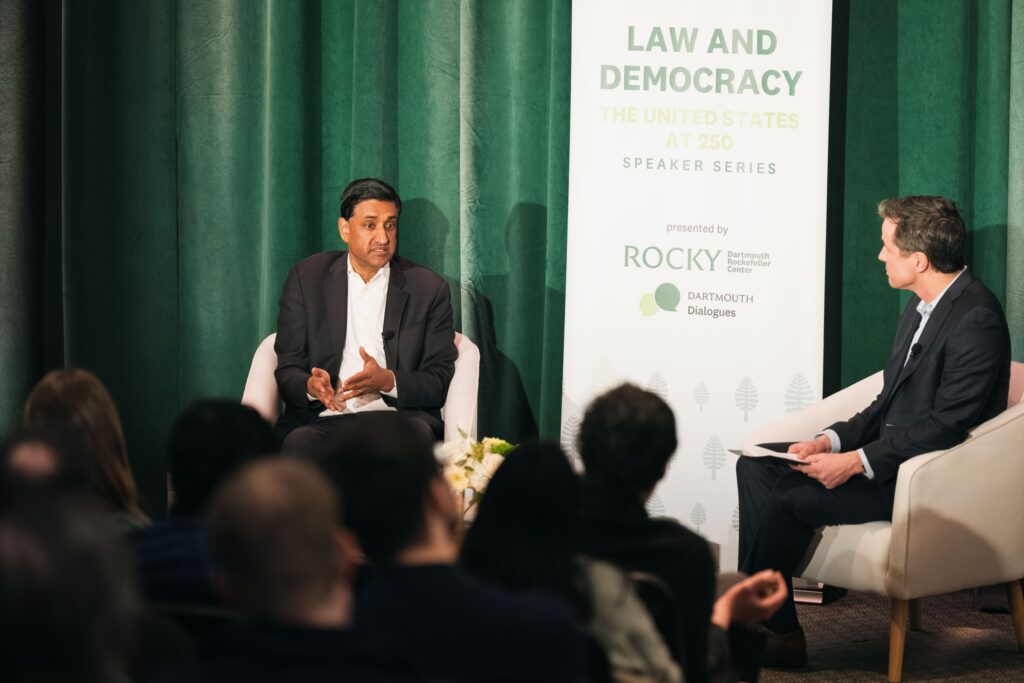
On Feb. 28, just hours after U.S. strikes in Iran, Rep. Ro Khanna (D-Calif.) visited Dartmouth’s Filene Auditorium. Moderated by government professor Brendan Nyhan and hosted by the Rockefeller Center, the event covered foreign policy, legislative transparency, and artificial intelligence. The event drew significant interest in general, as Filene Auditorium was completely filled, but much less so on the part of students, as two-thirds of the room was filled with local seniors rather than students.
The throughline of the afternoon was clear: Khanna is an eloquent speaker, but his platform remains a patchwork of contradictory populist promises designed to tell his audience exactly what they want to hear.
Addressing the escalating situation in the Middle East, Khanna predictably condemned the recent military action as an “illegal, unconstitutional war.” His proposed solution? Diplomacy. He recommended a return to negotiated agreements, a derisive stance given that years of such “diplomacy” have led us to the exact place we are today: with Iran on the brink of attaining a nuclear weapon. We have seen this diplomatic playbook before with North Korea, where inaction ultimately allowed a lunatic to gain control of ballistic missiles fully capable of reaching American cities, including Khanna’s own Silicon Valley district.
Khanna then briefly pivoted to domestic policy, highlighting his bipartisan work on the recently passed Epstein Files Transparency Act, framing the near-unanimous congressional effort to release the Department of Justice’s investigative records as a triumph of due process.
Later, the center of the conversation shifted to the economic impact of artificial intelligence and the congressman’s proposed solution to the economic challenges posed by the emergent technology. The audience, one could argue, could not have asked for a better man to outline a vision for legislatively navigating the AI world, as Khanna has already proven his capacity to make wise economic decisions in much less turbulent times. This is, after all, the UChicago-educated economist who is currently championing a massive 5% federal wealth tax on billionaires, modeled after California’s own proposed 2026 Billionaire Tax Act. The looming threat of this unrealized gains tax has already driven tech titans like Peter Thiel and Google co-founder Larry Page to flee his home state, taking their tax revenues with them.
By punishing success and driving wealth away, he actually drives down overall tax revenue, suggesting this economist-legislator is entirely unaware of the Laffer curve; or, most likely, he is fully aware, but simply chooses to enact what is popular.
During his conversation with Nyhan, Khanna asserted that he stands up for his convictions regardless of how an issue is polling. Yet choosing to ignore fundamental economic principles in favor of heavily touted, “eat-the-rich” tax structures stands in stark contrast to that claim. This populism extended into his vision for an AI-integrated economy. Khanna proposed a sweeping, FDR-style federal jobs program aimed at creating jobs for those replaced by AI, even going as far as suggesting that the government should take on roles that have traditionally been considered “deep free-market territory,” like biotech research.
Mr. Khanna then continued to drop dribs of populist oxymorons: he argued that regulations must not hurt the global competitiveness of American firms, and acknowledged that the European Union has hurt its own economy through overregulation, but continued simultaneously to advocate for regulations that prevent AI-induced job loss and reap the full benefits of the technology at the same time. The congressman specifically named self-driving vehicles as a threat to workers, where regulations must ensure that workers are protected.
Ultimately, whether discussing global conflicts or tech regulation, Khanna proved to be an engaging presence. Beneath the polished rhetoric, however, his vision is little more than a patchwork of contradictory populist promises. He operates as a political chameleon, carefully calibrating his message for whoever happens to be in the room. Recognizing that he was speaking at an Ivy League institution, to an audience familiar with basic economic principles, Mr. Khanna conveniently left the more radical tenets of his “progressive capitalism” at the door.
Be the first to comment on "A Political Chameleon at Dartmouth"