
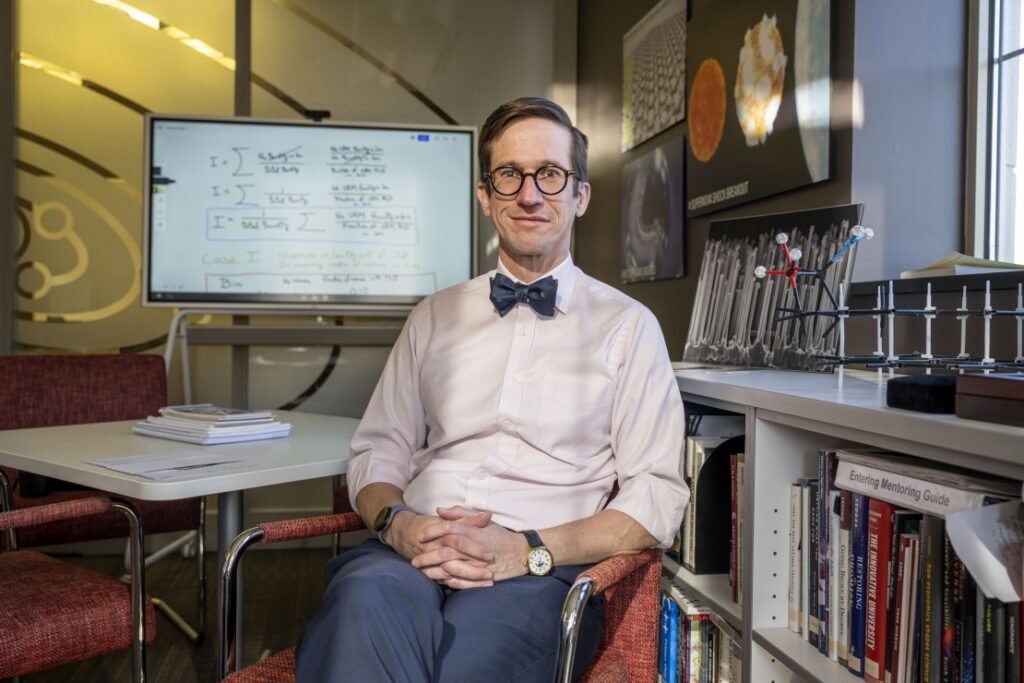
On February 26, The Review sat down with Dartmouth Provost Santiago Schnell. Among other things, we discussed his academic vision for the College, the influence of Catholic theology on his teaching style, his response to criticisms of alleged administrative bloat, and the future of higher education more broadly.
When Provost Santiago Schnell discusses the future of Dartmouth, he does not reach for the tired lexicon of the modern administrator. There was no talk of “synergy” or “strategic pivots.” Instead, he reached for a pen and drew a circle. This is his “circle of knowledge,” a geometric metaphor for the human condition. As the area of the circle, our collective understanding, expands, so too does its circumference: the frontier where knowledge meets ignorance. It is here, at the diameter of the circle where the boundary between knowledge and ignorance is “diffuse,” that Schnell believes the true university must operate.
We opened the discussion with a conversation about his reasoning for coming to Dartmouth. The Review covered Santiago Schnell’s appointment as Provost several months ago, in which we touched on the responsibility he felt to come to Dartmouth from Notre Dame, a renowned Catholic university. In our recent sit-down with the Provost, it became clear that this mathematical rigor is inextricably linked to a “deeply Catholic” intellectual tradition. Schnell, who arrived in Hanover in 2025, having served as Dean at Notre Dame prior, emphasized that the role Catholicism plays in his vision for the College is less a theological one and more so a spiritual lens. He argues that the Catholic Church, in many ways, is the basis upon which the modern university is founded. He views the foundations of higher education not as a secular invention of the Enlightenment, but as a tradition designed to “put water into the brain” to eventually “light a fire” in the formation of the whole human being.
Schnell went on to describe Dartmouth’s mission as a university as being to form human beings, as opposed to merely producing vassals to the job market. Schnell described the primary difference between Notre Dame and Dartmouth as being that Notre Dame has fully retained theology at the center of it, but noted that both institutions, as universities, have the same mission, one that is Catholic in origin. For Schnell, the “teaching-scholar” model known at Dartmouth is a vocation to educate from the “heart and the mind.”
We then pivoted the conversation away from Schnell’s broad spiritual vision for the College and toward particular policy positions. Regarding growing concerns about artificial intelligence, Schnell acknowledged the role that AI has in learning at the “center of knowledge,” that is, fields of study in which the facts are well established and beyond debate. Schnell emphasized through a vivid drawing that at the “frontiers” of knowledge, where we continue to make discoveries and deliberate, AI is of no help and can, in actuality, be detrimental. Schnell emphasized that the “frontier” of knowledge is where, ultimately, university work should be preparing students to operate.
Schnell pushed back on the idea that administrative bloat is mainly self-inflicted, instead arguing that much of it is driven by federal regulation. Still, he stressed that his instinct is to keep administration lean and direct resources toward teaching, research, and students. Regarding the New School of Arts and Sciences and potential criticisms of more bureaucracy, he defended the restructuring as essential to strengthening academic leadership. He argued that the restructuring of the College gives more autonomy to faculty and frees the president of the university to act more fully as the public figurehead of the institution.
We concluded our conversation with Provost Schnell with him emphasizing the importance of Dartmouth’s policy of institutional restraint and its fostering of free and open discourse. The Review, being in the minority of opinions on campus, is most certainly thankful for Provost Schnell’s steadfast dedication to seeing through the true, integral mission of the university. We look forward to what his tenure as Provost will entail. In a time in which tradition has been eroded, we, for one, fully support Provost Schnell and the agenda that he and President Beilock are pursuing in seeing through our College’s integral mission.
When Provost Santiago Schnell discusses the future of Dartmouth, he does not reach for the tired lexicon of the modern administrator. There was no talk of “synergy” or “strategic pivots.” Instead, he reached for a pen and to draw a circle. This is his “circle of knowledge,” a geometric metaphor for the human condition. As the area of the circle—our collective understanding—expands, so too does its circumference: the frontier where knowledge meets ignorance. It is here, at the diameter of the circle where the boundary between knowledge and ignorance is “diffuse,” that Schnell believes the true university must operate.
In our sit-down with the Provost, it became clear that this mathematical rigor is inextricably linked to a “deeply Catholic” intellectual tradition. Schnell, who arrived in Hanover in 2025 (having served as Dean at Notre Dame prior), views the foundations of higher education not as a secular invention of the Enlightenment, but as a tradition designed to “put water into the brain” to eventually “light a fire” in the formation of the whole human being.
For Schnell, the “teaching-scholar” model known at Dartmouth is a vocation to educate from the “heart and the mind.” He notes that while the “center” of his circle is well-trodden and firm, it is also the domain where Artificial Intelligence is most effective.
“AI works pretty well right here in the middle,” he told us, but at the frontier where the teaching-scholar lives, AI is not yet effective. To combat the potential for automated mediocrity, Schnell is calling for “personalized education”—a system where assignments are “interrogated” in small classrooms to ensure students have the judgment to move learning from the mind to the “heart.”
This commitment to the frontier explains Schnell’s sense of “moral obligation” to serve in the Ivy League. He views elite universities as the “punching ball” of the general public and the government, often bruised by a “small fraction” of faculty who present a “narrow” view that turns toward “activism instead of scholarship.” Against this intellectual conformity, Schnell offers a defense against “unearned certainty.” He envisions a Dartmouth that protects “heterodox” thinking, serving as an antidote to the confusion of those who have replaced inquiry with ideological broadcasting.
As he navigates his tenure, Schnell’s philosophy on “administrative bloat” remains refreshingly lean. He sees every non-teaching hire through a moral lens: “For every person that I hire that is not doing teaching, I don’t have the opportunity to offer financial aid to a student.” This is exceedingly refreshing for us at The Dartmouth Review. While he acknowledges the obscene paperwork required by federal agencies like the National Science Foundation, he is sure to place the blame squarely on the government rather than colleges. He argued that colleges have to hire the support staff or already burdened professors would not be able to execute their position between the classroom and their research.
Ultimately, Schnell’s vision is a paradoxical one: a world-class scientist using the logic of the frontier to defend the “historical richness” of the liberal arts. By championing President Sian Beilock’s idea of institutional neutrality, he seeks to protect the “radical” or controversial ideas that might one day become the breakthrough truths of tomorrow. If he succeeds, he will do more than just manage the College; he will restore it to its rightful place at the edge of the circle, where the pursuit of truth takes precedence over the performance of petty politics.
Be the first to comment on "An Interview with Provost Santiago Schnell"