
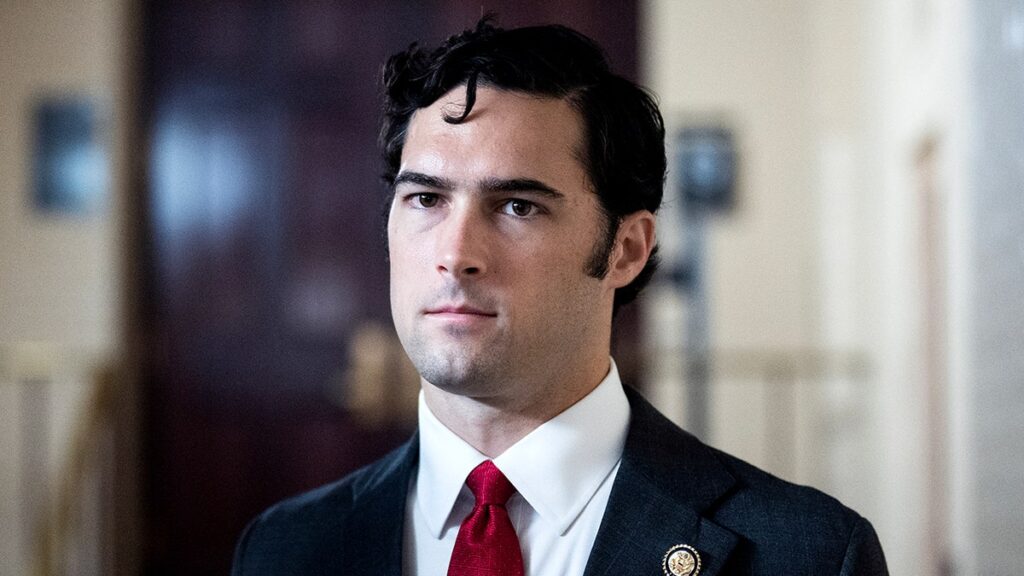
In the stifling, often monochromatic halls of the Ivy League, there exists a specific type of education that no syllabus dares to codify. It is the education of the dissident, the sharpening of the blade that occurs only when one is forced to defend the “permanent things” against a sea of institutional hostility. For Brandon Gill ’16, that sharpening took place in the basement offices of The Dartmouth Review. Now, having traded the granite of New Hampshire for the marble of Capitol Hill, Gill serves as the youngest Republican in the House of Representatives, bringing the same traditionalist spirit to Texas’s 26th District that he once brought to the Green.
Gill graduated cum laude in 2016 with a double major in economics and history. Along the way, he led the Christian Union and spent two years as a pole vaulter on the track team. Even the lineage checks out: his eventual father-in-law, Dinesh D’Souza, served as editor of The Review as well.
We at The Review recently caught up with Representative Gill to discuss how his time at the College and The Reviewprepared him for the corridors of power, and whether the spirit of institutional skepticism survives the transition from critic to legislator.
Gill’s reflection on his Review years is telling. “When you’re operating in a hostile environment, it makes you intellectually sharper,” he said. “I understood how the rest of campus thought about the world. You’re inundated with [leftist ideology] from the media, from professors. I remember some of my professors, even those who were willing to engage with me, treated me like an anthropological experiment.”
Dartmouth’s ideological homogeneity wasn’t a barrier to his education but a deeply valuable feature. The Review, in other words, was not merely a publication but a gymnasium for the mind, a place where one learned to think against the grain because the grain itself was so relentlessly uniform. This was a place where Gill could grow more conservative, a change he credits his time at Dartmouth for helping to facilitate.
This is The Review’s enduring contribution to its alumni: not a set of policy positions, but a posture. It is the posture of the permanent minority, the conviction that truth is not determined by consensus and that institutions, especially elite institutions, are not neutral arbiters but interested parties. Gill’s father-in-law’s tenure at The Review adds a dynastic dimension to this inheritance, a reminder that conservatism at Dartmouth has always been less a political affiliation than a kind of intellectual bloodline.
But what happens when the dissident enters the Capitol? The Review traffics in criticism and exposure, in naming names and unsettling the comfortable. Congress requires coalition building, horse trading, and a tolerance for the art of the possible. Can the two coexist, and if so, on whose terms?
His answer is pragmatic. “Whenever you’re in a position of power to change things, incremental progress is often the goal,” he explained. “I could criticize almost any bill that I’ve voted for. It’s rare to get a perfect bill. The goal with criticism is to use it as a resource to push the ball forward.”
This is the eternal tension of conservative governance: the critic must become the administrator, the gadfly must learn to steer the ox-cart. Gill seems to have made his peace with this, recognizing that the purity of opposition is a luxury unavailable to those with legislative authority. Yet one wonders whether this represents a maturation of his Review-honed instincts or their domestication. The Review has always prided itself on being the institution’s conscience, not its manager. Can Gill be both long-term?
Conservatives, particularly those educated in The Review’s intellectual tradition, tend to harbor a deep skepticism of centralized power. The Review has long echoed this Kirkean wariness of an omnicompetent state. But Gill draws a sharp distinction between conservative principle and libertarian absolutism.
“I’m a conservative but not a libertarian,” he said. “We’re rightfully concerned by any conglomeration of power. We’re uniquely concerned about the government because they have coercive power. But sometimes the feds need to step in. Border security, for example. The president is solving a problem that the federal government walked away from.”
This is a revealing formulation. Gill is not interested in dismantling the state apparatus so much as redirecting it, wielding federal power when it serves the ends Gill and his allies see fit. It is a Hamiltonian conservatism rather than a Jeffersonian one, more concerned with who holds the levers than with dismantling the machinery itself. Whether this constitutes principled governance or convenient opportunism depends, perhaps, on whether one shares Gill’s hierarchy of ends.
At the end of his first term, Gill wants to be judged not by media appearances or rhetorical flourishes but by tangible policy victories: conservative wins, cuts to wasteful spending, codification of executive orders, border security. Yet he is also keenly aware of the power of spectacle. He recounted a recent hearing with NPR CEO Katherine Maher in which he confronted her with her own damning tweets, a moment that became one of the most-viewed clips on C-SPAN and, by his account, persuaded numerous Republicans to vote to defund NPR.
“Messaging and media have a huge impact,” Gill admitted. “This is something I’d like to continue.” Here, perhaps, is the synthesis. Gill understands that legislation and theater are not mutually exclusive in today’s Congress. The Review taught him to wield rhetoric as a weapon; now he wields it in service of legislative ends. The hearing room becomes the op-ed page, the C-SPAN clip, the campus broadside. The medium has changed, but the method remains recognizably Review-esque: provocation in the service of persuasion.
Brandon Gill’s trajectory raises an old question: Can the outsider ever truly govern from within? Or does governance inevitably require a compromise of the very principles that made the outsider’s critique so compelling? Gill seems to believe he can thread this needle, that the sharpness honed in The Review’s offices can be preserved even as he navigates the legislative labyrinth.
Whether he succeeds will depend not merely on his policy record but on whether he can maintain The Review’s essential quality: the refusal to accept institutional pieties at face value, the insistence on asking the questions that make the comfortable uncomfortable. This remains to be seen. Congress has no shortage of ideologues; what it lacks are genuine dissidents. If Gill can remain one, even, or especially, when his own party controls the House, then his time at The Dartmouth Review will have been worth every word.
Be the first to comment on "Brandon Gill ’16, TDR Alumnus, Takes on the Halls of Congress"