
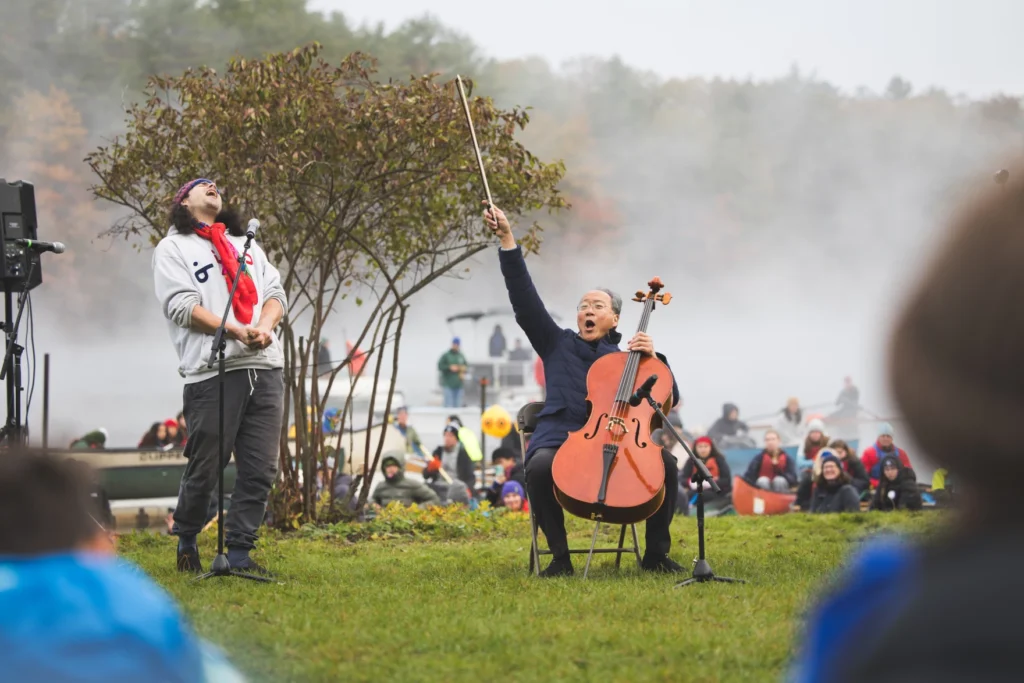
The pen may be mightier than the sword, but at Dartmouth, the stroke of a bow might be mightier still. When the Hopkins Center for the Arts reopened last weekend, it did so with a single, unforgettable performance. The two-and-a-half-year, $124 million transformation was celebrated with the world premiere of “We Are Water: A Northeast Celebration,” an original collaboration led by cellist Yo-Yo Ma that blended music, storytelling, and Indigenous perspectives. The star-studded cast included Jeremy Dutcher, Mali Obomsawin ’18, and Chris Newell ’96, and a neon blue hue bathed the newly opened Hop as the sold-out concert was broadcast to the audience on the Green.
For Dartmouth, the evening marked not just the long-anticipated reopening of a building but the return of a longtime friend. Ma is a 2025/26 Montgomery Fellow, his third such fellowship after previous appointments in Spring 2018 and Winter 2001. The Montgomery Endowment brings outstanding luminaries from academic and non-academic spheres to campus, and few exemplify its mission better than Ma.
Ma’s life story reads like a testament to the power of displacement and determination. Born in Paris in 1955 to Chinese parents who had fled during the Chinese Civil War, he began playing the cello at age four. His family soon moved to the United States, where a young Ma performed for Presidents Kennedy and Eisenhower at just seven years old. A child prodigy, he would go on to graduate from Harvard College as part of the class of 1976, balancing his academics with an already burgeoning career as a soloist. His professional achievements are unrivaled: 19 Grammy Awards, recipient of both the National Medal of Arts and the Presidential Medal of Freedom, and appointed as a United Nations Messenger of Peace. The most famous of his four instruments is the Davidov cello, crafted in 1712 by the distinguished Antonio Stradivari.
Ma embodies many characteristics that feel especially vital in this moment. He is Chinese American, born in France, performs on an instrument made by Italians, and “in der Welt zuhause” (at home in the world), as Germans would say. Perhaps because of his own background, Ma has been particularly drawn to the intersections of cultures. He marvels at how Roman glass ended up in a Hanoi museum, how silk appears in ancient Egyptian burial sites, or why folk songs from Xinjiang in western China echo melodies found in Hungary. This fascination with cultural exchange has shaped not just his philosophy but his artistry as well, leading him to collaborate with musicians from every corner of the world. Be it the Kalahari Desert or the streets of Mumbai, Ma has consistently sought out musical traditions that challenge and expand his understanding of what the cello can express.
But if there is one work that defines Ma’s career, it is Johann Sebastian Bach’s Six Suites for Solo Cello. Composed around 1720, these suites were largely forgotten for over a century until cellist Pablo Casals rediscovered them as a teenager in a Barcelona music shop in 1890. Since then, they have become the Mount Everest of cello repertoire for being technically demanding and emotionally profound. Furthermore, they are special in the sense that no manuscript, “urtext,” has survived, which makes the suites very open to interpretation.
Ma’s relationship with the suites spans his entire life. He first learned them as a child and has returned to them repeatedly, recording them three times: in 1983, 1997 (as part of his “Inspired by Bach” film series), and 2018. Each recording captures a different stage of his artistic evolution, but it is the 1997 version that has become iconic: The Cello Suites – Inspired by Bach. Ma’s interpretation is not an attempt to recreate what Bach might have intended, nor is it a strictly historically informed performance. Instead, it is Ma’s own vision of the suites, filtered through decades of experience. His sound is unmistakably his own (what many consider an unbeaten tone worldwide). He takes liberties with tempo and phrasing that some purists might question, but the results are great: performances that put listeners in a trance.
Ma has spoken often about what the suites mean to him. “All the things I love about life outside music have to do with people,” he once said. “Playing the cello allows me to fulfill all those interests through music.” In Bach’s suites, he finds not just technical challenges but ones about discipline and freedom, tradition and innovation. In an age of constant noise and distraction, there is something radical about sitting with six suites for solo cello. They ask us to listen, really listen, without the safety net of words or images to guide us. And in the glow of the reopened Hopkins Center, Dartmouth was reminded that art is not separate from life but central to it, and that in a world often short on common ground, music remains one of our most reliable ways of finding it.
Be the first to comment on "Classical Currents: Yo-Yo Ma and the Hop’s Transformation"