
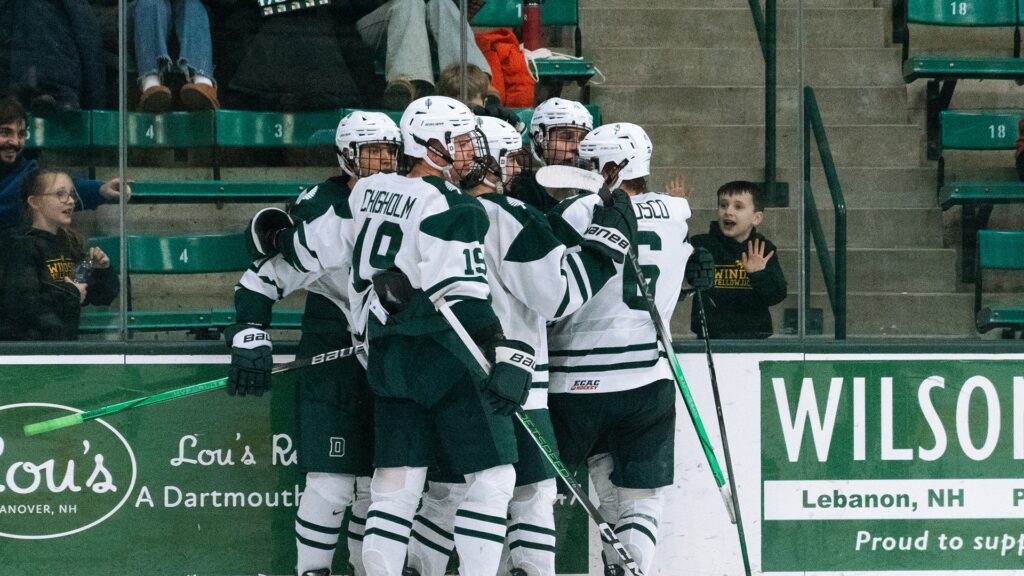
The Dartmouth men’s hockey team has gotten off to an exceptionally strong start this season: it has already logged six consecutive wins, of which four were triumphs over opponents within the ECAC. This explosive start to the season is the strongest early-season performance Dartmouth has had in over fifty-five years. Notably, the second-longest winning streak to begin a season in that period was last season’s five-game streak. Last year, Dartmouth finished the season with the best record of the six Ivy League schools which field men’s hockey teams. This year, the Big Green seems to have set out to not only win the Ivy League title again but to fiercely defend the perch at the very top of the ECAC leaderboard which it now holds.
Perhaps the recent sequence of productive seasons may be connected to the leadership of coach Reid Cashman. He has extensive coaching experience, including stints at Dartmouth’s highly successful ECAC rival Quinnipiac and with the NHL’s Washington Capitals. This is his fifth season with the team, which means he has both had the necessary time to acclimate to coaching in Hanover and he finally leads a team that he is fully responsible for having built and trained. The opinion that Coach Cashman has played a sizable role in the upward trajectory of the hockey program appears to be widely held within the ECAC: at the end of the 2023–2024 season, he was honored as the Tim Taylor Coach of the Year.
The team he leads has engaged in a consistently high standard of play; it is thus difficult to single out either strong offense or defense as the chief reason for the team’s success so far. At this point in the season, Dartmouth’s offense has scored more than three times as many goals as its defenders have allowed (26 and 7, respectively).
A particularly stand-out moment of defensive prowess came during the end of the game against Cornell, when the Big Red pulled its goalie with over two minutes left in the game, and soon after Dartmouth was left shorthanded because of a holding penalty. Cornell was successful in keeping the puck in its attacking zone for most of that time, and this enabled Cornell to pepper the Dartmouth goalie Emmett Croteau with a veritable onslaught of potentially game-tying shots on goal. Every one was deftly stopped, which protected Dartmouth’s lead and ensured a 2–1 victory—the closest margin of every game played thus far. Upon his graduation, Croteau will surely be a valuable asset to the Montreal Canadiens, who have already drafted him.
That victory over Cornell was satisfying insofar as it represented a victory over a historic rival, but it paints an even more optimistic picture of Dartmouth’s prospects when put in the context of last season. In the 2024–2025 season, the two teams which reached the ECAC championship game were Cornell and Clarkson (Cornell emerged victorious). At this point in this season, Dartmouth has now defeated them both.
Several other games played thus far deepen the favorable comparison with last season (which, it bears repeating, was itself highly successful). Dartmouth’s home game against Yale last season was a 2–3 loss. This year, the Big Green scored six goals in the first two periods alone while hosting the Bulldogs. Last season, Colgate finished two places above Dartmouth in the standings and won both head-to-head matchups: in Thompson Arena Colgate won in a shootout and in Hamilton Dartmouth never once held the lead before losing 2–3. This year, Dartmouth dispatched Colgate handily with a 4–1 victory.
The current Dartmouth men’s hockey team does not only compare favorably to other ECAC teams—it is truly one of the most impressive programs in the United States. According to the reputable USCHO rankings, this season Dartmouth ranks as the thirteenth-best men’s hockey program in NCAA Division I. That is only five places below Western Michigan University, which won last year’s national championship.
It is incredible that Dartmouth provides the opportunity to be able to watch a world-class team play for free in seats right beside the rink on a weekly basis. It is a shame, then, that the current level of stadium attendance, particularly among students, is not reflective of the high quality of the team.
The student bodies of nearly every other college and university that contains a team of a similar caliber do a better job of seizing the chance to watch them play. Of the top twenty NCAA DI men’s hockey schools, as ranked by USCHO, thirteen are able to require students to buy tickets while still maintaining a sizable student section. In the remaining six schools (excluding Dartmouth), demand still outstrips supply, but the limited seating capacity of their respective student sections is allocated in other ways, including through lotteries and requiring students to reserve seats days in advance.
Quinnipiac is one such school which distributes free student tickets through a portal which opens early. The value students place on those tickets is plain to see through the resale market, which springs up to serve the large number of interested students who are inevitably unable to grab tickets on time. For some games, including the highly anticipated Quinnipiac–Yale game, free tickets sometimes resell for over $100.
Conversely, a Dartmouth student who shows up to a men’s hockey game only fifteen minutes early is virtually guaranteed a front-row glass seat in the student section if he wants one. The full crowd will only have formed by the end of the first period, and that full crowd is always a fraction of the student section’s capacity (often just about a third). The attendance at the Colgate game was particularly anemic.
Cornell clearly recognized the importance of the game on November 8th: not only did a sizable group of visiting fans turn out, they even sent a contingent of their marching band (which they didn’t even do for football) to blare their alma mater (which is actually quite decent) and their primary fight song (which is a downright bizarre would expect for a game of its importance.
It is possible that student attendance may be partially depressed by the fact that games thus far have taken place in the late Fall Term, when football also vies for students’ attention and final exams are upcoming. It would be somewhat encouraging if that were the chief issue, especially since it would suggest that turnout will improve next term.
Somewhat more worryingly, the home game against Princeton, being the only game during which Thompson Arena’s student section properly fills, seems to have an outsized influence on student perceptions of the team. If the disappointing, unexpected, and somewhat sloppy 1–3 loss against Princeton was the only game a given student attended last season, it is understandable that he would be in no rush to see Dartmouth play again.
It is then important to disseminate the message that last year’s poor performance was a strange fluke wholly unrepresentative of the team, which was genuinely great last year and even better now. Hopefully as the news of the impressive record belonging to this year’s men’s hockey team spreads, it will gradually bring more students through the door.
The more students start coming, the more energy, enthusiasm, and spirit will characterize the student section. In addition to visibly showing support for the players, this makes attending the games a more enjoyable experience for everyone involved; a better experience at the games would encourage students to watch them more often. This means that a few more students who decide to start attending the games and who bring along friends can start a virtuous cycle with relative ease: a fuller student section is a more spirited one, and a more spirited section will fill even more in the future.
Hopefully that would stand a chance of reigniting the enthusiastic hockey-watching culture which was far more deeply rooted in Dartmouth decades ago. After all, the Dartmouth student body has historically been far more invested in past teams that have been worse by an order of magnitude: we are gifted with a truly world-class team now.
If that campus-wide enthusiasm for hockey is resuscitated, it would have a positive impact on the overall culture of the school through its capacity to offer the campus a shared experience around which the students can unite. College athletics have a long history of serving that end within the Ivy League and elsewhere; it would be a good idea to leverage the incredible ongoing season of one of our absolute best varsity teams as a focus for heightened camaraderie and school spirit.
Be the first to comment on "Dartmouth Hockey Enjoys Historic Start Despite Poor Fan Attendance"