
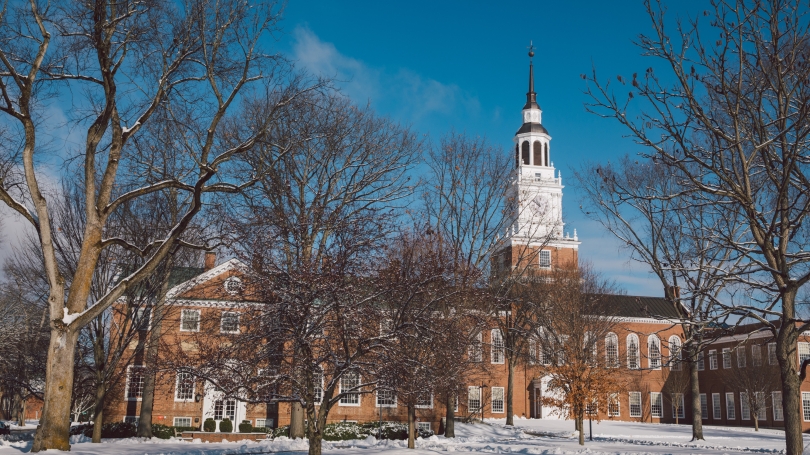
Early on Friday, January 30, a parade of students shuffled off to their respective 9Ls in a set of individual journeys that began much the same way that they had the previous Friday. However, that morning soon took a turn at 8:40 AM, when the bells that form the carillon atop Baker Tower began their unexpected assault on the ears of passers-by. The timing was certainly unusual, but what was genuinely unprecedented was the set of tunes the carillon-keeper elected to perform: first “Bella Ciao” before switching to “Which Side Are You On?” These songs have significantly different tones and tempos. They emerged from different contexts, and the lyrics associated with them are even in different languages. However, they are united in one key aspect: they are both leftist anthems with violent undertones.
The first, “Bella Ciao,” is a farewell song from the perspective of an Italian partisan departing to fight. The partisans (“partigiani”) were a subset of the Italian resistance during the Second World War. The Committee of National Liberation (“Comitato di Liberazione Nazionale”) organized its activities and facilitated communication between units. Its composition is deeply telling about the ideological principles motivating its fighters: while a varied set of groups came together to form it, of the three that were the largest and most influential, two were avowedly socialist, and one was openly and explicitly communist. The Garibaldi Brigades (Brigate Garibaldi) contained significantly more fighters than any other partisan faction, and they were aligned with the communists. In addition to fighting Mussolini’s government, they took aim at a host of other Marxist targets, quite prominently including religion. For instance, in the infamous Porzûs Massacre, they massacred a group of devout Catholics who were also engaged in the same resistance movement they were.
When “Bella Ciao” was first given lyrics about the partisans’ cause (since the song is adapted from an earlier agricultural workers’ song), there was a verse which proclaimed “Ed era rossa la sua bandiera [….] La bandiera del lavor!” (“And his flag was red [….] the flag of labor!”). This has often been excised in recent performances to sanitize the lyrics for more politically diverse audiences, but the song’s most ardent fans (likely including our carillon-keeper) have not forgotten. Left-wing publications like The Guardian have chronicled the song’s years of frequent use at European anti-capitalist protests, and when modern leftists whip themselves into a frenzy about a supposed need to fight against a nebulously and idiosyncratically defined modern “fascism,” it may seem natural for them to reach for a song associated with guerrilla fighters opposed to Mussolini.
One such American fan of “Bella Ciao” was Charlie Kirk’s alleged assassin, who carved the song’s chorus into one of the bullet casings investigators recovered around the scene of his murder. This played a role in increasing awareness of the song on this side of the Atlantic, and it is absolutely necessary context when evaluating its having been played on the Dartmouth carillon: that specific song is now linked with a prominent and recent act of violence, which aimed to suppress civic dialogue through force. Regardless of how it was intended, it certainly comes across as an endorsement of Kirk’s killing and the ideological principles that made it happen.
The other song played on the morning of the 30th, “Which Side Are You On?” bears similar ideological baggage. It was written by the wife of a union organizer in Harlan County, Kentucky, at the beginning of a nearly decade-long labor dispute which was dubbed the “Harlan County War” in retrospect. “War” is an apt characterization: the striking mine workers, whom the song lionizes, started an armed conflict that led to significant casualties on both sides. Like the Italian partisans, the strikers adopted guerrilla tactics, and the conflict was characterized by exchanges like the Battle of Evarts, in which concealed mine workers ambushed a set of vehicles operated by the mines’ management and slaughtered three people. As the conflict dragged on, leadership of the strikers passed from the already left-wing United Mine Workers of America to the National Miners’ Union, which was run by doctrinaire Communists and openly connected to the USSR through its involvement in the Comintern.
However, it is crucially important to note that the Harlan County miners did not only attack the mines’ management. Soon after the conflict started, both local law enforcement, led by Sheriff J.H. Blair, and the Kentucky National Guard descended on the county, and the strikers proceeded to bomb and shoot them in much the same way they had attacked their bosses. “Which Side Are You On?” particularly demonizes the sheriff’s deputies, who are derisively referenced as “thug[s] for J. H. Blair.” It is tasteless and contemptible, but likely intentional that a song with those themes was played at the same time tensions about the operations of federal immigration enforcement have been boiling over (particularly in Minneapolis). Our college bells thus may have rung out an endorsement for the current organized cells of radicals which, rather than directing appeals at lawmakers to change policy and rather than appealing to the electorate to effect change through elections (either of which would fall within the scope of their First Amendment rights), choose to wedge themselves between federal law enforcement and the commission of their sworn duties in a manner which is dangerous for all involved. Perhaps the example of Harlan County is being deployed as a more explicit endorsement of the actions of men like the gunman who shot into the Dallas ICE facility or the several “protestors” thus far who have rammed agents with their cars.
The song also adopts an all-or-nothing perspective on politics, which casts all but ardent supporters of its cause as despised enemies. The name “Which Side Are You On?” makes this apparent enough, and the idea that there is a rigid dichotomy imbued with intense moral significance pervades the piece. While statements used to introduce and explain the Dartmouth Dialogues project articulate a mission the College has set for itself to “trai[n] future leaders to engage meaningfully across political and personal differences,” “Which Side Are You On?” declares that “in Harlan County, there are no neutrals there” and accordingly each individual can be classified as either “a man” or an irredeemable “dirty scab.”
Simply put, in our present deeply tense and polarized political moment, a pair of songs that explicitly endorse taking up arms against actors of the state do not contribute productively to fostering constructive dialogue.
Fundamentally, this act represents a blatant betrayal of the bells’ purpose: they are meant to bring students together in community rather than to drive them apart through divisive messaging. This is most strikingly apparent when one considers the location and function of the College’s primary set of bells preceding the 1928 construction of Baker Tower (and the 17-bell carillon placed within it). Beginning in 1885, a set of three bells situated atop Rollins Chapel chimed the hour, rang at class meeting times, and most prominently called to remind students of the daily religious services, which were mandatory from the College’s founding until 1925. Through bringing students together for prayer services, the bells of Rollins Chapel invited the entire student body to physically gather on the basis of shared religious and moral conviction.
Even after the full campus ceased physically meeting daily at the bells’ behest, the current carillon continues to bring Dartmouth students together and welcome new ones into the fold. For admitted students attending Dimensions, the first time they hear the bells toll the Alma Mater in person (perhaps after having encountered many recordings in personal research) has the potential to be a magical reminder that they have arrived at their potential home for the next four years. The Alma Mater, played daily on the bells at 6PM, is a song all matriculated students, faculty, and alumni share; it symbolically brings the campus community together. The Twilight Ceremony is a time-honored tradition which seeks to welcome recently-matriculated students into Dartmouth; the bells play a role in greeting those students through sounding out an extensive medley of Dartmouth traditionals. The bells often highlight shared experiences or make references the full campus can understand—like playing “Here Comes the Sun” during Spring Term once the harsh weather we all endured at the beginning of the term starts to soften. Other topical songs have celebrated accomplishments of Dartmouth’s varsity athletics, which
The bells do not have a history of loudly and publicly endorsing a side of contentious political disagreements. However, on Friday, January 30, the bells abandoned their task of encouraging school spirit across the full Dartmouth community to shout from atop the tallest and most recognizable building in Hanover a radical medley which alienated conservatives, moderate liberals, and even leftists who believe in advancing their cause through discussion rather than violent uprisings.
Baker Tower appears on the College’s websites, on postcards at the Coop, on physical acceptance letters, in promotional materials, and even in the insignia of both the Town of Hanover and the Hanover Police Department. Students who disagree with the messages of the songs did not experience those messages through discussions with fellow students or even interactions with student organizations: they instead heard the songs pouring out of a prominent edifice of the institution in which they are enrolled. Unlike the chalk student radicals have used to disseminate their messages on school property at other times, the nature of playing these songs through the bells means that they permeated the full campus at once, and they were impossible to ignore. Also, unlike the chalk, the bells give the distinct impression that they are speaking on the College’s behalf (even though that is exceedingly unlikely to be the case); it provides the affectation of hegemonic control by truly radical elements. This act came five days after President Beilock’s recent and widely praised editorial “Is a Four-Year Degree Worth It?” in the Wall Street Journal. She explicitly outlined her condemnation of academic institutions’ “signaling to [students] what rather than how to think.” This thundering, overhead declaration that certain perspectives are unwelcome on Dartmouth’s campus is exactly the sort of “political posturing” President Beilock vowed to eliminate from Dartmouth in her third point within the piece.
The morning was not the only time leftist music rang out from the Baker carillon. While The Review is unable to speak with certainty about the full set of times irregular pieces were played and the complete list of songs, another verified time when the bells rang out in support of leftist agitation was 5:30 p.m. At 5:30 p.m., “Which Side Are You On?” came cascading down from Baker Tower, which was fully illuminated green—the sign that the Trustees were actively meeting at the time. Thus, the students were likely not the entire intended audience then. It is quite possible that the performance at that time was intended as an act of wanton defiance. It is not impossible that it could have been specifically intended to disrespect and repudiate President Beilock’s myriad defenses of institutional restraint. Perhaps it may have been an attempt to seize what amounts to a crude megaphone in order to apply pressure on the trustees to argue for certain policy decisions.
The uppermost portions of Baker Tower are inaccessible via elevator without special authorization, and access through the stairs is impossible without a particular key. The leftist anthems that were played are (of course) not present on the public song request form, which means that they are unlikely to be stored in the computer system that operates the bells now. Accordingly, this means that someone with sophisticated knowledge about the operation of the bells either programmed them anew or manually operated the bells at the times the songs played. This certainly winnows down the potential suspects. All signs seem to point towards these songs having been the work of the carillon-keeper, but a proper investigation is necessary. Whomever that investigation finds should be met with the requisite consequences to ensure an incident of this sort does not happen again.
Be the first to comment on "For Whom DO These Bells Toll? The Leftist Hijacking of Our Tower"