
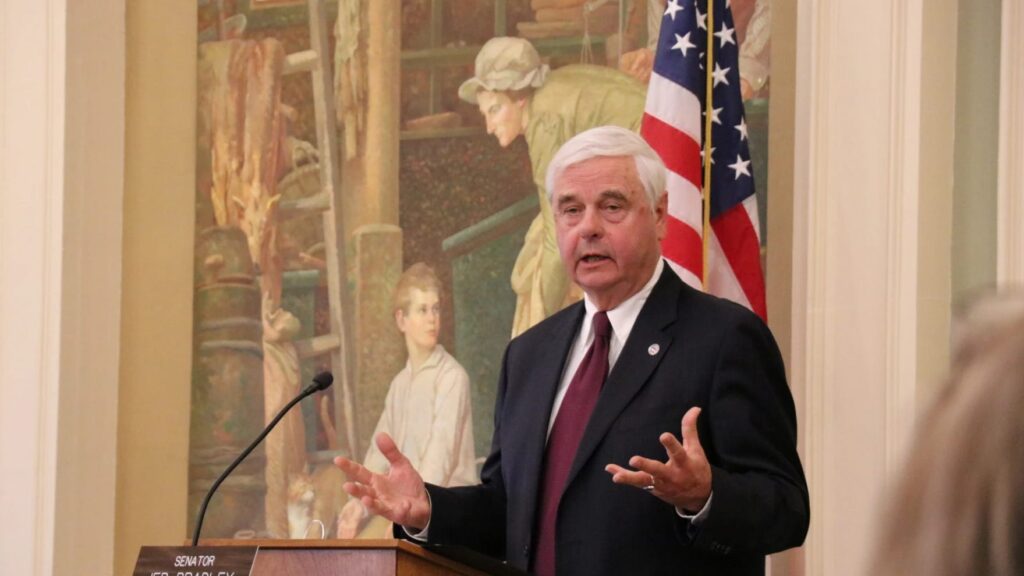
Last Thursday, the Rockefeller Center played host to retired New Hampshire Senate Majority Leader Jeb Bradley as the 2025-26 Perkins Bass Distinguished Visitor. A cornerstone of the burgeoning “Dartmouth Dialogues” initiative, the event featured a man whose storied career has traversed the New Hampshire House, the State Senate, and the halls of Congress. He offered a rare glimpse into a brand of retail politics that feels increasingly like a relic of a more civil age—one defined by muddy boots and bipartisan handshakes rather than wars fought on X.
The evening began not with a policy white paper, but with the Granite State’s true religion: hiking. When asked for his favorite trail, Bradley’s answer was immediate—Mount Moosilauke. It was a fitting opening; the mountain is as much a Dartmouth institution as the man himself is a New Hampshire one. The Senator even invited a former colleague from the audience to reminisce about their shared treks through the White Mountains. This in fact took up so much of the event questions got shortened. In an era where political differences are often treated as fundamental moral failings, Bradley’s focus on shared experience served as a quiet, necessary rebuke to the current climate of division. We may disagree on the floor, he seemed to suggest, but we can still share the summit.
Bradley’s most salient points centered on the structural rot in Washington compared to the efficiency of Concord. Having served at both the state and federal levels, his critique of the national government was incredibly biting. He noted that the constant battle for the “gavel” in D.C. precludes any real governance. His proposed remedy? Aligning House and Senate terms with the four-year presidential cycle to foster compromise—a bold, if perhaps structurally impossible, reimagining of the status quo. He further highlighted the “New Hampshire Way,” noting that in our state legislature, every single bill gets a vote. This stands in stark contrast to the federal system, where leadership kills most legislation in the cradle. Bradley attributed the current gridlock to the primary system, where a mere 20–30% turnout allows the ideological fringes to send “giant egos” to Washington, effectively making “compromise” a dirty word.
Senator Bradley pointed to his work on the reauthorization of New Hampshire’s Medicaid expansion as a crowning achievement. With the freedom of a retired statesman, he admitted to supporting specific facets of the Affordable Care Act while opposing others—the kind of nuanced “middle way” that is often punished in today’s partisan heat. He earned the nickname in Concord as the closer. Perhaps the most charming anecdote involved Bradley’s youth as a street performer in Switzerland. He credited his political poise to those days on the pavement, offering a simple mantra for public life: “Never be nervous; things don’t come out right if you are.” For those of us who view public speaking with a sense of dread, it was a practical, if daunting, piece of advice.
While Bradley’s focus on the minutiae of the ACA may have felt distant to a generation that has never known a world without it, his mastery of the subject was evident. If there was a flaw in the evening, it was the Senator’s penchant for the “middle approach.” When pressed on the current state of national leadership, Bradley retreated into a diplomatic neutrality that left some in the audience wishing for the fire-breathing clarity of a partisan. However, in a time of extreme polarization, there is a certain dignity in a man who argues that a good compromise is one where “everyone gets something, but everyone leaves a little bit upset.” For the Dartmouth student accustomed to the ideological echo chamber, Bradley’s pragmatic, trail-tested wisdom was a breath of fresh air.
Be the first to comment on "Former NH State Senator Jeb Bradley Visits Dartmouth"