
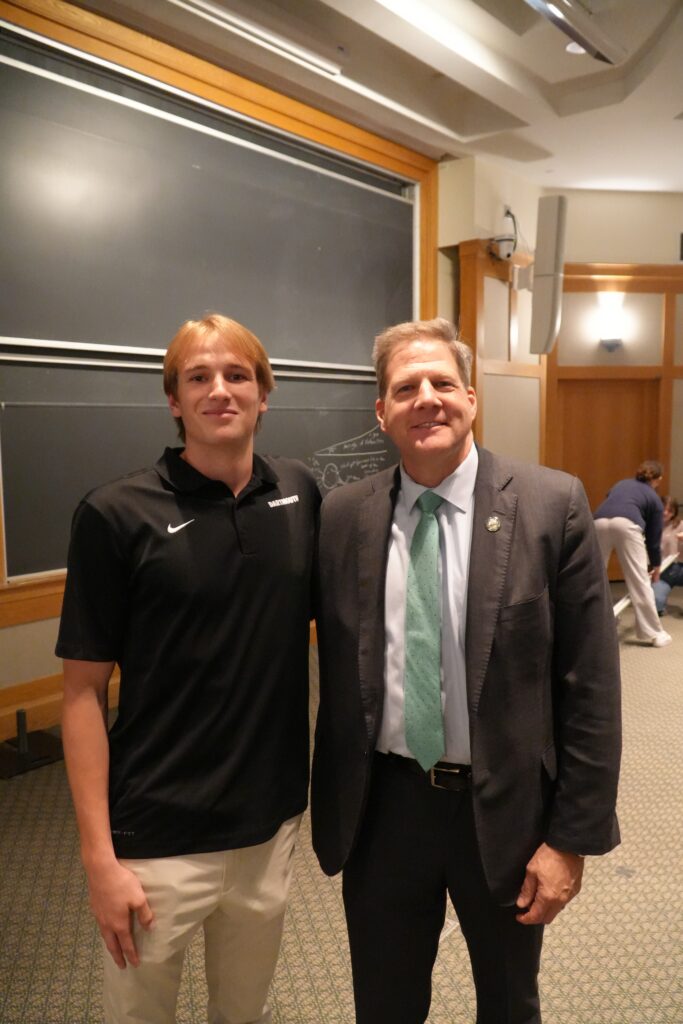
Former New Hampshire Governor Chris Sununu recently paid Dartmouth a visit in a Dartmouth Political Union-moderated conversation on “Federalism and State Governance.” The Dartmouth Review’s own Alexander Barrow did a great job leading the discussion. In a world that has gone mad, Governor Sununu certainly acted as a voice of reason. Even as a Republican, he managed to remain relatively neutral as he explained the recent actions of President Trump. While he was more critical of President Trump than your average Republican, the governor helped explain the reality behind many of the administration’s current efforts. The recent events covered included the Russia-Ukraine war, the efforts of the Department of Government Efficiency (DOGE), federal funding of universities, and the strategy behind tariffs.
Perhaps the idea most important to the discussion – and what I will choose to focus on in this article – was the recurring principle of federalism that the governor properly emphasized. The reality is that daily politics, while eye-grabbing and seemingly urgent, are not even a fraction as important, in the grand scheme of things, as the budgetary crisis that is to come. As the governor stated, the current federal deficit continues to climb at an alarming rate. Specifically, he warns that Medicare and Social Security will go bankrupt in eight years or so. Reform is necessary, yet politics -especially in Congress – is often prioritized over the people. When these programs go bankrupt (after Congress refuses to act), I hope that every single senator and representative is voted out of office.
This is a curse. However, as I brought up to the governor, this is the precise result of our federal government’s complete disregard for federalism and the text of the Constitution. It is a curse that is the fault of the FDR-era Supreme Court, which has set the precedent for the federal overreach that has tainted the nation. The case that best acted as a turning point was Steward Machine Co. v. Davis, 301 U.S. 548 (1937). In upholding the federal government’s right to tax for Social Security, the court did so through the complete reinterpretation of the Constitution’s General Welfare Clause.
In Article I, Section 8, the General Welfare Clause very clearly acts as a precursor to the privileges granted to Congress that follow in the form of a list: “The Congress shall have Power To lay and collect Taxes, Duties, Imposts and Excises, to pay the Debts and provide for the common Defence and general Welfare of the United States; but all Duties, Imposts and Excises shall be uniform throughout the United States.” What follows is a list of all the granted powers to Congress. “General Welfare” is the concept behind all the vested responsibilities of Congress. Conceptually, everything the government does should be for the general welfare of the United States. If not, our government is treasonous (sometimes I think it just might be). In allowing the General Welfare Clause to act as a separate grant of power, this allows the federal government unrestricted freedom in legislating. The necessity of a list to follow would, therefore, be nonexistent.
Steward Machine Co. v. Davis, 301 U.S. 548 (1937) completely changed precedent in American law, crippling the nation ever since. The federal government now effectively has the power to legislate on any affair it wants, completely reinterpreting Article I, Section 8 as well as the Tenth Amendment, which reads “[t]he powers not delegated to the United States by the Constitution, nor prohibited by it to the States, are reserved to the States respectively, or to the people.”
The federal government is now expected to take care of all the nation’s issues. Instead of the states having their own diverse laws suited to the desires of their own people, a slim Congressional majority is expected to dictate policies that affect all of us. This is, at its core, highly dysfunctional and unconstitutional. Rather than see the trial and errors of different states implementing their own Social Security or Medicare programs, the federal government has all the responsibility. The policy adopted by the federal government just happens to be disastrous. With the impending fiscal crisis, it’s about time we ask ourselves whether or not the federal government’s actions can truly be seen as promoting the “general Welfare.” Governor Sununu’s appreciation of the federalism problem is welcome, but more people need to sound the alarm if progress is to be made.

Be the first to comment on "In Defense of Federalism: A Reflection on Governor Sununu’s Visit"