
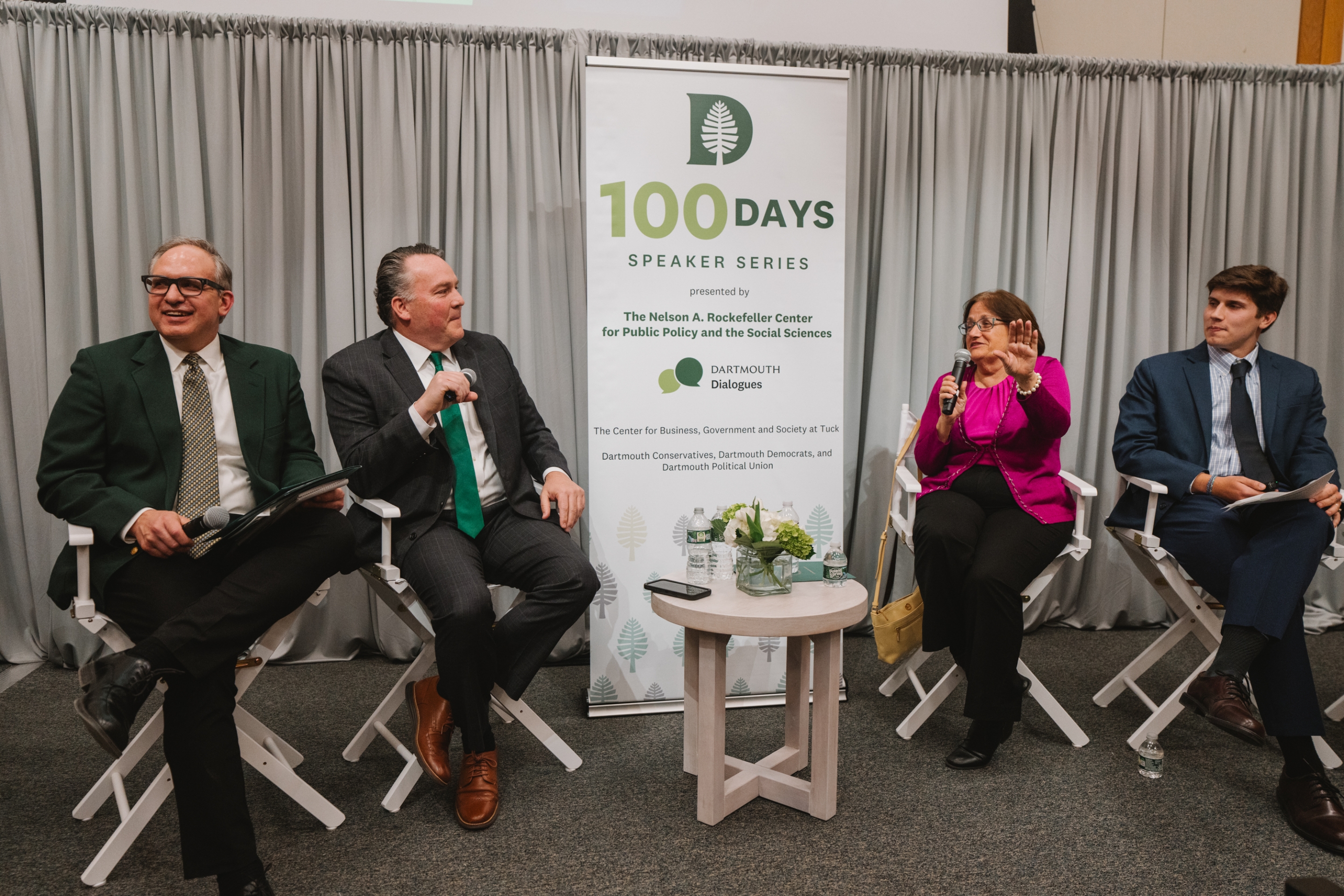
Recently, Dartmouth hosted a pair of former U.S. Representatives: Ann McLane Kuster ’78 (D-NH) and Alex Mooney ’93 (R-WV). Both received an education from our College on the Hill, and upon their recent return they each endeavored to share accounts of their respective experiences working in Congress with a new generation of Dartmouth students. The former Representatives made visits to individual classes, Kuster was interviewed individually as part of one public event, and both Kuster and Mooney participated in another public event together.
They each spent roughly a decade working in Congress (exactly ten years for Mooney and twelve for Kuster), which allowed for the accumulation of considerable experience. The fact that they both left Congress prior to its present term ensured that their membership was recent enough for them to comment on present dynamics within the chamber, but at the same time their lack of incumbency afforded them the ability to speak with greater candor. Whether it was out of habit or out of a desire to protect each of their respective legacies, the former Representatives did not entirely seize this opportunity to be forthright with the audience; Kuster in particular dodged acknowledging her decades of experience as a lobbyist with the vague assertion that she was “practicing law” prior to her work on behalf of former President Obama.
The tone of the discussion in which they both participated was largely amicable and reflective of the respect they each encouraged students to have when engaging in dialogue with ideological opponents. Each noted positive traits of the opposite party’s organizational structure: Kuster discussed her preference for the House GOP’s system for assigning committee leadership positions and Mooney noted the strength of Congressional Democrats’ party discipline and internal communication. Mooney shared a story of a liberal intellectual sparring partner with whom he engaged in many debates as an undergraduate, while Kuster reflected on the fact that the caucus she chaired in the 118th Congress – the New Democrat Coalition – is composed of members who consider themselves relatively moderate and interested in bipartisanship relative to the rest of the House Dems.
The only point at which the discussion resembled something of an adversarial debate came when Kuster broached the subject of Elon Musk’s access to government data, which prompted a brief back-and-forth exchange about the sorts of roles for which Senate confirmation is necessary and the type of work DOGE has thus far been performing. This discussion was somewhat restrained by the desire of the moderators and former Representatives to avoid a lengthy digression, but perhaps it would have been valuable to more extensively air their perspectives given the robust discourse surrounding Musk’s role in the current administration.
As has been the case with most political speakers thus far invited, both Representatives took the time to call on Dartmouth students to engage with public policy. Kuster commended Dartmouth’s present culture of significant participation in elections, while Mooney emphasized a variety of other methods of political participation beyond voting itself.
It was interesting to see something of a clash of theories of representation. Kuster made a point to emphasize the ideological breakdown of her district and its bearing on her political decisions. She discussed carefully considering communications from constituents and the efforts she made to tour New Hampshire’s Second District to solicit opinions on specific issues. Conversely, Mooney’s philosophy on constituent input far more closely echoed the one Edmund Burke articulated in his Speech to the Electors of Bristol: as a Representative he valued constituent input, but he also emphasized both the importance of voting his own conscience and his more general perspective that his electoral success constituted an endorsement of his entire governing philosophy.
In addition to Kuster’s leaning more towards delegate-style representation over the trustee model, she also placed far more emphasis on descriptive representation (over a model which is purely substantive). She spoke with some degree of pride regarding her experience supporting the PAC “Elect Democratic Women,” which is oriented around the goal its name would suggest, and she criticized the high average age in Congress. Mooney did not directly respond to this, but elsewhere he did reference Republicans’ stronger defense of meritocracy in what was likely a critique of Democrats’ emphasis on considering immutable characteristics when evaluating candidates.
On a related note, the joint event with Mooney may have been a better time to understand the breadth and depth of Kuster’s experiences as a Representative alongside her perspective on significant policy issues; this is even though she had double the amount of speaking time in her own event. This is because a total of six separate questions asked of her there were either partially or entirely premised on the fact that she is a woman. Perhaps that ought to be somewhat unsurprising when the moderator declares herself a “gender scholar,” but all the same it meant that the individual event had a somewhat repetitive quality and it failed to explore as much as it could have.
The theme of the talk with both former Representatives was intended to be “Congressional Checks and Balances,” and Mooney in particular chose to emphasize his desire to see Congress reassert its Constitutional authority to authorize military engagements. Mooney also stressed his desire to see well-written and specific appropriations bills delivered on time instead of the current reliance on continuing resolutions and large omnibus packages. This would ensure that government resources are genuinely allocated in accordance with Congress’s will; Kuster seemed to be relatively supportive of this as well. Regarding federal expenditures, Mooney strenuously objected to the fiscal irresponsibility which has contributed to the size of our current federal deficit. He noted his support for a balanced budget amendment.
Kuster voiced some concern about the fact that many key policies are unstable and change considerably under different Presidential administrations, which she asserted complicates businesses’ ability to make long-term plans. She largely attributed this to the substantial portion of key policies which are currently set via executive order. Mooney emphasized the fact that Congress has a responsibility to write more specific laws than it does at present in order to contribute to solving this, and he believes that the death of Chevron deference will force Congress to accept more of the responsibility it has shirked over the past few decades.
Both former Representatives brought valuable insight regarding the incredibly unique considerations which characterize service in Congress. It was also likely quite valuable to demonstrate such a productive and respectful dialog for Dartmouth students, many of whom are often engaged in analyzing politically contentious ideas.

Be the first to comment on "Mooney, Kuster Speak at Alma Mater"