
America finds itself at a turning point whose juncture poses many unknowns for the future. Over the past few decades, the nation has seen a significant rise in political polarization. While the difference in parties has greatly increased, so too has the federal government and, specifically, the influence of the president. Local and state elections have become increasingly irrelevant, with national politics dominating political discourse. Communities and municipalities are no longer the building blocks for implementing the policies that most directly influence the lives of citizens. States are no longer the governments that dominate most domestic affairs. The outcomes of national elections now significantly affect the lives of the citizens in all fifty states. An overall growth in the federal government since FDR has resulted in the political stakes being greatly raised for the average American. Even with a Congress who can hardly pass meaningful legislation, the nationalization of political issues has only increased. And with gridlock in Congress and still an overall growth of the federal government, the result has not been an absence of legislation. Rather, it has been a redelegation of the powers to legislate, particularly to the executive branch. Modern policy change no longer requires consensus. All it requires is one man with one pen.
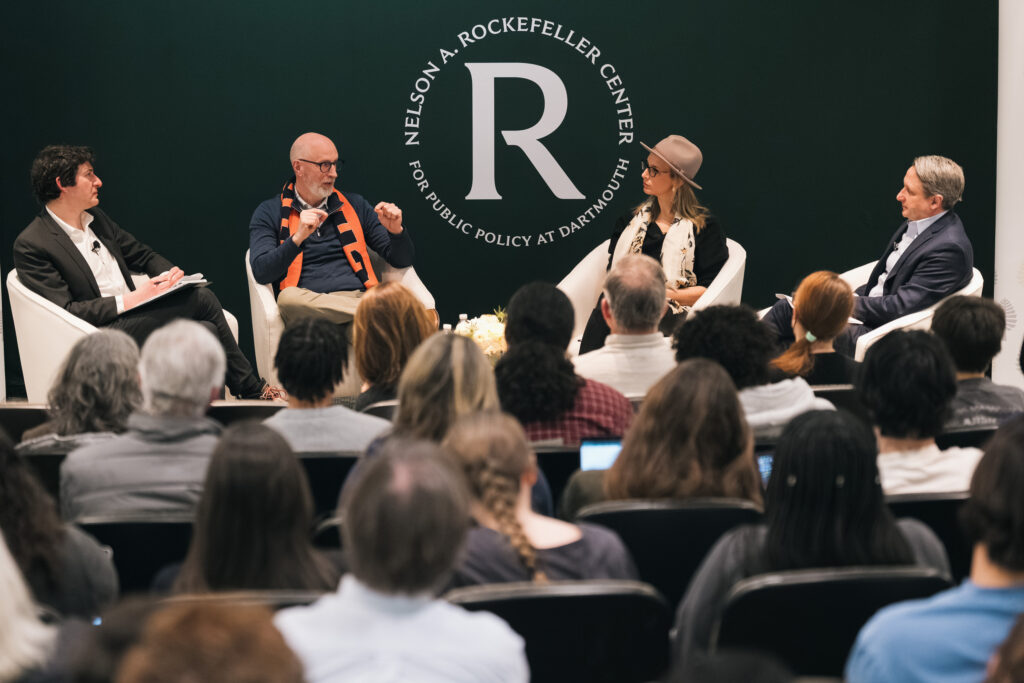
Recently, as a part of the Rockefeller Center’s Law and Democracy speaker series, the College hosted New York Timescolumnist and bestselling author David French and SCOTUSblog editor, ABC News legal analyst, and co-host of the Advisory Opinions podcast Sarah Isgur. During the discussion, which covered an array of SCOTUS-related topics, perhaps the greatest issue raised by the panelists was the state of the modern executive branch. The role of the presidency has grown far too powerful and has far exceeded the Founding Fathers’ design and intent. The result has been an increase in the stakes of the presidency and the inefficiency that comes with having laws that only last four to eight years.
At the same time, public confidence in the Supreme Court has dropped. The panelists insist that the internal legitimacy of the Court remains intact. In other words, the seemingly politicized nature of the Court (and the increasing lack of faith in the Court by the public) has been unfairly attributed to the Court as one of its own faults. In reality, it is Congress’s inability to legislate and modern presidential overreach that have resulted in public policy decisions needing to be resolved at the judicial level. No matter how often its decisions might be unanimous, the Supreme Court has taken an inevitable political hit due to the other branches of government failing to properly play their parts. And, according to the panelists – although it might seem to be the opposite – the Roberts Court has overturned precedent at a lower rate than any previous Court. Since Trump’s appointees, this has happened even less frequently. Perhaps precedent ought to be overturned.
Perhaps a Court that has allowed Congress to defer authority to the executive can also bear some blame? The reality of the state of modern American political affairs is that our current style of governance – of four to eight years with a temporary Republican strongman and then another with a temporary Democratic one – is not sustainable. Having short-lived unilateral policymakers run the country is not how our government was designed. The current state of politics that comes with incredible inefficiency and polarization can likely not survive. The nation is left with only a few options. The first and ideal solution would be to have a significant change in governance that returns consensus to federal policymaking and significantly limits executive power. This would best be achieved by a judicial branch willing to stand up to executive encroachments on the rights and responsibilities of Congress. The second and unfortunately more probable “solution” would be an executive that continues to grow in power. However, unlike the modern day where presidential growth has been met with inefficiency due to frequent partisan change, if executive growth is not stopped, perhaps the presidency will find a way to free itself from the limitations of this inefficiency. After all, it makes no sense to govern for a mere four to eight years when one has a lifetime’s worth of ideas.

Be the first to comment on "Taming the Executive: David French and Sarah Isgur on the Presidency"