
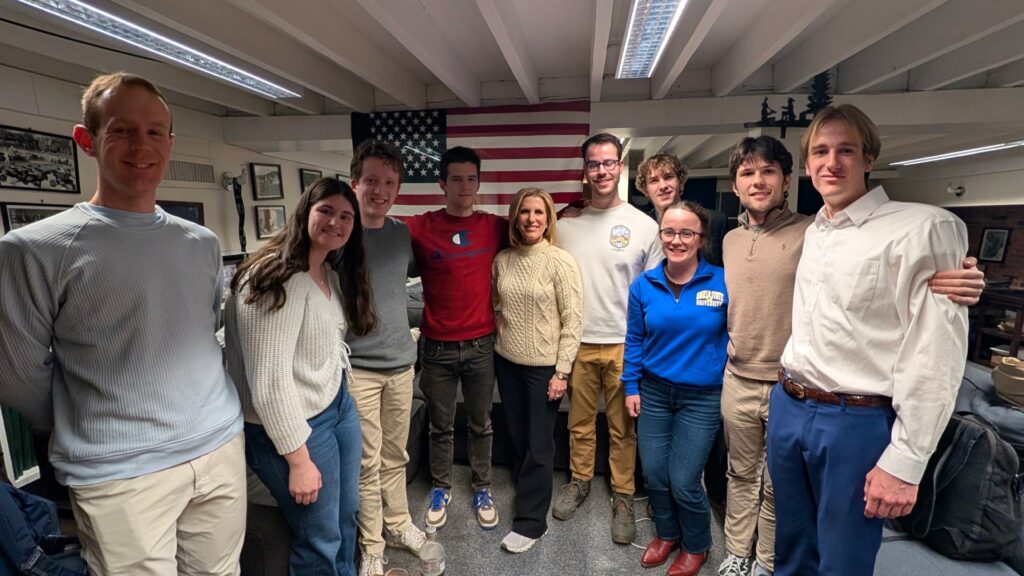
The Review’s own Editor Emerita Laura Ingraham ’85 returned to campus recently for a DPU speaking event and Q&A. Shockingly enough, there managed to be no disruptions during the event itself. This is not to suggest there were not protests, but they were much feebler than I was anticipating. I think the weak turnout to protest even made Ms. Ingraham feel a bit disappointed. And while the protesters who gathered up the stairs of Filene Auditorium were few, you would be surprised just how annoying so few cries could be, even from within the event downstairs.
The most impressive feat by the protesters was hijacking the Green’s igloo with flags and banners. They even managed to get it demolished by DoSS. Ms. Ingraham mocked their “cultural appropriation” of Native Alaskan dwellings, but what she didn’t realize was that they were also appropriating the community’s igloo for private political interests. The most resourceful of all the protesting, however, were the pamphlets that were handed out as people entered the building to attend the speaking event. The purpose of the pamphlet was to dismiss Ms. Ingraham as a hateful “FASCIST,” challenging the legitimacy of her place in speaking on campus. It was titled: “DEBATE? DIALOGUE? OR JUST DEHUMANIZATION?” They also posted similar flyers across campus to encourage students to join their protest. While the protesters were not willing to have a conversation with Ms. Ingraham and chose rather to promote misconceptions and out-of-context quotes, The Dartmouth Review owes these protesters a right to know how misguided they truly are.
The first of the pamphlet’s complaints against Ms. Ingraham is regarding her supposed “Hatred of the Queer Community.” There are three issues raised within this general theme of hatred. The first of three quotes provided seeks to dismiss her take on same-sex marriage. It is claimed she said same-sex marriage is “the same as polygamy or incest.” However, this first out-of-context quote is referring to the implications of loosening the legal definition of marriage; it is not calling to outlaw private homosexual relations but to contest the redefining of the legal definition of marriage. Even if Ms. Ingraham believes it is a morally superior way of life to marry and have children if God is so willing, this quote brings up an interesting viewpoint to which the pamphlet does not properly respond.
After all, the definition of marriage used to be the union of a man and a woman under God, with a duty to procreate and provide a stable household for children, sex existing as a sacred act within this marriage. Nowadays, however, it is not very clear what marriage is as an institution. It seems we attempt to understand it as a union between two people who love each other and want to spend the rest of their lives together. This seems like it could work as a definition until you realize that – once the definition changed from the traditional understanding shared almost everywhere for all of human history – the definition has now become arbitrary. Some might believe limiting marriage to men and women is an arbitrary restriction, but rather it is the opposite. If marriage is now just a dedication of love with no higher purpose, the institution itself implodes.
The issue of polygamy Ms. Ingraham raised is certainly relevant. With our new understanding of marriage, why can a Mormon or Muslim man not marry multiple wives? After all, his love for all his wives cannot be challenged (not to mention it is his religious freedom). In fact, what if there are three people in love with each other? Why can they not all three be married in a sort of love triangle? What about four people? If you are a progressive and are consistent with your reasoning, you should agree that we ought to expand the current definition of marriage. After all, limiting marriage to only two people is arbitrary when love and sexual impulses know no bounds.
The second instance of Ms. Ingraham’s supposed hatred toward the queer community is in her opposition to “drag queen story hour.” This matter of contention is in the queer community’s attempt to enforce their moral unorthodoxy on others, and in this case, on children. She highlights the “[indoctrination of] our children.” She even suggests the motives of the movement might be geared toward “lowering the age of consent.” While the latter quote might initially seem ridiculous, it is not unfair to point out. Drag queen story hour is blatant perversion. This is not inherently a matter of “queerness;” stripper story hour would be just as immoral. This is one of the many ways in which modern progressivism seeks to sexualize children. As the pamphlet points out, Ms. Ingraham has commented on the nature of these “groomers” and, yes, even “pedophiles.” This would remain the same whether it was a stripper or a drag queen promoting sexually degradation to children. Even if we don’t consider drag queens or strippers to be morally deprived, no talk of sexual activities belongs in conversation amongst children.
Keep in mind, this controversial opinion has nothing to do with grown adults making decisions for themselves, whether electing for sex-change surgeries or having homosexual relations, etc. It always has to do with pushing back against the LGBT community’s attempt to impose their morality on others. It is the duty of parents to create and raise moral human beings. It is not the duty of teachers, drag queens, or strippers to impose their moral viewpoints on children.
The third of Ms. Ingraham’s supposedly hateful quotes concerns trans people using “bathrooms aligning with their gender identity.” She made a joke – as a conservative media pundit might make – about “adult diapers, diapers for everyone, [as] no one’s going to be going to the bathroom [anymore].” It is true that this quote did not take place in a formal academic setting; this quote remains a joke. The pamphlet, however, is likely concerned with the premise of the joke – which is that (at least) biological men should only be allowed in the bathrooms that pertain to their biological sex. We must address this.
Once again, an individual’s freedom to identify as he/she wishes, or cross-dress, or even pursue a sex-change surgery is not at risk. But the transgender community believes it has a “right” to impose its beliefs and personalities onto others. Apparently, women must be forced to put up with men who “identify” as women and wish to use their bathrooms. This was supposed to be about individual freedom, but the reality is that it never has been. It has always been about imposing new, immoral ideas onto others and destroying Western institutions – including the most basic idea that men are born men and remain that way, vice versa.
The transgender community is just like the vegan community. In principle, they are harmless and ought to be free to do what they want with their own lives. But in practice, they always end up attempting to impose their viewpoints and life choices on others (as we see with all those foolish “veganism is a moral urgency” posters across campus). Women’s privacy and women’s safety should not be at risk because of the “rights” of a man who claims to be a woman. He has the right to identify as a woman if he chooses, but women have a right not to have men who identify as women in their bathrooms.
Not only is Ms. Ingraham supposedly against “queer rights,” it turns out she also opposes women’s rights. This is ironic given that one cannot fully support trans “rights” without infringing upon women’s rights. However, there are three quotes that highlight Ms. Ingraham’s hatred of her own kind. The first thing she claims is that “The most powerful thing a woman can do is give birth. That is it.” Just as she hates women’s rights, I hate men’s rights. Just as she is an extremist, I would go so far as to say that the most powerful thing a man can do is to participate in the creation of a new human soul with his wife. What feminism has taught women is that fulfillment does not come through marriage, children, or familial obligation, but rather through sexual “liberation” and prioritizing their careers. Career before family, sex before marriage, and abortion before children are the new mottos of feminism. And no, women are not happier.
Apparently, questioning the legitimacy of Planned Parenthood is also an act of hatred (according to the protesters’ pamphlet). In response to Planned Parenthood suing the government to reinstate funding after it was discovered they were selling the body parts of fetuses, Ms. Ingraham referred to unspecified members of the organization as “Heinous Hitlerian Freaks.” Given the context of the quote, this is not a ridiculous thing to say. However, the protesters feel anyone who questions abortion or the act of selling unborn babies’ body parts should not be welcome on Dartmouth’s loving campus. Lastly – as it relates to women’s rights – it appears Ms. Ingraham referred to the Violence Against Women Act (1994) as “pork with a tear-jerker title.” Finding this quote is not very accessible; however, I would not be surprised if there was, in fact, more within the bill than can be considered strictly related to countering domestic abuse.
Perhaps the best of all the quotes used to portray Ms. Ingraham as a hateful extremist regards illegal immigration. The protesters claim that the DPU’s choice to bring Ms. Ingraham to campus is “A SPECTACLE OF RACIST, HOMOPHOBIC, XENOPHOBIC BIGOTRY.” They go on to show “LAURA INGRAHAM’S HATE-SPEACH [sic] TOWARD IMMIGRANTS.” Unfortunately for the protesters, their integrity is even more questionable than their ability to spell. Ms. Ingraham is then quoted, saying “WHY DON’T WE SHIP THEM BACK HOME AND SAY YOU COME AGAIN AND YOU’LL BE SHOT.” This seems rather brutal, and the pamphlet certainly achieves its objective in framing Ms. Ingraham as overtly cruel. However, the full quote paints a rather different picture: “[California Governor] Brown is releasing all these criminals, because they’re spending too much money in the jails. By the way, the jails are what, 27 percent illegal immigrants? Why don’t we ship them back home and say you come again, and you’ll be shot crossing the border? Why don’t we ship them out of this country, why are we paying for these horrific individuals?” These poor immigrants!
Ms. Ingraham is also rather controversial at Dartmouth due to an article she approved in which The Review is accused of doxxing students who attended a meeting for the school’s Gay Student Alliance (GSA) in 1984. As the pamphlet points out, she has been accused of “bullying” and “[terrorizing]” her peers – particularly due to the reporting on the GSA meeting, but also for using rhetoric that includes referring to members of the organization as “cheerleaders for latent campus sodomites.” However, as Ms. Ingraham made clear when asked about the incident at her talk with the DPU, the controversial GSA meeting was open and advertised to the public, and the only names published in the article were publicly listed officers. All other students were anonymous, listed as “GS #1,” “GS #2,” etc. The reality is that “bullying” and “[terrorizing]” might be a bit of a reach.
However, while the protesters have sought to primarily lie and deceive – as well as dismiss any perspective that challenges their own views on abortion, open borders, etc. – they seem to have a genuine concern for Ms. Ingraham’s moral view on homosexuality. And here would have been the grounds for a legitimate conversation to be had. Ms. Ingraham was not asked to directly clarify her views on the matter, but she made clear at her talk that she believes every human – regardless of their life choices – possesses an inherent dignity that comes with their soul. Even if she holds a moral disapproval of a particular lifestyle choice, the reality is that moral debates must not be feared or avoided. In fact, the most illuminating discussions take place when you attempt to uncover the moral bedrock of a person’s character and perspective.
Ms. Ingraham did not come to the DPU talk at Dartmouth to platform her personal beliefs on homosexuality (as she may have done at The Review in college). If she held a personal belief on the issue of homosexuality fundamentally different from that of the protesters, then they should have inquired into what it is that makes her believe her apparently troubling perspective. They should have forced Ms. Ingraham to explain her convictions, and if she failed to do so sufficiently, they would have demonstrated a weakness in her reasoning.
The central question the protesters asked was “where does Dartmouth draw the line” in inviting “hateful” and “fascist” speakers to campus. A better question to ask would be: “where do these militant, leftist protesters not draw the line?” It is certainly easier for them to dismiss an opponent by labelling him/her as “hateful” or “fascist” than to have to burden themselves with arguing an actual position. Ironically, these same protesters are some of the most hate-filled and insufferable students on this campus. Even with their hateful hearts, I would see no need to dismiss them if they ever sought dialogue or debate (although it is doubtful they ever will). After all, the only thing more powerful than hate is love. However, if love simply can’t do the job, facts and logic will.

Be the first to comment on "The Ingraham Anger: Politics, Protests, and Pamphlets"