
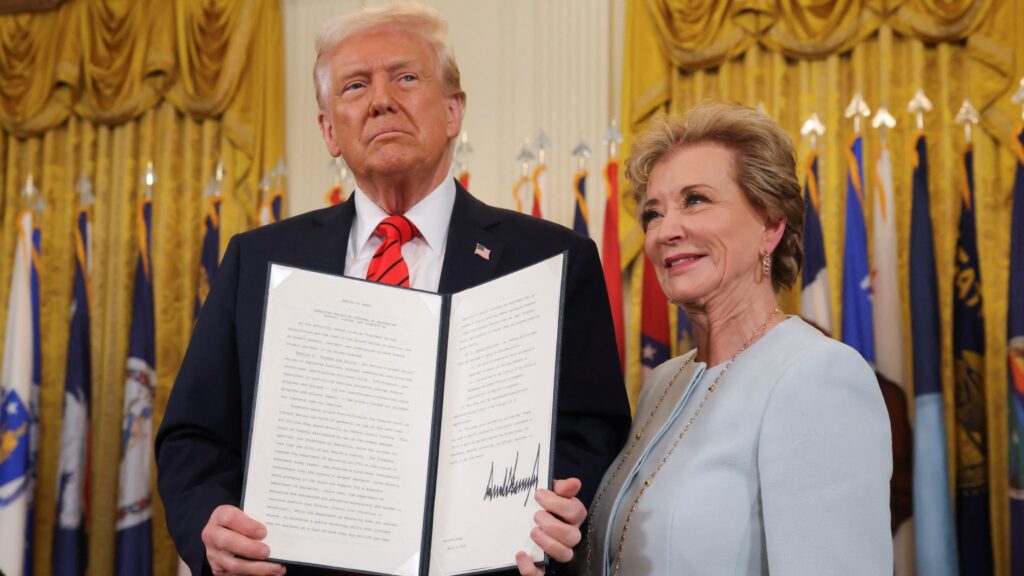
On October 1, Washington Examiner and other news outlets reported that nine universities – including Dartmouth College, the Massachusetts Institute of Technology, the University of Pennsylvania, Vanderbilt University, and Brown University – were offered by the White House to either adhere to the Compact for Academic Excellence in Higher Education or, as one may read between the lines, suffer the consequences and forgo their current privileges. The Compact details a list of ten demands that promises a series of benefits including preferential access to federal grants, contracts, and, unofficially, political favoritism and potential protection from government persecution.
Since the beginning of the year, the new administration has made several controversial moves against elite universities, including cutting over $2.2 billion in federal grants to Harvard and $400 million to Columbia, with threats to strip accreditation from the former. As the latest transgression in the normal operating status of private universities, many fear that this is not an offer of alliance but rather submission – many of the stated benefits are already in place, and the perception from many is that this lies as a threat of removal of said privileges rather than an enhancement. Now, what many question is whether this is truly a chance for the nine universities to collectively get ahead, or if this is merely a bribe from the current administration.
Whether the demands would cause any effective change, at least in undergraduate university education, is up for debate. Now, in terms of the international community itself, it would be indeed correct to affirm that the Compact poses little threat to them. Out of the schools that were invited, USC, which has the highest, has approximately a 14% international student population – still below the proposed 15% hard limit. Most of the invited universities sit between 10% and 14%, and are equally unaffected. The concerns around the curtailing of international students in these universities are wholly unfounded. If the Compact were to propose graduate students to be under the same limit, that would be a problem. Yet the language specifically mentions undergraduate studies. To argue against the Compact with the international community in mind, at least following its framework, is dishonest and negative in nature.
On the other hand, the curtailing of faculty speech is so terribly phrased in the Compact to the extent that, if applied word-for-word, it would cause the shutting down of the government, economics, philosophy, and many other departments since “all university employees … will abstain from actions or speech relating to societal and political events.” In what way can a “marketplace of ideas” prosper when the very discussions are being prevented from taking place at all? And even to the lovers of hard sciences, the idea that only so-called soft courses would be affected is in itself null. Can you imagine an economics class without being able to discuss Locke, Hayek, and Marx? Without revision, this document would act as a death sentence to the humanities.
Then there’s the issue of excellence-based admissions through objective testing standards and the removal of any DEI considerations in admissions, despite the SCOTUS decision in 2023. While in principle this letter follows the Supreme Court decision on the case of Students for Fair Admissions v. Harvard in 2023, it rejects the practicality of implementation. It is not negative to include objective standards for top colleges as the recent movement to reinstitute test-required policies demonstrates. Now, in terms of the gender-based language, that’s a whole separate issue. While the idea that gender and sex rather than socioeconomic status plays a role in academic admissions is kind of contrarian in a post-civil rights and suffrage period, this is the kind of issue that, while conservatives and liberals will disagree on how gender and sexuality are defined, it remains bipartisan that a unilateral decision in either way would create great unrest and protest. To perform this on college campuses, where the debate and progressive push is most concentrated, is unwise and it, in turn, politicizes the university – breaking with the idea of institutional neutrality.
Then comes the issue of implementation. At Dartmouth, thousands of faculty members, students, and alumni have signed a petition to prevent the College from becoming a signatory. Although federal grants and funding constitute around a fifth of the Compact’s universities’ annual budget, alumni and students supply around 35% of the budget. Being on the wrong side of the former could place these schools in just as much jeopardy as would conceding to the Compact. In Dartmouth’s context, Beilock promised and continues to maintain a policy of institutional neutrality, and to agree to a one-sided castration of the university’s purpose would break with that. Then again, to not sign a more reasonable version of the document would simply prevent the College’s growth in a stubborn anti-government act of futility.
The fact that the letter is simply a draft is a sign of hope, perhaps, and may allow for more well-thought-out, practically implementable ideas to be agreed upon in the final version. Until then, the Compact is rather impossible to practically implement, and jeopardizes the university’s academic independence.
Be the first to comment on "Trump Administration Offers Deal With Compact For Academic Excellence"