
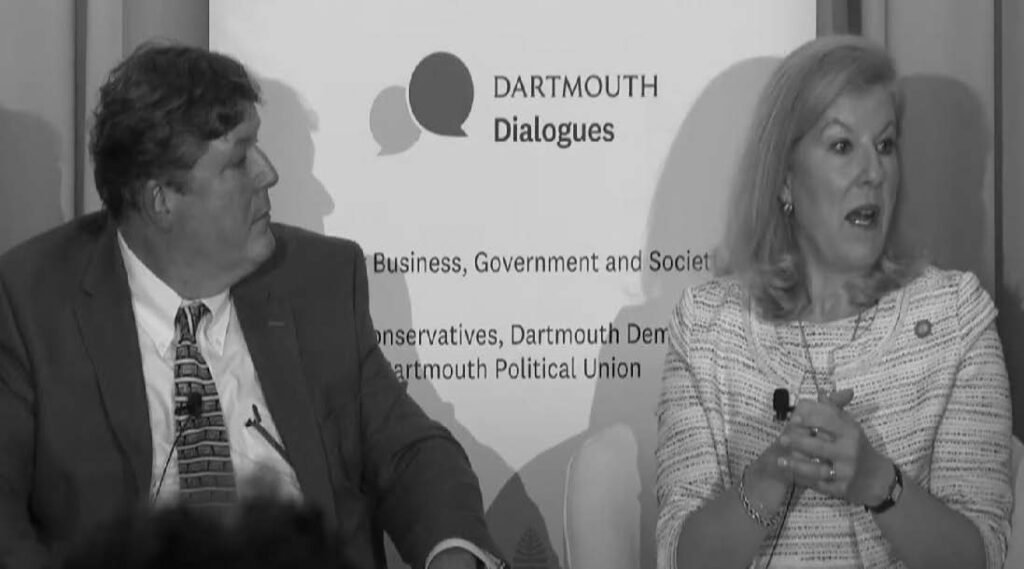
In a wide-ranging policy debate last week in Filene Auditorium, Virginia Secretary of Education Aimee Rogstad Guidera and SAU 70 Superintendent Jay Badams offered their visions for the future of public education. The event, part of the Rockefeller Center’s 100 Days series, was co-sponsored by a diverse array of groups, including Dartmouth Conservatives, Dartmouth Democrats, Dartmouth Dialogues, and the Dartmouth Political Union.
The core debate of the evening centered around a fundamental question in American education: Who should make decisions for students—state governments or local school districts?
Badams, who oversees schools in areas of New Hampshire and Vermont, argued for more centralized governance in more rural states like Vermont, where he suggested small school districts lead to inefficiencies and inequitable teacher pay. He argued that there is no reason for all of the districts, referring to Vermont’s more than 50 supervisory unions, each negotiating separate contracts and allocating resources independently.
Guidera, appointed by Republican Governor Glenn Youngkin in 2022, countered with a defense of local control, one she argued was consistent with conservative principles of local governance. In her view, state governments should set general standards and offer support when needed, but allow superintendents and school boards to lead actual differentiated implementation based on community needs.
Despite their political divide, the pair found common ground on one key issue: the politicization of the Common Core State Standards. Once broadly viewed as a bipartisan effort to match learning goals across states to ensure greater equality, the standards eventually became a lightning rod for political controversy. Badams pointed to media figures such as Glenn Beck, who publicly condemned the standards, as key players in derailing consensus. Guidera agreed that the collapse of consensus from the Common Core debate led to damaging regulatory rollbacks. She said federal lawmakers, in response to the backlash, relaxed accountability requirements in national education law. She claimed the move was catastrophic for Virginia.
Guidera warned that systems get the results for which they’re designed, referencing a decline in student scores in the wake of these weakened standards.
The conversation later shifted to the salient impact of President Donald Trump’s executive order restricting the use of diversity, equity, and inclusion (DEI) frameworks in federally funded institutions. Guidera used the moment to emphasize her administration’s renewed focus on merit and student readiness. She referenced how in Virginia, 10% of their first-year college students drop out with $10,000 in debt and no credentials, calling the trend immoral and a result of admissions policies that emphasize access over actual preparedness.
Badams offered a different perspective. His district, SAU 70, joined a lawsuit filed by the ACLU challenging the federal rules, which he called dangerously vague. He warned that such policies risk censoring open classroom dialogue and could jeopardize federal funding for essential services, especially special education. He expressed frustration about the vague standards set by the federal government, but still believed they were fully in compliance with Title VI.
The pair also sparred over the controversial rise of charter schools and school choice. Guidera praised Virginia’s new lab school initiative, which uses public funds to create new, career-centered learning environments in partnership with higher education institutions. Badams criticized parallel systems that both drain funding from traditional public schools while also facing fewer regulations and accountability standards. He went on to argue that public schools should get the same latitude.
A final question from the audience brought the conversation back to funding and equity. Guidera praised Virginia’s ongoing efforts to modernize its school funding formula by weighing based on student need, a move she said would better serve low-income and rural students. Badams acknowledged the value of such reforms but was concerned about their durability, citing Vermont’s recent struggles to redistribute education resources, which have been highly inequitable.
Despite their differences, both Guidera and Badams affirmed a shared belief in education as a cornerstone of American democracy. Their exchange revealed the ideological and structural tensions shaping the future of U.S. public schools, a system caught between competing visions of equity, excellence, and autonomy.

Be the first to comment on "Virginia Education Secretary Aimee Guidera, SAU 70 Superintendent Discuss Education Policy"