
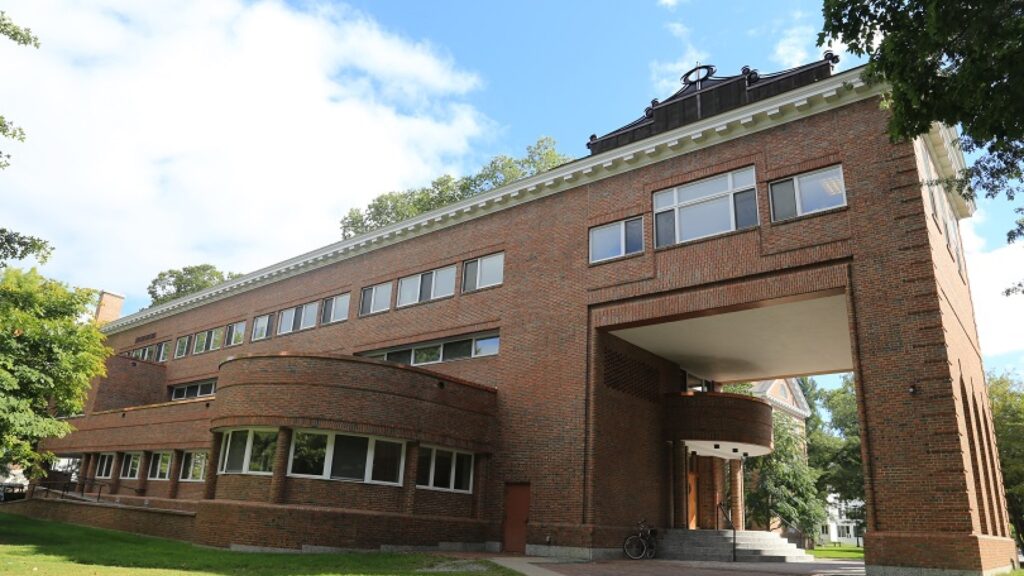
The Nelson A. Rockefeller Center for Public Policy made headlines across New Hampshire and the Dartmouth campus during the most recent election cycle, largely thanks to its high-profile events that brought several presidential hopefuls to speak directly with students. While this visibility may have felt novel to some or made some unique headlines, the Center, “Rocky,” has long played a central role in Dartmouth’s civic life for decades. Founded in 1983 to honor Nelson Rockefeller—Dartmouth Class of 1930 and former Vice President of the United States—the Center was created to carry forward his legacy of public service, pluralism, and democratic participation. Rockefeller himself remained an engaged alumnus until his death in 1979.
Rocky’s mission is “to inspire and energize undergraduates to become effective leaders in their communities and to cherish and participate in democracy on the state, national, and international stages throughout their lives.” This mission is both admirable and timely, especially in the world of extreme polarization we live in today. And to be clear: the Center does a great deal of meaningful, high-impact work. Through its commitment to facilitating research, lectures open to students and the town, student-funded initiatives, and Washington internships and experiences, it has aspired to help shape generations of Dartmouth students into civic-minded leaders. It even works to present numerous awards, bridging factional divides across campus.
However, in light of that mission, “Rocky” finds a structural blindspot—one that could strengthen its long-term impact: more intentionally fostering ideological diversity within its core student programs. Former Board of Visitors Chair, Timothy Harrison ’78, said that “We (the Rockefeller Center) encourage those who vehemently disagree with each other to learn, to listen, to learn to respect each other, and to see if there is a way to find common ground.” While the Center is commendably consistent in inviting public speakers from across the political spectrum, this commitment is not always mirrored in its internal programming, particularly in selective opportunities like the First-Year Fellows (FYF).
This year, of the twenty FYF placements awarded to members of the Class of 2028, only four could be reasonably described as centrist, and just one could be considered right-leaning. The remaining fifteen placements are with progressive or left-leaning organizations, elected officials, or policy offices. While these are undoubtedly valuable opportunities, the broader pattern suggests an ideological misplacement that undercuts the Center’s stated goal of preparing students to lead in a pluralistic democracy, through one of their key programs.
This is not about offering token representation to conservative or libertarian students. It’s about developing real civic leadership—the kind of leadership that requires the capacity to engage across lines of political difference, not just through guest lectures, but through immersive, formative experiences. Even when invited to talk to the Class of 2028, the Class of 2027, who had a few members known for their conservative ideology, only those who worked at liberal-leaning organizations were invited.
There is a quote on the wall in the Rockefeller Center that has been highlighted over the years from Nelson Rockefeller ’30, that “It is essential we enable young people to see themselves as participants in one of the most exciting eras in history and to have a sense of purpose in it.” Essential to this quote, this message highlighted on their walls and even their 40th anniversary program, is that young people can see themselves as participants. I ask, how do we make students feel represented who see themselves as apolitical, center, or even right-leaning? Exposure to diverse political perspectives shouldn’t end at the Q&A mic or the event invitation, where it currently does; it should extend into the institutional structures and professional networks that shape students’ understanding of public service.
This upcoming fall, Rocky has the opportunity to build the infrastructure as an off-year program. They could do outreach to the prospective placements and alumni to build bridges that last beyond the microphone at a speaker series. These connections will be key to ensuring that the program doesn’t tokenize students for their beliefs, but instead rounds out an already flagship program.
Expanding the range of placements in programs like FYF—by partnering with center-right think tanks, bipartisan nonprofits, or alumni working in conservative policy spaces—would be a meaningful step toward realizing this vision. It would build a better intellectual environment, build empathy and perspective-taking, and model the kind of inclusive leadership our country urgently needs. This is also an opportunity to better engage Dartmouth’s alumni community across the political spectrum—not just the liberal ones.
The Center could also more deeply engage students in creating these types of partnerships that more accurately represent the ideological diversity of the student body. Other ideas for a more complete representation are more actively seeking partnerships with alumni, or just interested professionals, to have career roundtables similar to the ones with prominent alumni who are generally left-leaning.
This all starts with realizing there is a real problem here. Students who are somewhat interested in politics, from the moment orientation week starts, are pushed towards Rocky, but those who aren’t deeply left-leaning or partisan struggle to find meaningful engagement in many of Rocky’s programs.
If the Rockefeller Center’s mission is to be more than polished rhetoric on a wall or a tagline in a program brochure, then its commitment to truly inclusive leadership must extend beyond the Q&A mic. Rocky risks signaling to center-right and even moderate students that their perspectives are welcome only in the audience—not in the programs, fellowships, or leadership pipelines that shape the institution’s core. Honoring Nelson Rockefeller’s legacy means more than quoting him; it means living his example of pragmatic, principled engagement across difference. Until that vision is reflected not just in who Rocky invites to speak, but in whom it prepares to lead, the Center will fall short of the pluralistic democracy it claims to champion.

Be the first to comment on "Where the Microphone Ends: Rethinking Civic Inclusion at Rocky"