
There is a frustrating incongruity to be found in the fact that the portions of the Dartmouth Administration tasked with raising funds, showing the campus to prospective students, advocating for the College’s interests, and generally representing Dartmouth to the outside world sometimes appear to have a far more robust sense of the College’s best and most unique attributes than the key decision-makers who set policy for the school’s future.
This is most self-evident when one examines the posture different portions of the Administration take towards the buildings on campus. The College’s major promotional materials take great pains to depict the architecture of the row of picturesque white buildings along College Street. The wood-paneled interiors of the Sanborn Reading Room and the Tower Room have graced many College websites and mailers.
It is an illustrative exercise to compare the number of College materials which feature images of the Baker entrance of the Baker-Berry Library to the number sporting the Berry side: one can easily spot the set of aesthetics which the College’s promotional departments know will connect with people.
However, ever since College President John Sloan Dickey removed Jens Fredrick Larson from his position as architect-in-residence in 1947, Dartmouth’s explicit commitment to the Georgian Revival style was replaced with a nebulous directive for “Modernism”; the first projects constructed under the new policy were the Choates. This pivot has not been properly reconsidered since, as evidenced by the 2016 construction of House Center B (“The Cube”) or the corrugated metal additions inelegantly grafted onto the historic Fayerweather buildings.
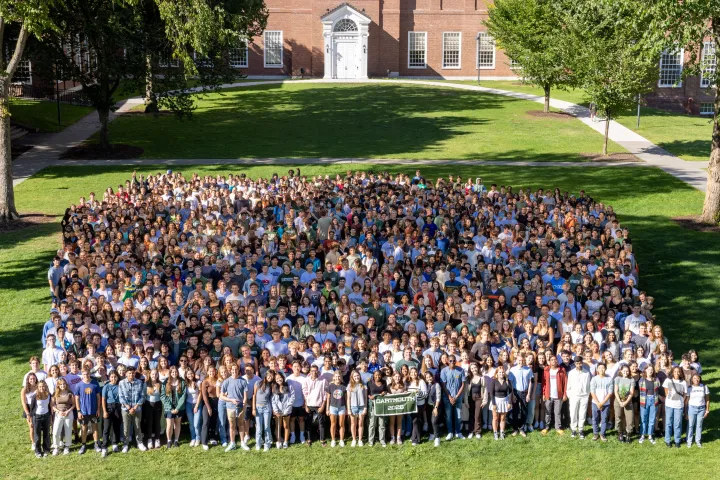
This is far from the only—or even remotely the most significant—way in which the College is vigorously sawing at the base of the branch on which it is perched despite some internal recognition of the danger. Approximately eight to ten times per week, a group of starry-eyed high schoolers and their parents shuffle into the upstairs presentation room of McNutt Hall to receive a lecture which, among other things, extols the unique virtues of Dartmouth’s relatively small undergraduate population. It is darkly ironic, then, that at exactly the same time in Parkhurst, the building next door, other employees of the College can be presumed to be busy concocting plans to increase the size of the student body. This comes in the wake of the decision by the Board of Trustees to “direc[t] the administration to begin planning for how to add more students and faculty” reached at their Commencement Weekend meeting.
It is crucial for the trustees who reached this resolution to keep in mind that the “Dartmouth experience” they provide for students is not some packaged consumer product which can be manufactured in whatever quantities they choose. Every individual member of the Dartmouth community both shapes and is shaped by his peers, which means that significantly varying the size of the undergraduate population alters the education itself in addition to the number of people who receive it.
First, it is a straightforward matter of fact that fundamental constraints of time and human cognition set limits on the number of close interpersonal connections a given individual can form. If a student is thus likely to have a similar number of friends and acquaintances in a college of 4,500 as one of 6,000, growing the school from the former to the latter would only serve to dramatically decrease the frequency of a given student’s interactions with those friends (“diluting” them, in a sense). As students begin to feel that they know a smaller and smaller overall proportion of their classmates, it is bound to have an adverse impact on the strength of their sense of belonging within the school. Many of Dartmouth’s traditions, special events, and alumni activities rely on a sense of school spirit derived from the sentiment that Dartmouth truly is one unified community. The more that the student body grows, the more that the fragility of the aforementioned sentiment of unity is put to the test.
As the class size gets steadily larger, it becomes progressively easier to build sub-communities composed of like-minded individuals of a common background and to silo oneself off into them. Not only does this further interfere with the sense of class unity, it also interferes with the Administration’s stated interest in developing a culture of healthy and reasoned debate on campus. If President Beilock and the trustees would like to foster respectful engagement across personal and ideological differences through programs like Dartmouth Dialogues, any growth in the overall undergraduate population thus runs directly counter to their aims.
Another positive aspect of the current Dartmouth community that this proposed expansion jeopardizes is the College’s collaborative spirit. It is remarkable and extraordinary that Dartmouth’s population of deeply passionate and motivated young people, which is continuously goaded toward vicious competition through enforced medians and the limited availability of study abroad programs and fellowships, is so kind and helpful. This becomes less surprising, however, upon noting that a considerable portion of the most collaborative institutions of higher education in the country are liberal arts colleges with half the enrollment of even Dartmouth (e.g., Bowdoin College). In a small school, once a student reaches upper-level classes within his primary areas of study, his classmates are likely to be familiar acquaintances often encountered in other classes rather than faceless adversaries.
Dartmouth classes are also often small and discussion-based. The College prides itself on the strength of connections between undergraduate students and accomplished faculty, and there is plenty of basis for this: award-winning experts teach even intro classes to small groups, getting involved in research is often as simple as sending an email, and initiatives like the faculty lunches foster even closer connections.
A dramatic expansion in the student population would imperil all of the above. In management, there is a notion that from the list of “fast, cheap, and good” business leaders can choose any two but not all three; such a tradeoff is popularly termed an “iron triangle.” Another such iron triangle exists in undergraduate education between small class sizes, access to accomplished faculty, and a high overall undergraduate enrollment. Thus far Dartmouth has wisely opted for the first two, but if the undergraduate population grows significantly then the Administration will need to abandon one of them.
As a dramatic example to illustrate the principle, Georgia Tech (with its ~21,000 undergraduates) chooses the second and third options, thus allowing each student to learn from the members of their faculty engaged in groundbreaking research from the beginning; the necessary tradeoff comes in the form of the cavernous and impersonal lecture settings in which such instruction occurs. The school’s primary Physics building alone has four lecture halls with over 150 seats. Even at Penn, which is half the size (~10,300 undergraduates), most majors are noted to begin with a sequence of “weed-out classes” with enrollments well over 100.
Certainly large universities can achieve small class sizes anyway through opening a much larger number of small, individual class sections. Unfortunately, the tradeoff comes in the fact that a given student’s odds of securing a seminar with one of the school’s best professors (or any professor at all) under such a paradigm are exceptionally low. There are only so many Rhodes Scholars and Nobel Laureates to go around, and if large schools choose not to have them address full lecture halls, most students will simply never encounter them at all. Even if the process of recruiting faculty to lead these small classes goes perfectly smoothly and swiftly, the new professors will still be individuals who would not otherwise have been hired if the school could afford to be more discerning.
Because of the actual complexities of faculty recruitment (and to avoid allowing too much of the new students’ tuition dollars to be swallowed by salaries), in actuality the implementation at Dartmouth would almost certainly involve a dramatic expansion in the teaching role of graduate students (who currently only lead a small handful of math classes) to fill gaps. Columbia University (~9,500 undergraduates) proudly boasts that three quarters of its undergraduate classes have enrollments under 25, but it has come to rely so significantly on graduate student teachers that in August 2025 it even began recruiting them from other New York City universities.
In 2024 and 2025, a newly-arrived freshman in his very first Dartmouth term could take Government 10, the Government major’s prerequisite course, in a section which was taught in a seminar classroom with under 30 students by Professor Sean Westwood, one of the country’s leading scholars on the subject of partisan polarization. It is impossible to imagine that anything like that lies in the College’s future if the trustees allow future classes to grow too large.
Dartmouth’s small undergraduate population makes it especially easy for students to become invo-lved in research, and that is undoubtedly a valuable strength. However, if some major projects do require a greater number of knowledgeable students than Dartmouth can furnish, which is admittedly sometimes the case, our present age of unprecedented communication makes it easier than ever to find those additional researchers on other campuses without the need for more Dartmouth undergraduates. To invoke Professor Westwood in another example, his Polarization Research lab seamlessly incorporates input from scholars at Dartmouth, Stanford, and Penn. Outreach to other institutions has a much better chance of actually yielding prospective contributors to research products than gambling that enough of the random assortment of new students brought in by a class size expansion will have the knowledge and interests necessary to make meaningful contributions.
Shifting from academics to student life, the College is in a much worse position to house the new students than may initially appear to be the case. Russo Hall and the Fayerweather expansion have added many new beds, but it is rash and imprudent to rush immediately into filling them. The Fayerweather renovations forced many students for whom housing was ostensibly guaranteed to live in Summit on Juniper last year, which put on full display how fragile the housing arrangement previously was. The College has just gained much-needed breathing room, and immediately throwing it away is unbelievably shortsighted in light of the impending necessity of renovations to the Massachusetts Row dorms and the Choates. One wonders if the plan is to send people to Summit again, which would mean that the Administration does not recognize that arrangement for the mess that it was.
In the Administration’s rush to give up these new beds to new students, it neglects the needs of the existing student population: would it not be better to use them to join Harvard, Princeton, Columbia, Stanford, and many more of our peer institutions in guaranteeing four years of housing (as opposed to the two currently in College policy)?
Growing the class size requires rethinking fundamental aspects of Dartmouth’s structure. The current campus planning philosophy centers around building a smaller overall number of physical structures but developing them far more elaborately. Unfortunately, there is a hard limit to how large Dartmouth can get before this stops working.
One of the strongest examples of this can be found in our library system. Rather than covering the campus in mid-sized libraries, Dartmouth has chosen to extensively develop the sprawling Baker/Berry/Carpenter/Sanborn complex at the center of campus. This centralization of library resources in Baker-Berry developed naturally, but it has actually accelerated in the past few years when the functions of the defunct Kresge Physical Sciences Library and Paddock Music Library (both of which closed in 2021) were folded back into Baker-Berry. However, it is difficult to deny that even the current undergraduate population stretches the Baker-Berry close to its natural capacity. This is already on display whenever one attempts to find a Stacks desk on any “off” night, but the 30s will soon be shocked to behold just how packed Baker-Berry can truly get during finals periods. A massive influx of additional students would require more study spaces, and the impossibility of another Berry-sized expansion due to space constraints means that those spaces would need to be situated in another building.
This comes with a set of problems. Dividing humanities and physical science resources into a pair of separate libraries, as is the case at Brown (~7,200 undergraduates), would have a massively deleterious impact on the quality and quantity of the sorts of “liberal arts” interdisciplinary projects that the administration prides itself on encouraging. The messy constellation of sixteen libraries which enormous Cornell (~16,100 undergraduates) must maintain on its Ithaca campus alone would make any research project that relies on physical texts a complicated mess to research. Furthermore, such an arrangement would necessitate checking multiple buildings across campus when scanning for available study areas. However, it is the direction in which the library system must tend if it is going to serve more students.
What Baker-Berry is to Dartmouth’s library system, Foco is to Dartmouth Dining. Collis, Ramekin, and other such dining locations are useful supplements providing variety, but Foco is the only dining area capable of feeding massive numbers of students at one time. Rather than proffering the same limited fare from a scattered set of mid-sized dining halls, we have one large complex which serves as a gathering place for the full campus (and thus a welcome source of spontaneous friendly encounters) and which offers a much wider variety of foods than would otherwise be possible. However, it strains credulity that Foco can meet any more demand than it already handles at peak mealtimes, and the building lacks clear avenues to expand further to the extent required. For decades, there was a shuttered seating area in Foco’s basement (the Hovey Grill, formerly the home of the controversial Hovey Murals), but ever since the Hinman Mail Room (which was formerly in the Hopkins Center) moved there a few years ago it is unlikely that basement seating at Foco will ever return.
If there had always been several “mini-Focos” dotted across campus, it would not be especially difficult to conduct minor expansions of each. As it stands, the College must ask itself if it possesses the space, financial resources, and will necessary to build a second entire Foco.
There is a wide assortment of other, smaller complications that the Administration is unlikely to adequately consider. The College must scale the Controlled Storage offerings with the increase in students. The House Communities’ trips and PE ski lessons will fill up even faster than usual. The home men’s hockey games against both Princeton and Harvard last season drew standing-room-only crowds: is the Administration prepared to expand Thompson Arena? At this year’s Homecoming game, students and alumni nearly filled the West Stands completely. If the student section significantly grows, alumni who feel sufficiently well-connected to their alma mater to make the trip back to Hanover will be pushed out into the East Stands with visiting fans.
On the subject of Homecoming, one of the most beloved traditions used to be the annual tug-of-war between the freshman and sophomore classes. While the proximate cause of its demise was the abolition of the freshman beanies (and thus the loss of the prize over which the classes used to fight), the swelling ranks of new Dartmouth cohorts around the time of the tug-of-war’s death would have caused it to become untenable soon after anyway. It is not difficult to imagine that the annual winter term snowball fight may be at risk if there are further expansions to the Dartmouth undergraduate population.
And yet, the Trustees still see some worthwhile benefit in this proposed expansion. The idea that this could possibly be in any way financially advantageous to the College necessarily rests on the notion that Dartmouth will maintain its present alumni donation rate while bringing in more tuition dollars and (eventually) more donations from the enlarged pool of future alumni. This is a dubious and deeply questionable assumption.
First, most current alumni donate funds out of an earnest love of the community which helped shape them and a desire to pass along their experiences to a new generation. If they can no longer recognize the community of which they were a part because fundamental changes have been made, it may try their generosity. This is not some idle speculation: in 2018 under President Hanlon, another group was convened to study the possibility of growing Dartmouth’s undergraduate enrollment. An alumni poll conducted in response to that initiative yielded an 84 percent alumni disapproval rate to any significant growth.
Dartmouth cannot safely extrapolate current rates of giving to hypothetical future alumni. Our College on the Hill routinely ranks in the top ten schools in the United States by alumni donation rate, but that certainly cannot be taken for granted. The more the Administration threatens the unique sense of community in Hanover and makes the school more “normal,” the more one should begin to expect “normal” rates of alumni giving. Furthermore, this proposed expansion will not exactly assist students with finding the sorts of financial-sector careers which tend to beget large gifts for the College. In an environment where recruiting depends heavily on undergraduate prestige, a move which would cause a spike in the College’s acceptance rate (and a consequent drop in rankings) is not going to help matters. Fixed resources like Center for Career Design Internship Funding will also be dissipated far more quickly.
Finally, it may be a cliché now, but Daniel Webster’s famous quote, “It is, Sir, as I have said, a small college. And yet, there are those who love it!” (emphasis mine), has genuinely meant something to generations of Dartmouth’s stewards over the College’s history. This proposed move sincerely threatens the identity of Dartmouth as an institution: our “voice of one crying out in the wilderness” (Vox Clamantis in Deserto) may be on the precipice of becoming less solitary than it always has been, and the average student is likely to feel markedly less nestled in “the Woods.”
A College spokesperson has intimated that Dartmouth will remain the “smallest Ivy,” and that may be the case for this round of growth. Even if that is the case, this proposed expansion in the undergraduate population will fail to meet any of its possible goals. It will harm students’ sense of community, the school’s educational quality, the College’s financial situation, and more. In exchange, the proportion of American college students who receive their respective educations in Hanover will increase by an infinitesimal margin indistinguishable from a rounding error. However, the historical record is clear that changes in undergraduate enrollment (particularly at elite institutions) tend to ratchet only in one direction and be taken for granted afterwards, notwithstanding any specific promises. Worse yet, as long as the same obstinate elements remain in the Administration who began this investigation eight years after the last one, the frightening prospect remains that the trustees may try to fix the issues engendered by this reckless expansion with another one in the future.
It is easy to forget how much the Dartmouth student population has exploded already. The most poignant illustration of this comes in the fact that prior to 1925 every Dartmouth man was required to attend compulsory religious services in Rollins Chapel each day. That means that just over one hundred years ago, the entire student population could fit there. The students who filled that chapel never would have dreamed that the College would reach its current size. In much the same way, if the ongoing drift towards progressively larger classes remains unchecked, Dartmouth may end up in a place unrecognizable to current students in another century.
At this time, no specific numerical targets have been released for the “structured, multi-year process” on which the College decided, and the proposed growth was only briefly discussed in a few lines of the report from the trustees’ June 11-14th meeting. It is certainly not too late for the trustees’ commitment to be fulfilled with a face-saving but ultimately inconsequential increase in the class size (perhaps in the double digits). Alternatively, they could drop the issue like they did eight years ago, which is likely the best solution for everyone.

Be the first to comment on "On Proposed Growth in the Class Size"