
Neel Behringer:
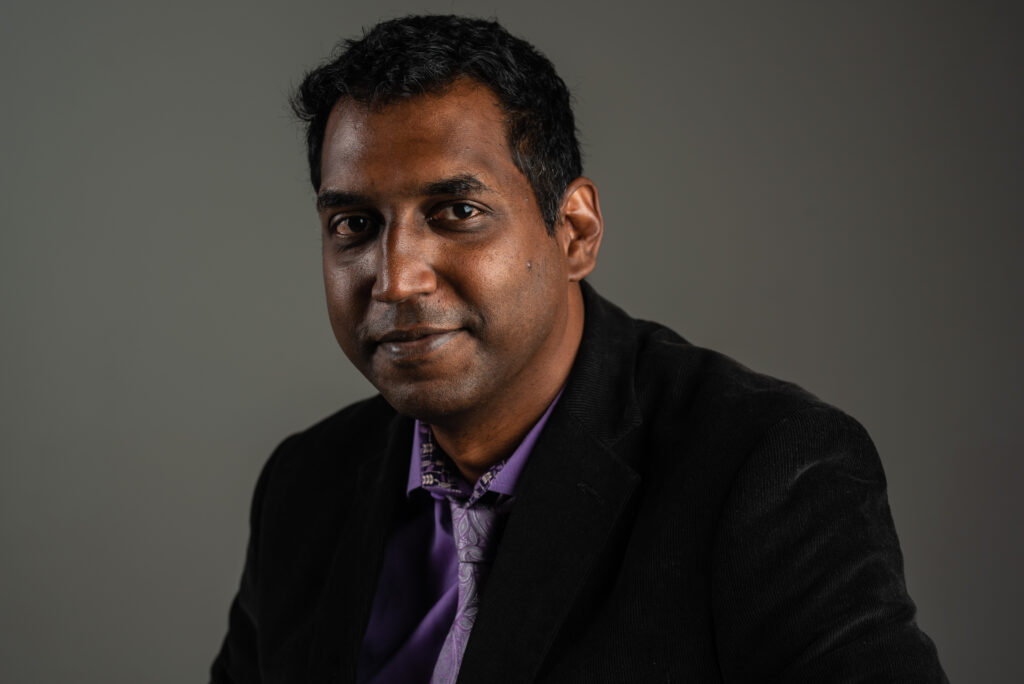
“I don’t hate you…” “…” “And God doesn’t hate you either… God loves you.” “Thank you???” Professor Josh Swamidass had to reassure his intellectual opponent, Professor James Binkoski, that it was all love in the heated (yet structured and cordial) debate last Thursday night in Collis. The point of interest: Does science leave room for God? Prof. Swamidass, an Evangelical with a strong scientific background in biological AI models, argued in favor. Prof. Swamidass argues that science cannot explain what matters most in life, citing examples: “[science does not explain] who to marry, who is right, [or if] my wife loves me back.” He argues that religion, specifically Christianity, offers explanations that people care about. “Science is so narrow, and that’s where religion can explain what matters – the rest.”
Prof. Binkoski, a Roman-Catholic-Atheist-Episcopalian (yes… my reaction exactly), had a more scientific approach to the point of interest. He wants to “treat religion as a hypothesis” and evaluate it against evidence. He poses a three-parameter “equation”: Religion + Science = Conflict. Specifically, he wants to evaluate what religion says, what science says, and what that conflict means. In most cases, religion and science do not conflict because religion focuses on morals, whereas science focuses on facts. However, when religion “oversteps” its authority and makes scientific claims, then there is “logically incompatible conflict.” Specifically, science places “epistemic pressure” on religion and the word of God. Thus, science does not leave room for God because, within the gray areas of overlap between religion and science, science offers the more logically feasible explanations.
When asked to elaborate more, Prof. Binkoski mentioned three pressures: cosmological, biological, and anthropological. The sheer size of the universe is too big and too old for “God’s greatest creation to appear only 3.5 billion years ago” out of a 14-billion-year-long universal life span in a nonsignificant space. Moreover, the flaws in human anatomy and “junk DNA from earlier species” are not compatible with humans being “God’s perfect design.” Finally, looking at the history of global religions, the plurality of religions suggests that the best-case scenario is that one religion among many actually represents the truth.
Admittedly, it’s a strong response, but Binkoski’s perspective on God was narrow, and Swamidass picked up on it. He responded that no one can jump straight from science to religion from pure evidence, even though the data presents itself in a certain way. His subjective experiences – specifically with Jesus – are what also need to be evaluated.
Similar points were brought up again when both were asked about positive and negative epistemic pressures. Binkoski mentioned that Christianity was an amalgamation of non-verified accounts and is therefore unable to give rational credence to the metaphysical aspects of Christianity. Swamidass retorted that there is “too small of an evidentiary basis of atheism to make sense.” Swamidass believes that studying science pushes one to see God – it is deeply powerful to understand man’s cosmic background, and this accentuates God’s teachings.
Charles D. Lankow:
Stepping back for a moment from this debate, one that has featured prominently in the collective consciousness of human civilization since the Enlightenment, I argue that the essence of the conflict is irreducibly irreconcilable. First, it is clear that religion encapsulates the part of our human nature that yearns for connection with something larger than ourselves. Thus, from an anthropological perspective, it is hard to see religion as not being merely a solution to the existential problem of human meaning and as a spiritual conduit for resonance with that larger Being. What’s more, the basis of this spirituality is fundamentally experiential in that it directly addresses a particular psychological predisposition of our species. Psychological states are internal to their subject, inaccessible from the outside, and thereby completely unmeasurable, unverifiable, and unrepeatable with precision. This wouldn’t be a problem if it weren’t for the fact that science, by its very definition, deals with that which is external [empirical, accessible, measurable, verifiable] and repeatable with precision.
Herein lies the irreconcilable conflict I mentioned above. Science is empirical and quantitative, while religion is experiential and qualitative. Some may recognize this dichotomy clearly in its other common forms, namely as the ‘mind-body problem’ or the ‘hard problem of consciousness,’ each of which approaches this same underlying tension from slightly different angles. That tension is the conundrum of explaining and unifying two vastly, almost impossibly disparate, realms of existence: the physical world of deterministic material transformations and the mental world of thoughts, feelings, memories, and imagination.
The greatest minds in all of human history have grappled with this tension for as long as they have inhabited this rocky “Blue Marble” we call Earth, and yet we seem no closer today to a genuinely satisfying and consensus-garnering explanation than we were hundreds of years ago. That is not to say that strides have not been made towards a scientific unification, as Darwin’s evolutionary theory attempts to do, but simply that no scientific explanation will ever succeed in satisfying the existential need that is fulfilled by religion. As a testament to this fact, we need look no further than the views of such paragons of the scientific enterprise as those present at the birth of quantum physics. These scientists stretched rationality itself to its limit, leading them to a frontier at the smallest scales of reality which seemed to defy their expectations in every conceivably possible way. In lieu of concluding with answers, I leave you with a quote from Max Planck—one of the aforementioned founders of quantum theory—for whom God represented a kind of inevitability: “Both religion and science need for their activities the belief in God, and moreover God stands for the former in the beginning, and for the latter at the end of the whole thinking. For the former, God represents the basis, for the latter, the crown of any reasoning concerning the worldview.”

Be the first to comment on "Review Reviews: Veritas Forum on God and Science"