
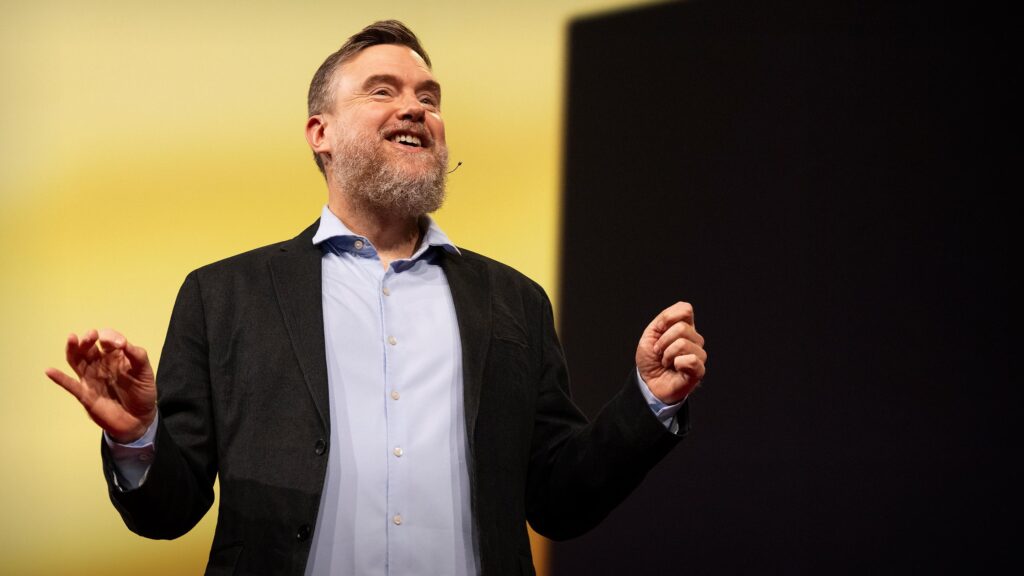
On Thursday, May 21, Greg Lukianoff, president of the Foundation for Individual Rights and Expression (FIRE), wrapped up his visit to Dartmouth with a public forum in the Hayward Room of the Hanover Inn. With opening remarks from Professor Sean Westwood, the Q&A was initially moderated by Professors Jonathan Smolin and Ezzedine Fishere, before microphones were passed around to the audience for a community Q&A.
Greg Lukianoff is known for his wide-reaching books The Coddling of the American Mind and its follow-up, The Canceling of the American Mind. His career defending free speech, particularly on college campuses, started at the American Civil Liberties Union (ACLU). Professor Westwood’s introduction started with a brief history of the relevance of the ACLU, from their prominent defense of the free speech of Nazi demonstrators in Skokie, Illinois, in 1977, through to their updated guidelines after the 2017 Charlottesville Rally to curtail their defense of controversial speech. As a result, FIRE, Westwood concluded, is now a considerably more relevant organization for the defense of free speech than the ACLU.
FIRE is known for publishing an annual report on free speech on college campuses. In the 2026 report, Dartmouth College was the most improved, rising 189 spots from our 2024 standing. This improvement is largely due to Dartmouth’s new policy of Institutional Restraint, and the improved diversity of speakers brought in by the Dartmouth Political Union and other campus groups. While President Beilock’s efforts have not gone unnoticed, there is still much room for improvement; Dartmouth’s improved ranking is still only a D+. The highlighted issues stem from biases in the classroom, which lead to self-censorship and disruptive conduct outside the classroom. Recently, we’ve seen students with megaphones shout down attendees of an invited speaker’s talk, yelling “shame on you” while shamefully hiding behind facial masks. This level of aggression, along with many other “micro-aggressions,” continues to add to a culture that, while improving, still does not embrace freedom of speech. Student groups have been the dominant source of fighting polarization on campus, notably this publication and Dartmouth’s chapter of BridgeUSA.
The questions posed to Lukianoff were largely aimed at specifying just how bad the issues of polarization and censorship are on college campuses, and what can be done about them. One attendee pointed out that 97–99% of political donations from Dartmouth employees go to supporting Democratic candidates, a statistic that should give pause to anyone skeptical of the degree of political polarization on campus. While not explicitly mentioned in the talk, a large contributor to this discrepancy in political funding from college staff comes from the fact that the administrator-to-teacher ratio at Dartmouth has roughly doubled since a few decades, due to increasing compliance requirements from increasingly complex federal regulations. Unsurprisingly, beneficiaries of government largesse will fund the party that most perpetuates increased government spending!
A particularly interesting exchange occurred when a student asked Lukianoff whether the perceived bias and polarization among faculty are as bad as they seem, or whether self-reporting metrics tend to underrepresent conservative members due to self-censorship. Lukianoff’s response was that the best metric was this political donation statistic mentioned earlier by another attendee, and that, interestingly, the percentage of Republican donations even drops to only about 0.7% among faculty members. Lukianoff supported political neutrality policies like Dartmouth’s institutional restraint and the University of Chicago’s Kalven Report, which aim to end practices like egregious instances of professors having their names signed to political statements via a departmental majority vote.
This question was followed up by another student question, and one that is often repeated: assuming that liberal individuals make up the vast majority of faculty members, might it not be fair to conclude that this is merely a correlation between intellect and liberal politics? Lukianoff’s response was one that is necessary but not considered often enough. He highlighted the distinction between liberalism and left-wing politics in modern America, noting that present-day factions of the Democratic Party, like the Democratic Socialists and the flat-out Marxists, are highly illiberal by any fair use of the word. While classical liberals tend to score higher on IQ, this ideology aligns more closely with what is commonly called conservatism in America (particularly Reagan’s flavor of conservatism). Lukianoff summarized this very well with a comical parody of his father’s remark after immigrating to America in the 1950s: “Why are the Marxists calling themselves liberals?” Only in America can the party that aims to subjugate the freedoms of the individual to the will of the masses also enjoy the façade of liberalism.
The community at Dartmouth and in Hanover seemed to appreciate the wisdom Greg Lukianoff brought to campus, and we are especially glad that the college continues to bring strong First Amendment defenders like him to campus. While Dartmouth still has a long way to go towards fully supporting free speech and viewpoint diversity on campus, there have been great strides in the right direction in recent years.
Be the first to comment on "A More Perfect Union at Dartmouth"