
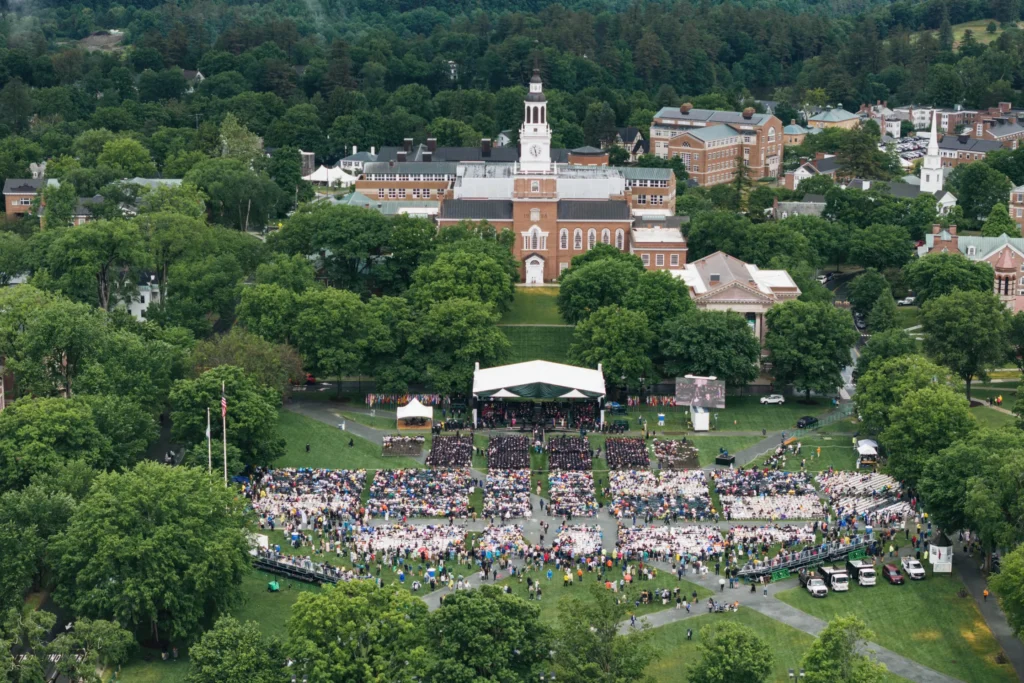
At long last, the end of the school year has arrived. It brings to us the all-too-common difficulty of saying goodbye to those who are walking across the Commencement stage and moving into the “real world.” The tone on campus is typical of that of late spring: jubilant and optimistic, with a healthy dose of apprehension. The question at hand for us all is, “How do we navigate this change in landscape?” The impending arrival of the Class of 2030 on campus is a sentence which still feels surreal to type out. But the more palpable shift shifts is happening on the other side of the college expeirence: The ‘26s are navigating an entrance into a world that seems more uncertain than ever for college graduates. Meanwhile, the ‘27s, a class whose gratitude towards the ‘26s knows no bounds, are themselves coming to grips with the loss of those who have thus far guided them.
The transition between junior and senior year is palpable. For the entirety of one’s first three years at Dartmouth, those above us in class year have acted as mentors, guides, and beacons of knowledge about this place. It is almost surreal the way in which the constant comfort of having such people in our lives dissipates with the graduation of the next class. All of a sudden, there is no one to look to, no person to ask about how “this or that” works at Dartmouth, no people to look to for guidance during the most turbulent moments. That role now falls upon the rising seniors, who have a responsibility to pay it forward, fulfilling that role for those who look up to us now.
If there is one piece of advice that I would give, as someone who has moved from school to school often enough growing up, it is that the necessity for closure with those who are about to leave us is essential. It is all too easy, especially during this soul-crushing finals season, to get swept up in our responsibilities and miss out on a proper goodbye with the people who deserve it most. I myself have let this happen, regrettably missing the chance to bid farewell to ‘24s and ‘25s, whom I owe everything to. There is no obligation worth missing out on this for. Not all of us have the time to attend commencement, so making time for such goodbyes is essential. Don’t let an “Irish Goodbye” define the final moments of time you spend on campus with those who have made you who you are. Despite the commonalities in the color scheme, saying goodbye to those on the Green should never be done without a personal moment of face-to-face closure. A text message is not enough; if you can help it, make time for a proper farewell.
It is in this spirit that I’d like to thank the members of The Review who are about to leave the College for whatever comes next. They, of whom there are many, are about to leave the Masthead, leaving us all the emptier. They have all placed this paper in a better position than any of us could have asked for. I will reiterate the sentiment in my first editorial, that my foremost goal will be for someone to feel that I have given to them the same as my own mentors have given to me. We are nothing without our mentors, and we are worthy of their guidance by virtue of our repayment of such to those who follow us.
It is my utmost hope that the people of Dartmouth who enter the workforce, however fraught and uncertain it may seem at this moment in time, will remember to never forget the ties which they have forged at Dartmouth. No matter where you go, there is a chunk of the Dartmouth community never too far away, one which, more than any other place, can be your beacon of support as this new chapter of life begins.
Go forth and conquer. We’re all in the home stretch now. Make time for the Lou’s challenge, finish your exams strong, and say your farewells. And to the ‘26s in particular, thank you for everything. The campus will be emptier with your departure.
Safe travels to everybody. We’ll see you back on campus when the leaves change color.
Be the first to comment on "Farewell Big Green, not Irish Goodbye"