
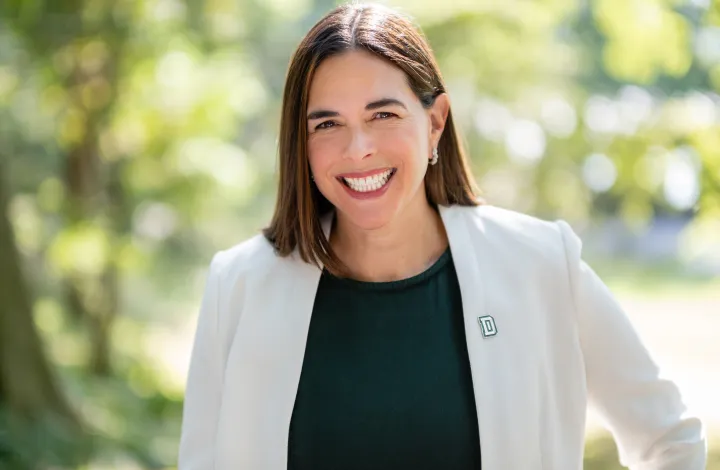
The email from Dartmouth Alumni Relations arrived, with all of the fanfare of a scheduling notice: “We can’t wait to see you in New York City!” President Beilock would be making a stop in the Empire State as part of her “On the Road” tour. The format of these events—intimate, conversational, dialogic—is meant to distinguish the exercise from a standard intellectual address. Whether it succeeded in that distinction depends on your tolerance for the word “dialogue” used as both noun and verb in the same sentence. As a young alumna, I am always eager to attend Dartmouth-sponsored events in the city, and the promise of Beilock’s presence added to my excitement.
Beilock has gathered with alumni in Miami, San Francisco, and Chicago to host discussions with alumni, faculty, and students. The topic of the discussions shifts depending on which city she’s in, though every address is broadly about “innovation.” New York City was a particularly momentous stop. New York is the largest Dartmouth alumni hub in the world, though one must assume this definition of New York City is inclusive of Westchester, Greenwich, and Northern New Jersey. The space itself, the ballroom of the Cipriani Wall Street, was washed in green, and swarming with alumni of all years. Whether such an ornate setting was the right place to reminisce upon our rural New Hampshire alma mater was a question I found myself turning over, but the sincerity of the attendees’ smiles and the “Dartmouth” embossed napkins reminded me not all change is inherently negative.
Once all were seated, President Beilock took to the stage to deliver an update on life at the College. April was snowy; May will likely be rainy. They are still on the path to adding 1,000 new beds for students, with Shonda Rhimes Hall and the West Wheelock expansion program leading the charge. While we might be number thirteen in U.S. News and World Report rankings, we’re rapidly moving up and eyeing our rightful place among the top 10. Beilock offered the audience five of the most notable ways in which Dartmouth is currently leading.
Mental health is a top concern and area for growth at Dartmouth. A student-led mental health initiative called Evergreen aims to use AI to better support the needs of students. Second, Dartmouth is leading amongst peers in carbon emissions reduction, and this effort is bolstered by the research of the ever-shiny Irving Institute. Her third point addressed the newly remodeled career design department. Once a basement office for first-years needing advice on the distinctions between consulting and investment banking, the Center for Career Design is now open to current students and alumni alike. The Center offers a Career and Life Design Immersion program, where students can explore the opportunities that await them outside of the typical corporate track.
Beilock touted the College’s innovation at large, whether it be in Arctic Studies or rural health, we’re uniquely equipped, she said, to advance global understanding in some of the more unchartered academic areas of study. Additionally, dialogue, and her administration’s commitment to dialogue, remains one of the ways in which Dartmouth is besting any other university. Dartmouth experienced the largest positive change in our FIRE College Free Speech Ranking. According to Beilock, students report that “commitment to freedom of expression and dialogue is why they chose Dartmouth.”
None of the reasons Beilock presented come as a surprise. Perhaps the spirit of the College and the Beilock administration’s endless “innovations” are still fresh in my mind since departing Hanover last June. Perhaps I spent four years involved with The Review, and any movement in the “dialogue” space was particularly important to this organization. However, in discussing innovation and artificial intelligence, Beilock noted that students are using AI in their Writing 5 courses to “help them write.”
The room paused. Hundreds of attendees leaned forward in their seats. What? his remark was quickly brushed over, and the evening shifted to question-and-answer. In response to what, exactly, is the use of AI in Writing 5 classrooms, Beilock stated that the implementation of AI in the classroom is currently at the discretion of the professor. This implementation can look like using AI to research (a web search, in the modern era, was deemed too much work), draft an outline, or write a “competing” version of their paper to prove why writing it yourself remains the superior option. Sure. Of course.
Indeed, the reality of AI interference in everyday tasks has become inevitable. But the question it raises for an institution like Dartmouth is not a small one. The liberal arts education has always staked its value on something particular—not merely the transmission of information, but the development of a student’s mind. The ability to think for oneself, to sit with ambiguity and argument and emerge with newfound understanding, is not the byproduct of a Dartmouth education. It is the point of one. That what has always made Dartmouth worth arguing about—worth, frankly, defending—is something quieter and harder to quantify than whatever comes next. I left hoping that someone in the room, or at least, at Parkhurst, was asking that question seriously.
Be the first to comment on "President Beilock on the Road: A Young Alumna’s Thoughts"