
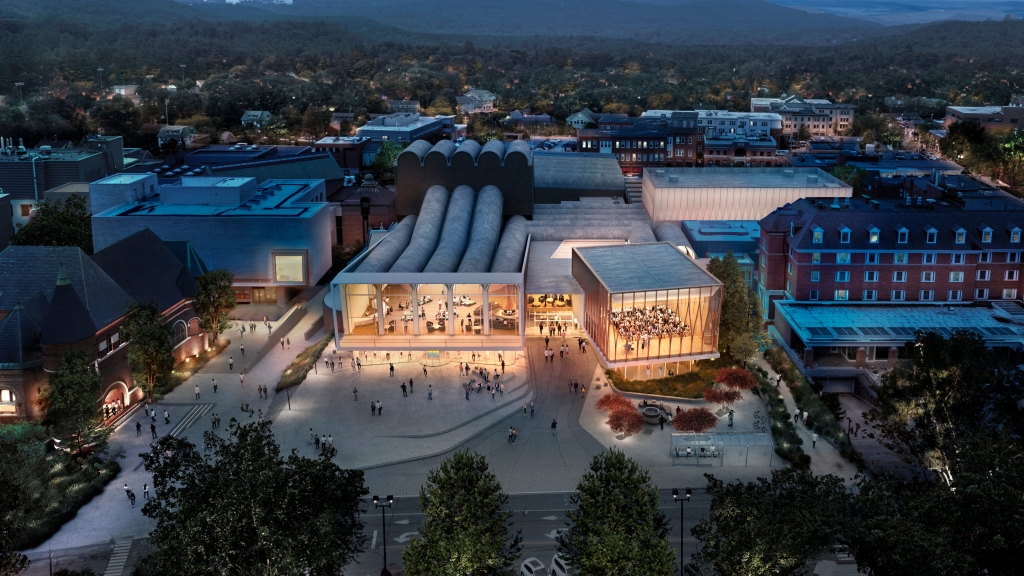
After a two-year hiatus from being fully open that some students described as “spiritually clarifying,” Dartmouth has finally reopened the Hopkins Center for the Arts with an opening weekend full of grandeur, stage lighting, and a distinct sense that most events were for someone else: the donors and alums. Administrators heralded the moment as “a new era of connection, creativity, and sustainably sourced light fixtures,” a phrase that has already been nominated for several LEED certifications.
The Hopkins Center, which originally opened in 1962, has now been recreated and reimagined for the 21st century (about time), featuring shinier glass, more adjectives, and fewer excuses to skip your friend’s dance recital.
The weekend’s festivities featured a constellation of celebrity alumni, including the immensely talented Mindy Kaling ’01, the queen of television herself Shonda Rhimes ’91, and of course Jake Tapper ’91, whose journalistic integrity (unless you count the whole Jake Tapper Biden book thing) survived several elections and Dartmouth dining. The trio made appearances in panels described by organizers as “intimate conversations,” though the intimacy was somewhat undercut by a few hundred iPhones and an official Dartmouth backdrop. Kaling, however, stopped by Courtyard Café to take photos and meet students, single-handedly revitalizing the value of the chicken tender queso.
Most student interactions consisted of waving from fifteen feet away while administrators probably whispered, “Be natural.” As one attendee summarized, “It was inspiring to see that if you get famous enough, they’ll actually let you into the Hop for something other than a dance recital.”
“The new Hop puts the arts at the core of the Dartmouth experience,” declared Executive Director Mary Lou Aleskie, likely gesturing toward a very expensive ceiling to illustrate the concept of “upward.” “It’s a versatile place for collaboration that meets the inspiring need for student experiences in the arts.” Sources confirmed that no one present could define what that meant, but it sounded important.
Visitors to the “expanded and reimagined” building are greeted by The Forum, a “central convening space” designed to “invite openness”—or, as one sophomore in Phi Delt put it, “a hallway, but fancy.” The Forum features seating specially engineered to communicate, “I appreciate modern design, but not for too long.” The seating arrangement seems to be geared toward someone around 3.5 feet tall.
The weekend also included the dedication of the Daryl and Steven Roth Wing, notably without the participation of actual Dartmouth students, which now houses a recital hall, a theater, and Dartmouth’s first-ever room for people who dance on purpose (those random dance-group folk). Attendees were encouraged to explore the synergy of movement and architecture, though most preferred the synergy of free mediocre catering that ran out a quarter of the way through the event and conversation about how parking used to be easier.
College officials emphasized that the new design “connects the Hop to the natural beauty of the Upper Valley,” largely through windows. “We wanted to bring the outside in,” said one architect, “because nobody was going outside.” Another consultant added that the project “celebrates permeability,” which appears to be what rich people now call having more doors.
Sustainability also played a key role in the renovation. The project reused existing materials, reduced carbon emissions, and recycled at least three mission statements from the Admissions Office. Or as one senior put it, everything looks kind of the same. We at The Review are proud to say the new Hop emits 20 percent less self-importance per square foot, allegedly.
“The energy in the new Hop is fantastic,” said another arts administrator, adding that students are already “forging connections” and “inspiring us all.” During a few press walkarounds, a group of first-years was seen inspiring the community by sitting silently on the new couches and pretending to read scripts for a photo op, thus closing the artistic feedback loop.
The Hopkins Center now promises to “anchor an inviting Arts District” at the heart of campus—a bold initiative ensuring that, for the first time in years, art majors once again have somewhere to exist visibly. As the last of the ribbon-cuttings concluded and the last cheese tray was whisked away, one could feel it in the air: a renewed commitment to the arts, to community, and to making sure that every creative impulse at Dartmouth passes through at least one donor-funded atrium.
It was, in the most true Dartmouth fashion, a victory of presentation over participation. Administrators spoke of collaboration while students watched from the mezzanine amidst a heavily donor crowd; the arts were said to be “recentered” precisely where no one who actually goes here could reach them. Yet for all the platitudes, the night succeeded in proving at least one eternal truth: at Dartmouth, art imitates fundraising far more faithfully than real life.
Be the first to comment on "Hopkins Center Reopens, Promises Art Will Be Fun This Time"