
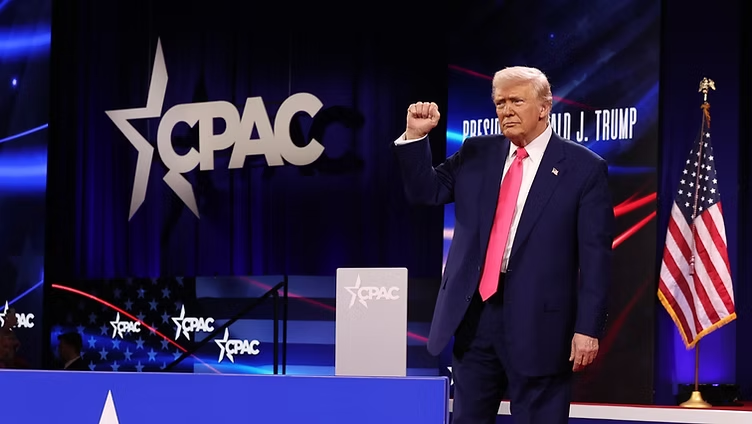
As part of an experiential learning opportunity through the Government Department’s Rockefeller Republicans course, a group of students traveled to CPAC, Conservative Political Action Conference, in Dallas, Texas, during the final week of Spring break. CPAC is an annual gathering of influential leaders, politicians, activists, and conservative organizations that spans four days. Although I was not formally enrolled in the course, I joined the trip and found it to be an illuminating and at times perplexing experience.
The first lesson of CPAC: American conservatism, it seems, has discovered the marketplace, and the marketplace has discovered it. Sequined MAGA jackets competed for shelf space with pamphlets on constitutional originalism. As I made my way toward the Interfaith Summit, I surveyed the scene. A carnival game filled one corner, interview stations were scattered throughout the hall, and vendors of every description rivaled for attention. The distinction between convention and carnival has grown decidedly blurry. My observations were interrupted by a preacher at the podium who blended religious proclamation with pointed political commentary. The result felt like a revival meeting that had been repurposed for electoral messaging.
This blending of faith and politics continued throughout the conference. Major speakers framed their remarks through Judeo-Christian values. Texas Governor Greg Abbott emphasized what he described as the moral responsibility of state leadership. Senator Rick Scott grounded his policy priorities in what he called the nation’s foundational religious heritage. These speeches reflected one of CPAC’s strengths. When the conference focused on the moral and philosophical roots of conservatism, it offered a coherent worldview rather than a collection of talking points.
The tone shifted when the conversation turned to immigration. The ongoing conflicts abroad, from the wars in Ukraine to those in the Middle East, shaped the mood of the conference in ways that were impossible to ignore. Speakers invoked these crises frequently. At their best, they used global events to underscore the seriousness of the moment and the need for thoughtful leadership. At other times, the references felt more like rhetorical accelerants than substantive analysis.
The presence of former British Prime Minister Liz Truss and former Polish Prime Minister Mateusz Morawiecki added an international dimension that is not typically associated with CPAC. Their speeches highlighted how immigration has become a global conservative concern. Yet their arguments raised questions that were left unexplored. Truss called for a more “Trump-like” movement in Britain, but did not address the reality that Britain’s parliamentary system and political culture differ significantly from those of the United States. Morawiecki warned about European border failures, but his remarks would have benefited from a deeper discussion of which lessons are actually applicable to the American context. These moments revealed a shortcoming of the conference. CPAC excelled at identifying the challenges facing the conservative movement, but it did not always take the next step of examining those challenges with the rigor they deserve.
A more troubling theme emerged in the discourse surrounding Islam. Attendees carried signs that read “Do not Sharia My Texas” and “Do not Sharia My Dog,” along with many variations of the same message. One might observe that a movement genuinely confident in its ideas rarely needs to traffic in signs about Sharia law befalling household pets. The gap between those two interpretations is rather the entire question. One might also fairly ask whether such slogans reflected genuine concern or merely channeled inchoate anxiety into manageable targets. This is another situation where CPAC fell short. Slogans that energize a convention hall do not necessarily persuade undecided voters. Americans consistently rank the economy, healthcare, and border security with real policy solutions far above hypothetical threats to their pets. A movement that wants to lead must be willing to distinguish between emotional release and political strategy.
Despite these shortcomings, CPAC demonstrated real strengths. It brought together a wide range of conservative voices and created opportunities for students and activists to engage directly with leaders who shape national policy. It offered a space for networking, for intellectual exchange, and for genuine reflection on the direction of the party. The conference succeeded when it focused on ideas, on the moral foundations of conservatism, and on the global challenges that demand serious leadership.
Yet, the event also revealed the tension within the party. Nearly every speech ended with some variation of Make America Great Again. The sentiment is unobjectionable. Everyone wants national greatness. The difficulty is that the phrase has shifted from an aspirational call to a marker of group identity. Enthusiasm is valuable, but enthusiasm without a clear governing vision is not enough. A movement that once prided itself on intellectual confidence and policy seriousness must decide whether it wants to return to that tradition or continue relying on spectacle that excites the base but does not broaden it.
This matters enormously as we approach the midterms, when control of Congress may well hang in the balance. A Republican Party that runs campaigns rooted in grievance and devoted primarily to bashing opponents is a party that squanders its opportunities. The conservative movement was once defined by its seriousness of purpose, that ideas, rigorously argued, could carry the day. That tradition demands better than rallying a base around manufactured outrage over issues already settled or fears that bear little resemblance to the challenges Americans actually face at their kitchen tables. Energy spent stoking anxiety over the mundane is energy diverted from the work of genuine governance. Rather than defining ourselves by what and whom we oppose, conservatives would do well to reclaim the intellectual confidence that once distinguished the movement uniting around an affirmative vision rooted in limited government, individual liberty, and institutional competence. One that articulates clearly how we intend to govern, and why the American people should trust us to do so. That is not nostalgia. That is the path back to a majority worthy of the name. Which is to say: there is a path to retain the majority, should the movement care to take it. But it will not be paved in slogans.
This trip to Dallas was instructive, though perhaps not in ways the organizers intended. I networked, questioned my assumptions, and reconnected with thoughtful Dartmouth alumni, all valuable. But the deeper takeaway was this: American conservatism currently finds itself in a peculiar bind. It possesses genuine intellectual resources and serious people. Yet it seems to have lost faith in them. Instead, it channels its energy into spectacle, slogans, and the mobilization of outrage. This is not, one should note, a sign of strength. A movement confident in its ideas does not need to shout over its intellectual foundations. CPAC was a useful reminder that the conservative movement’s real challenge is not external. It is the choice between what it could be and what it has chosen to become. That choice, ultimately, belongs to its members. One hopes that they choose wisely.
Be the first to comment on "The Rockefeller Republicans at CPAC"