
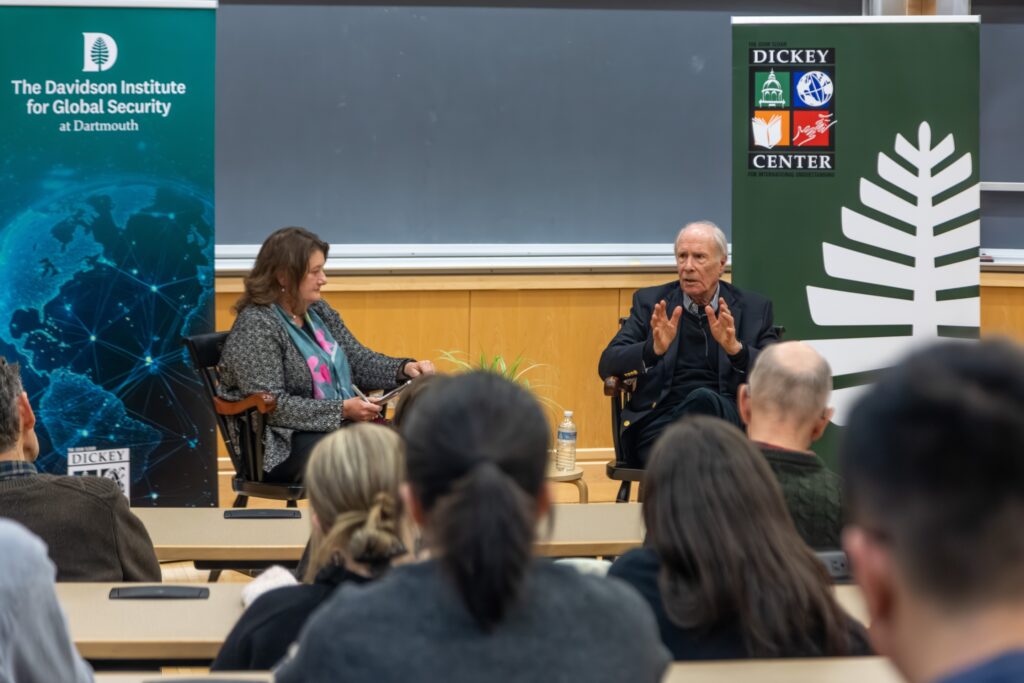
On January 10th, Ambassador Peter DeShazo ’69, visiting professor of Latin American Studies, spoke about the Trump Administration’s recent arrests of Venezuelan President Nicolás Maduro and his wife, and the implications for U.S. foreign policy and the world. I knew little about Prof. DeShazo before I heard him speak. I emerged from the discussion pleased, having learned something new about one of our good neighbors, and with new respect for another Dartmouth professor.
DeShazo opened his talk by mentioning the ambiguity of the Trump Administration’s intentions and explanations, making clear that the issue of drug trafficking, oil prices, and the relationship between the U.S. and Latin America factor into the equation.
Victoria Holt, the moderator for the discussion, pointed out early on that such an action by the Trump Administration is, while unprecedented, not entirely unexpected. The Trump Administration published a national security report in November, describing America’s priorities as, among other things, control of the southern border and ensuring that the hemisphere remains stable and cooperative with the United States. The report likewise calls for a reassertion of the Monroe Doctrine, a historic strategy calling for U.S. leadership in the Western Hemisphere. It is common to see media framing of the U.S. invasion positioning the Trump Administration as being in breach of its anti-war campaign promises; the Administration’s report defies such framing, asserting that the U.S.’s assertion of dominance in the Western Hemisphere is, indeed, vital to U.S. interests. Kudos to the Center for making note of this often-overlooked context for the U.S.’s actions.
The language used by the Trump Administration makes clear that Latin America is not perceived by the government as a foreign domain. Secretary Rubio’s foreign policy somewhat reframes the debate about “intervention” into an (arguably semantic) argument about spheres of influence. That framing does not, by itself, justify the policy, but makes it easier to see the Administration’s actions as part of a coherent train of logic. I found this framing useful; it is at least internally consistent. It makes the Administration’s choices legible in a way that mainstream media coverage often does not.
DeShazo gave a brief history of the historical relationship between the United States and Venezuela, including the cooperative arrangement that took place before the country’s descent into tyranny. Venezuela was once one of the world’s leading economies and was widely considered a legitimate democratic country. With an economy reliant on oil, the U.S. oil industry peaked at approximately 3.5 million barrels a day, then regressed, collapsing all the way to a few hundred barrels a day in 2021. Its government, meanwhile, suffers from extremely high levels of corruption. Elections appear to mean little: opposition candidates to DeShazo prevailed in the most recent general election, but no transfer of power ultimately took place. DeShazo went on to describe Venezuela’s economy as something that cannot be easily fixed, suggesting that it would take approximately 10 years for the country to reassert its oil regimen to the extent that it once did.
I acknowledge that Prof. DeShazo is not a professor in the economics department; however, I would have wanted DeShazo’s overview of Venezuela’s economy to include commentary on the vulnerability inherent to any state’s reliance on a single industry. Likewise, as someone who does not know much about Venezuelan politics, I would have been interested to hear about whether Maduro’s electoral opposition has framed their platform as merely the privatization of the oil markets again, or perhaps a wider diversification of the Venezuelan economy.
DeShazo continued that Hugo Chavez’s regime came into power in 1999, which was then succeeded by Maduro as part of the same regime. DeShazo described these events, as well as the re-nationalization of Venezuela’s oil industry, as the precipitating factor in the country’s economic collapse and the decline in relations between the U.S. and Venezuela. Notably, DeShazo veered away from more normative descriptions of Venezuela’s economy, not describing it as “socialist” in nature, but rather referring to the more vague idea of an authoritarian takeover of the Venezuelan government. Both descriptors align with the claim that the transformation of Venezuela into a command economy was the impetus for its decline in global economic prowess.
When asked about what the arrest of Maduro means for the country, DeShazo emphasized that the Trump Administration’s actions did not constitute regime change. He contrasted the U.S.’s actions in Venezuela with those in Panama in 1989. The new president of Venezuela, Delcy Rodriguez, formerly served as Vice President under Maduro, so the Maduro regime itself remains unchanged, even as the U.S. attempts to impose more stringent restrictions on Venezuelans’ actions under this new president. In Panama, conversely, the U.S. deposed the Noriega regime and installed a new democratically elected government. Although there have been elections held in Venezuela in recent years, the Trump Administration has made no indication that these parties will receive U.S. support for governance of the state.
DeShazo went on to emphasize the importance of promising U.S. relations with other countries in Latin America. Namely, he named Mexico’s relationship as the most important, highlighting the upcoming review of the USMCA trade agreement, scheduled to take place this summer. Regarding Cuba, DeShazo argued that the potential sanctioning of Venezuelan oil on Cuba will likely have an even greater detrimental effect on Cuba’s economy. As for Colombia, DeShazo pointed out that despite tension between the country and both the first and second Trump Administrations, a two-hour-long phone call between Trump and Colombian President Santos suggests a potentially cooperative arrangement as the U.S. attempts to rein in the Western Hemisphere.
DeShazo mentioned earlier in his talk that while the U.S. cited drug trafficking as a reason for Maduro’s arrest, Mexico and Colombia are the chief channels through which drugs flow into the United States, citing immensely recent high coca leaf production. Therefore, although Venezuela itself may not be the primary mechanism for drug supply to the U.S., increased U.S. cooperation with Venezuela may give us more leverage in negotiating with our neighbors.
DeShazo was thoughtful in framing the motives for the U.S. operation as a multifaceted decision, refusing to default to common narratives about the operation being a mere ploy for lower oil prices. Overall, I appreciated hearing a well-rounded and informative perspective on what is a developing situation. As opposed to knee-jerk opposition to the Trump Administration’s actions, DeShazo avoided making excessively normative claims, stated the facts as they stood right now, and suggested that we, with prudence, wait to see what happens. I, for one, do not expect an Iraq-esque scenario where the U.S. troops directly nation-build.
DeShazo is teaching a class on Latin American Policy and Development this term. To any government majors who still need a Non-Western credit: from what I saw from this one talk, this is a topic worth learning about, and this is a professor worth taking. Too bad this is going to print a few days after course election comes to an end. Alas, perhaps we can take it next year when we see what comes of this arrest.
Be the first to comment on "DeShazo on Venezuela "