
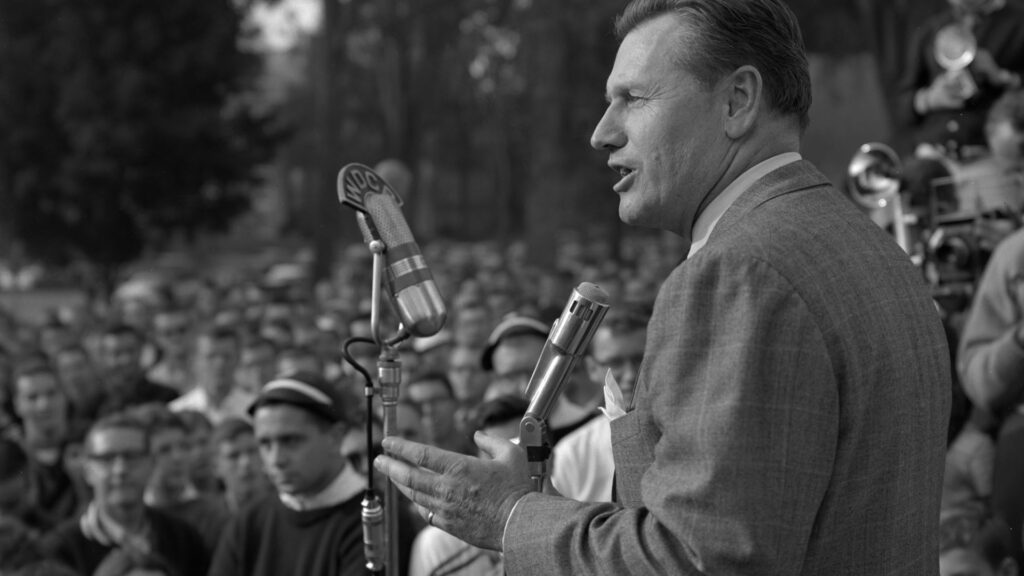
We are often blinded by what historian Richard Norton Smith calls the “civil view of progress,” a modern view that, because we possess more wealth and faster technology than we did fifty years ago, we are somehow more enlightened. In doing so, we implicitly hold our ancestors’ world against them. The biographer’s task, however, requires a specific leap of imagination to bridge this gap. As Norton Smith argues, we cannot accurately assess Nelson Rockefeller against the flattened party lines of the twenty-first century. One must instead trace the lineage backward to see him as the quintessential product of his time.
Norton Smith characterizes Rockefeller as a man who literally sat in the lap of history. As a child, he climbed onto the knee of Theodore Roosevelt, badgering the old Rough Rider for tales of African safaris. That inquisitive, relentless spirit defined his tenure. He was a vital tributary in a stream of political history that included both Roosevelts: TR, the liberal Republican, and Franklin, the transformative Democrat. Indeed, Nelson viewed FDR as his true “professor of government,” adopting a style that favored the friction of ideas over the comfort of consensus. He would famously assign the same problem to two or three different aides simultaneously. Norton Smith describes this method as a form of chaos, but it was a chaos Rockefeller loved because the most profound value emerged from a clash of perspectives.
To look at Rockefeller is to see an artist first and a politician second. While he did not paint, he possessed the “audacity and creativity” to treat the state of New York as his canvas. One need only look at the sheer scale of Albany to see this; only a man with an artist’s vision would have the audacity to set out to create the most monumental state capital in the country. He was, in essence, a frustrated architect. Where other state legislatures were content with undistinguished buildings for their universities, Rockefeller sought out world-class architects to design “cream of the crop” campuses. He believed that in the modern age, education was the primary necessity, and the sprawling SUNY system of today remains the physical evidence of his belief that the government must act as an instrument of progress.
This “Rockefeller Way” was defined by a public grandiosity paired with a deeply private philanthropy. While he was deeply close to the King family, he insisted on a policy of concealment. Norton Smith notes that in the late 1950s, when Dr. King was nearly assassinated via a stabbing at a bookstore in Harlem, it was Rockefeller who quietly settled the medical bills. This secret was kept for decades. Following King’s assassination, Rockefeller sent his advance team to plan the funeral, but his most defiant moment came from Atlanta. As he prepared to mourn, the Republican leader in Albany attempted to double-cross him on a key vote for the Urban Development Corporation. Rockefeller’s message from the funeral was as cold as it was effective: “You tell them until they fix this, there will be no jobs.” Within hours, the legislature reversed itself, the UDC was codified, and the seeds were sown for three new towns, including Roosevelt Island.
Norton Smith encourages all to reexamine the label “Rockefeller Republican.” Today, tens of millions of Americans still fit that description: socially liberal but fiscally responsible. He argues this only applies to the first half of the Rockefeller governorship. In the first half of his governorship, Rockefeller practiced a “pay-as-you-go” philosophy, showing the courage to raise taxes and submit balanced budgets because he believed in paying for the government you actually want. He refused to saddle future generations with the bill. It was only after 1966 that this shifted toward a reliance on bonds, a change that saw the bills eventually come due after he left office.
The hardest quality for any biographer to capture is charisma, yet in Rockefeller’s case, it was the undeniable engine of his career. It was a charisma that transcended his personal struggles; he didn’t even know the word “dyslexia” until he was fifty, yet he had the humility to surround himself with brilliant advisors who could fill the gaps. For fifteen years, he ruled New York not as a state, but as a nation-state, the financial, cultural, and media capital of the world.
Norton Smith observes that, by modern standards, Rockefeller stands to the left of Barack Obama, a testament to how far the American political center has drifted. He cites the Supreme Court as his test case, where almost every appointee has been further to the right than the person they replaced, such as Elena Kagan following John Paul Stevens. Since Ronald Reagan’s inaugural address, we have pigeonholed government as the problem rather than the solution. As Smith jokingly notes, while the government certainly gets much wrong, we have spent the last forty years lamenting the failures while forgetting what it looks like when the state does something right.
The Rockefeller era represents the high-water mark of a visionary, can-do Republicanism that viewed the state not as something to be starved, but as a canvas to be painted. As we look at our crumbling infrastructure and fractured consensus, this reviewer is left to wonder: who will be the next visionary with the audacity to build for the next century, or have we lost the Rockefeller scale of imagination entirely? Maybe we can finally get back to the politics of doing something.
Be the first to comment on "Artist of the Nation-State: Richard Norton Smith on Nelson Rockefeller"