
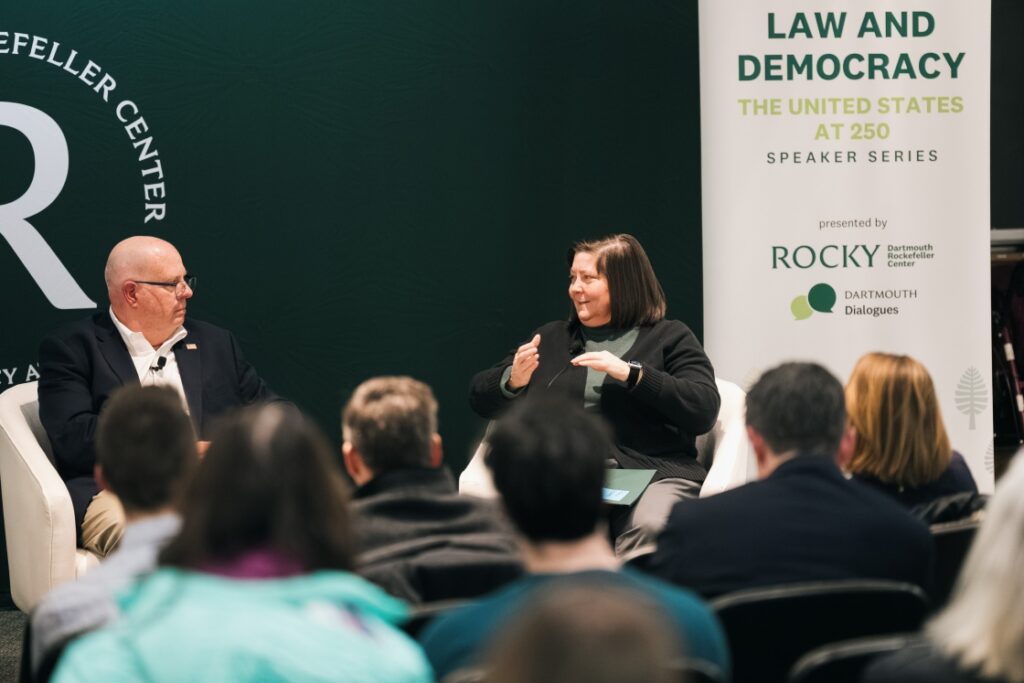
The former Governor of Maryland, Larry Hogan, came to Dartmouth on Jan. 28 with a resume that defied the era of polarizing politics: a Republican who won twice in one of the bluest states in the country, governed with a Democratic supermajority legislature, and left office with high approval ratings. The visit was a part of the Rockefeller Center’s “Law and Democracy: The United States at 250” series and made a strong critique of the way American politics currently functions.
Governor Hogan noted that current politics is filled with inflammatory and performative gestures before offering his eight-year tenure as governor as evidence that voters still support leaders who focus less on governing than on fanfare. He honed in on the idea that compromise is often now seen as a weakness but is in reality a necessity, especially in divided governments. “We tend to demonize the other side,” he said, claiming that the tendency to treat political disagreement as moral is damaging democratic institutions.
The theme of compromise and bipartisanship persists through most of the conversation. Hogan downplayed speculation about his political future, emphasizing that he does not want to be characterized as a career politician. Still, Governor Hogan made clear that he wants to be a leader in political discussions, especially around what he sees as the disruption of civic norms. He provided a unique look back at a governing model he believes is disappearing, and a critique of the figures that are pushing it out.
Hogan continued the theme of compromise as he described the government’s difficult decisions that carried real human costs. He rejected any strict partisan criticisms of government response. Rather than seeing public health and economic stability as a tradeoff, Hogan argued that effective leadership required holding both concerns at once. “I was trying to keep people alive and keep businesses alive,” he said, capturing his broader centrist governing philosophy.
Hogan claims the process is as important as the outcome. He spoke about relying on scientific expertise and coordinating with other governors and the federal government during the pandemic. He mediated between the states and Washington, often pushing back when federal messaging clashed with local realities.
Infrastructure provided another view of Hogan’s governing style. He saw state infrastructure as a tangible expression of state capacity. Poor infrastructure, he argued, erodes public trust in government. Hogan described bipartisan negotiations that helped move federal infrastructure legislation forward and defended partnerships with private enterprises as a response to fiscal constraints. Voters care less about who wins in online debates than about whether the government delivers visible results.
During the audience Q&A, when asked why his popularity as governor did not carry over into his 2024 Senate run, Hogan offered a blunt diagnosis of national politics. State executive elections allow voters to cross party lines and vote based on real results. Federal elections, by contrast, are battles over national party control, leaving little room for cross-party appeal. That distinction ran through much of the evening.
Hogan’s sharpest criticism was for political structures that reward hyperpartisanship. He poignantly called gerrymandering “a cancer on democracy,” and argued that safe districts and low-turnout primaries judge candidates based on party loyalty rather than reason. The result is a political class that is more accountable to the loyal party bases than the general electorate. He also endorsed term limits in Congress, portraying long-serving legislators who do not need to worry about competitive elections disconnected from everyday constituents.
What made Hogan’s appearance compelling was not novelty, as his arguments would have sounded familiar a decade ago, but timing. In 2026, calls for compromise in political discourse can feel almost contrarian. Campus political culture often favors moral clarity while national politics rewards outrage and spectacle. Hogan did not offer any unprecedented theories nor a revolutionary program. Instead, he made a quieter claim that democratic decay is driven less by bad people than by bad incentives. Those incentives can be changed by leaders willing to govern honestly and present clear results. Even in flawed systems where political polarities are favored, individual leaders can still gain agency. They can choose to listen, to negotiate, and to speak without civility.
For a series marking the nation’s approach to its 250th anniversary, Hogan’s visit fittingly presented it as work: tedious and often thankless work. Whether that model can prevail or survive the current political environment is an open question. Governor Hogan’s answer was that it will not survive by accident. It will survive only if voters and political leaders decide that governing is more important than winning the argument.
Be the first to comment on "Governor Hogan Visits Dartmouth"