
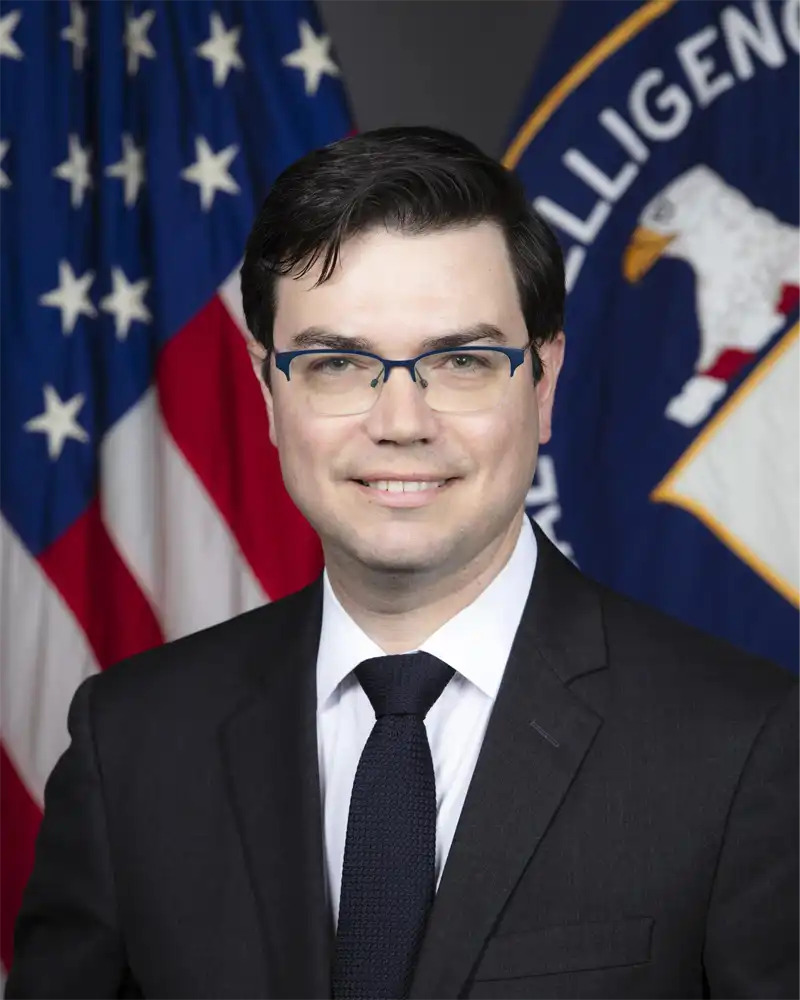
On Wednesday, October 14, 2026, The Review had the pleasure of sitting down with CIA Deputy Director Michael Ellis ‘06 during his visit back to Dartmouth’s campus. Deputy Director Ellis is no stranger to The Review, having served as Editor-in-Chief during his time at Dartmouth. The Review set Ellis up for an extraordinarily accomplished career, from serving as General Counsel at Rumble, to working as a campaign strategy official for Republican presidential candidates, to his intelligence work at the CIA. We began the interview by asking Ellis about his time at The Review and how it set him up for success moving forward.
Ellis began by providing a particularly thought-provoking memory from his time at The Review; Ellis poignantly described The Review’s coverage of Dartmouth’s Board of Trustees selection processes throughout the 2000s. Ellis recounted The Review’s advocacy of ultimately successful candidates such as T.J. Rodgers ‘70, Peter Robinson ‘79, and Todd Zywicki ‘88. Ellis describes The Review’s having advocated for these successful Trustee candidates, calling the Trustee selection processes the defining campus issue of his time at Dartmouth. Ellis emphasized that the most important takeaway from his time at The Review is that it taught the art of honing one’s writing ability and craft to an extent well beyond what is taught in classes. Ellis gave tribute to the work of the late Joseph Rago ‘05, one of The Review’s most eloquent writers, whose works have continued to inspire new members of The Review.
Ellis described his sense of Dartmouth’s current state of discourse and committment to its undergraduate students as notably improved since his time on campus 20 years ago, expressing support for President Beilock’s leadership. Ellis noted that support for Dartmouth’s actions has extended well beyond members of the campus community, even to Washington, D.C.; Ellis highlighted that the sentiment among certain members of the Trump Administration is that Dartmouth appears to be the only Ivy League university that is moving in the right direction on several fronts.
We would be remiss if we did not discuss the particulars of artificial intelligence and how it has factored into the work of the CIA. Ellis used President Trump’s preferred term of “Super Intelligence” (SI) while acknowledging the irony of using this new term on the campus on which the term “artificial intelligence” came to be. Ellis described SI as being essential in the CIA’s operations of information gathering and emphasized SI’s utility in recognizing insights and trends from massive quantities of data. Ellis further noted that SI has a pronounced role in cyber operations, both as something to safeguard against and to utilize to the greatest extent.
When asked about potential misunderstandings that young people might have about the CIA, Ellis noted that the clandestine nature of the CIA’s work gives rise to the proliferation of incorrect information about the agency, and that it is vital to grapple with the CIA’s dual role of conducting classified intelligence operations while also being part of a government founded upon the need for accountability from the public. Ellis noted, however, that while the CIA has dealt with this public perception problem for the entirety of its existence, the agency remains acutley constrained by all three branches of government.
Regarding Ellis’s role at the CIA and the accomplishments of the agency of which he is most proud, Ellis emphasized that he and CIA Director John Ratcliffe had the goal of “reinvigorating” the agency by heightening its ability to aid the President’s foreign policy objectives, emphasizing this as a keystone goal of the agency under the President whom it serves. Ellis named numerous accomplishments that he is proud of, including the effectiveness of intelligence gathering regarding advanced technology and China. Ellis highlighted Operations Midnight Hammer and Absolute Resolve, as well as the Dude-44 Bravo rescue, as military operations in which the CIA’s work was integral to the military’s successes. Despite all of the recent successes that are attributable to the agency’s work, Ellis emphasized that there remain many places to grow, particularly with regard to economic and technological prowess amid the rise of China. Ellis described the threat of China as particularly different from any other. The Soviet Union, for example, was described in contrast with China as a scenario in which the threat and role of sophisticated non-military technology, such as quantum, SI, and biotechnology, were far less decisive factors in the past than they are today. In short, The relatively new importance of these factors has resulted in an increased emphasis by the CIA on the accumulation of more scientific and technological expertise within the agency. Ellis concluded by highlighting advancements in partnerships with the private sector as being essential to the CIA’s future work.
Regarding career advice for those aiming to enter intelligence work themselves, Ellis emphasized that the value of a liberal arts education is more vital than ever. Ellis rejected the idea that SI has at all diminished the importance of learning. As broad advice, Ellis emphasized the necessity of retaining good relations with your peers and always putting your best foot forward with your colleagues, the people with whom you will grow professionally.
Perhaps most noteworthy was Ellis’ specific advice to conservative students at Dartmouth: Ellis acknowledged that many conservatives gravitate towards the idea of separating themselves from mainstream institutions that are not hospitable to conservative voices. Ellis disagrees with this sentiment, arguing that there is a lot of merit in attempts to change institutions like Dartmouth from within to the extent possible. The most important thing that the right-leaning student on campus can do to ensure the future legitimacy of their views is to be the voice that stimulates discourse. Doing so, Ellis argues, is the essential to ensuring a fruitful and productive environment at institutions such as Dartmouth.
In almost every way, Deputy Director Ellis is the embodiment of the best of The Review. At The Review, he found the opportunity to be a voice of dissent in an environment in which he and his compatriots were vastly outnumbered. In so doing, Ellis was able to harness his abilities and claim his place as one of the most impressive and accomplished alumni that the College has ever produced. He describes the skills he developed at The Review as paramount. We take Mr. Ellis at his word.

Be the first to comment on "Interview: CIA Deputy Director Michael Ellis"