
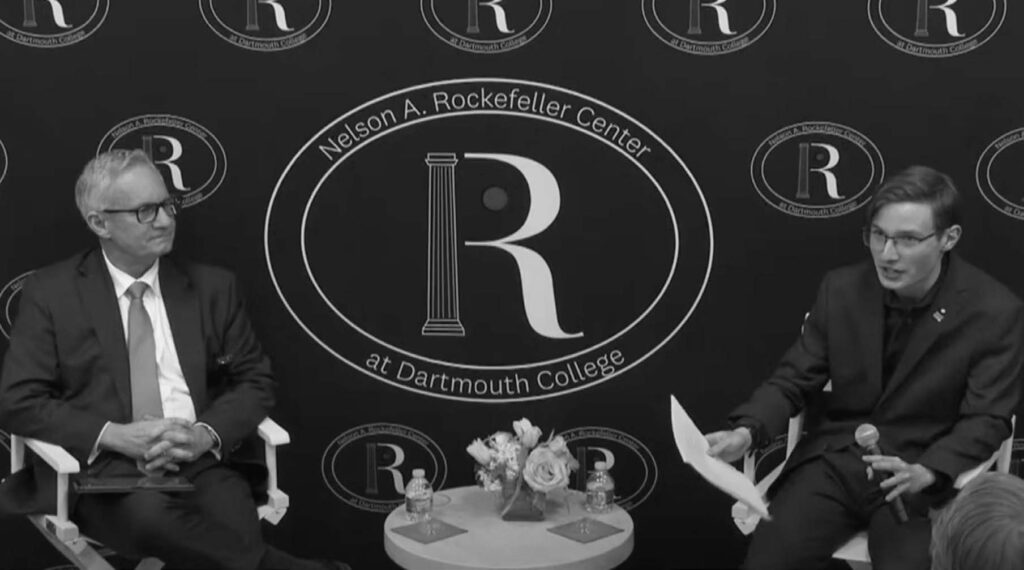
For anyone following international stock markets in recent weeks, the pressing question of the moment is: Why are markets responding in the way they are, especially throughout the European Union and Canada? On Thursday, April 10, former Canadian Minister for International Trade Ed Fast visited Dartmouth to discuss international trade dynamics in the Trump era. The event, which was jointly hosted by the Dartmouth Conservatives, Dartmouth Federalist Society, and the Rockefeller Center, offered candid insights on the disrupted international trade landscape and the particular challenges facing Canada in the wake of recent U.S. tariffs.
A prominent figure in North American trade policy, Mr. Fast has served as a member of the Canadian Parliament since 2006. He was Minister for International Trade and Minister for the Asia-Pacific Gateway under Prime Minister Stephen Harper from 2011 to 2015. Often described as holding “arguably the most traveled position in the Canadian government,” Fast oversaw critical free trade negotiations during his tenure, including Canada’s involvement in the Trans-Pacific Partnership (TPP).
Fast framed the current trade tensions not merely as an economic dispute but as a fundamental breach of trust. “Once trust is lost, it is hard to regain,” he emphasized, quoting former U.K. Prime Minister Harold Macmillan that “events derail governments.” Case in point: domestic Canadian politics, with the recent Canadian election having been thrown into complete disarray. The top issue ceased to center on the rising cost of living, and shifted to “how to respond to Trump.”
Fast suggested that recent U.S. tariffs have permanently altered the U.S.-Canada relationship. His claims are backed by popular media: recent polls and reports have shown that attitudes among people both in Canada and the U.S. are shifting, with both countries increasingly holding hostile opinions of the other. Fast, however, remains optimistic and believes much of the relationship remains salvageable. Some U.S. positions have merit, he admitted. For example, Canada must address its shortcomings in NATO defense spending to build credibility, an issue which should have been done years ago, he maintained.
To address the current challenges, Fast outlined an action plan for Canada. First, he highlighted that Canada remains the second-largest trading partner of the United States, just slightly behind Mexico. For many U.S. states, Canada remains the top export destination. Canada must accept that, despite its challenges, the U.S. will remain Canada’s number one partner due to numerous interconnecting factors. At the same time, the country must simultaneously undertake an honest reckoning of its own economic future through internal reforms on resources, taxes, and other issues.
Fast cautioned Canadian decision-makers to be deliberate in their responses, noting that both countries suffer when tariffs are imposed. Any response must remain measured and strategic, only targeting specific areas and staying oriented toward long-term negotiation. But most importantly, Canada must prepare comprehensively for the impending United States-Mexico-Canada Agreement (USMCA) review, which Fast believes cannot be approached passively.
Fast also addressed the fundamental question surrounding tariffs: Do they truly lead to economic security and prosperity, or are they ultimately shortsighted? Drawing historical parallels, he referenced the Smoot-Hawley tariffs of the 1930s, which proved harmful by triggering retaliatory tariffs worldwide with particularly negative long-term consequences. While acknowledging that economic history has shown that this type of measure is not effective in the long run, Fast conceded that tariffs do serve a purpose as a surgical tool within an international rules-based system. As a general policy tool, however, tariffs are counterproductive.
When discussing the current 90-day tariff pause imposed by the U.S. just recently, he suggested the strategy appears designed to “keep trading partners off balance while seeking concessions,” and speculated that these disputes might be tactical positioning for the upcoming USMCA review. Despite these insights, Fast candidly admitted that “nobody knows Trump’s real objectives” in his broader tariff strategy.
As global alliances shift and trust erodes, Fast concluded that the liberal international order faces unprecedented tests on multiple fronts – from military conflicts in Ukraine to economic conflicts with China. The former MP expressed concern that the World Trade Organization, once the premier forum for establishing global trade rules, has lost much of its authority and credibility over the past decade. He noted that when China and other nations joined the WTO, they did so with the express understanding they would move toward open markets and comply with rules, yet many have become what he characterized as “scofflaws.”
There is a time where new entrants are given time to liberalize, and once these nations reach a certain level, they receive “market economy status.” Both Canada and the U.S. have opposed granting China this status in the past, a stance that, in retrospect, appears justified in light of how China operates today. Another key reason for the WTO’s loss in authority is the growing influence of BRICS nations, whose divergent agendas have often prevented a robust outcome on many of the WTO sessions. Compounding the issue further, the United States under President Trump withdrew from the Trans-Pacific Partnership (TPP) and effectively sidelined the organization. For Fast, moves like these signal a broader trend of American retrenchment that raises uncertainty for allies like Canada.
Lastly, Mr. Fast emphasized that an infrastructure that ensures contracts and treaties are honored will be essential to restoring stability to international trade. He believes that trade liberalization remains a net positive for all participants. But with the U.S. becoming less predictable, the question that many nations now pose is how they can prepare for a more volatile future. In the U.S.-Canada relationship, one potential remedy could be requiring approval from both the Canadian Parliament and U.S. Congress before making major changes to the USMCA. Such a mechanism, he argued, could help stabilize cross-border trade relations and ensure that agreements, once signed, are honored despite political shifts. The former minister argued that the U.S. should return to its global moral leadership role, stating that “an exceptional America is needed now more than ever.” Canada wants its best friend back.

Be the first to comment on "Trade in the Era of Trump: Canadian Ed Fast Visits Campus"