
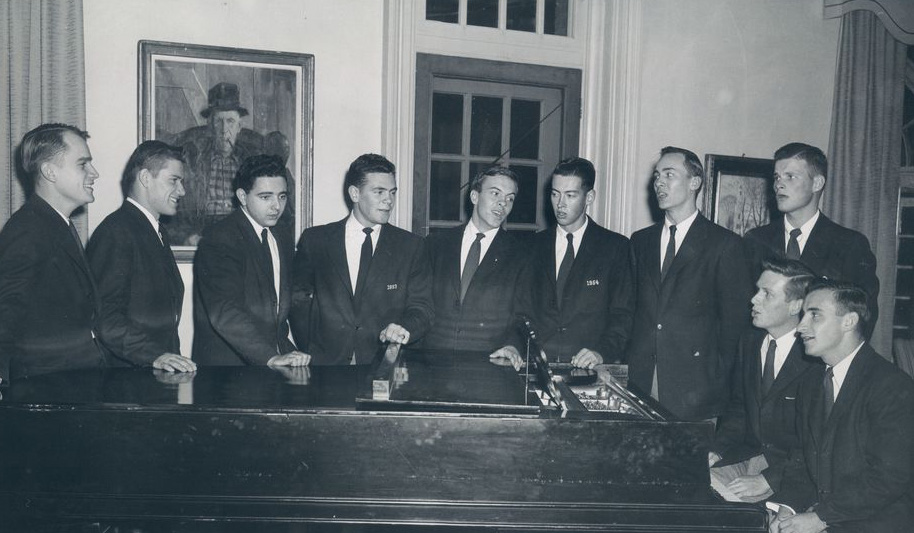
On the weekend before Green Key and its associated revelry filled the whole campus with music, the members of the Dartmouth Aires put on a show of their own on the steps of Dartmouth Hall. During this “Reunion Concert,” held on May 10, the ranks of the Aires were filled with scores of alumni whose respective educations at Dartmouth spanned various decades; each received the opportunity to spend time with his peers, to meet his successors, and to once again serenade his alma mater with songs endowed with personal significance due to his having performed them during his collegiate years. It is in equal parts a testament to the musical excellence of the Aires’ singers past and present and a testament to the efficiency of the group’s rehearsals that an ensemble of over 120 men could be prepared to sing beautifully and in unison in the space of only a few days: their crooning was as impressive as ever.
This concert was likely intended to emphasize our oldest a capella group’s status as an enduring, unique, and valuable Dartmouth institution. The choice to highlight and showcase members from previous classes emphasizes a spirit of continuity and situates the current members in the context of a proud tradition of music within the Aires specifically and at Dartmouth generally. That the current Aires and Aires alumni would rehearse and perform together seems to indicate a certain reverence for the fact that the current members are stewards of a group which they inherited from generations of alumni who shaped it over decades.
Their song mix seemed to be broadly reflective of this spirit. Some of the songs which were sung were often performed by individual generations of Aires; their performance at the concert highlighted the generations in question. Some songs performed have a long history of having been performed by the Aires stretching across many generations (e.g. “Mood Indigo,” “Somewhere”); they emphasized the bond all Aires have to one another. Finally, several of their songs are classic Dartmouth traditionals, which are intended to evoke school spirit and bring together not just Aires but all Dartmouth students and alumni.
The classic Dartmouth song “Son of a Gun” belongs firmly to this third category, and it was thus performed at the Reunion Concert about halfway through. However, the manner in which it was performed was jarring to the audience and it undercut the spirit of the event. The first verse was performed without incident: it was as energetic and well-sung as Dartmouth students have grown to expect from the Aires. The alumni then continued into the second verse according to its legitimate and traditional lyrics: “And if I had a daughter, sir, / I’d dress her up in green. / I’d put her on the campus / just to coach the freshman team.” However, at that moment the current Aires dropped their sense of musicality and turned to shout down their own forbearers with the following censored version: “And if I had a daughter, sir, / she’d dress herself in green. / She’d go to dear old Dartmouth / just to join the freshman team.”
This is not the first time this version has been sung: the Aires chose to perform these lyrics at their Homecoming show on November 2. However, the repetition of this version eliminates the possibility that the Homecoming Concert version was an isolated incident; the Aires likely intend for their mangled lyrics to become the new standard. However, even more troubling is the contempt for their predecessors expressed in the deeply symbolic manner in which their change was enforced. This is a dramatic shift in policy from just the previous triennial reunion (held in 2022), at which even during the Alma Mater (which has older edits to its lyrics, more moderate edits, and edits imposed by the College and not the Aires) the Aires alumni were instructed to “sing the lyrics true to [each of their respective] Dartmouth experience[s]”; the traditional and revised lyrics mingled together and harmonized.
“Son of a Gun” has a lengthy and well-established history on Dartmouth’s campus. Its exact provenance is unknown: it has appeared in College songbooks dating back to 1950, but it was likely performed far before then. Interestingly enough, its history appears to have played out across several campuses before appearing at Dartmouth in its present form. In 1894 Charles Ives wrote an adaptation of a maritime song titled “A Son of a Gambolier” for his Yale classmates; it contains a rough expression of the Dartmouth song’s structure and themes. Dickinson College made significant edits to its first verse. By 1908 students at the Georgia Institute of Technology wrote a song titled “Ramblin’ Wreck from Georgia Tech” which iterated further on the concepts. Dartmouth’s version is something of a composite of each of those versions with some more distinctive Dartmouth elements introduced, and that version was passed down through scores of Dartmouth classes unadulterated until the current Aires decided it needed to be “modernized.” It is a fact that the Aires are truly some of the most crucial stewards and trustees of the College’s distinct songs. Gone are the days when every son of Dartmouth would learn the traditionals in his first few weeks at the College. No longer are those songs sung with spontaneity on the Green. When the marching band plays medleys of our time-honored football songs, the crowd no longer roars as students belt the songs’ lyrics as once was the case: few know them now outside the band itself. If one of the few groups still performing Dartmouth traditionals chooses to change them, what other groups remain capable of reasserting their original lyrics? Certainly the Aires’ years of previous performances of Dartmouth music are commendable. Songs are an important part of the College’s identity and culture, and it would redound greatly to our detriment if we allowed our inheritance of Dartmouth music to slip away. However, at the same time, this specific situation powerfully illustrates the danger of entrusting the songs to the Aires (nearly) alone.
If this was an attempt by their leadership at making the song resonant with the specific experiences of modern Dartmouth students, it appears that the Aires have stopped short of their goal. After all, why would a song in which the singer declares that he “like[s] [his] whiskey clear” properly describe a school which since early 2015 has maintained a ban on hard alcohol? This issue also applies to the “barrel of rum” for which the singer wishes in the first line. However, there is an added loss there: the image of Eleazar Wheelock dragging rum into the wilderness, ready to found Dartmouth, was once a well-recognized symbol of the College. However, the Hovey Murals, which once included a prominent depiction of this, have now been cut down and spirited away to an offsite location. The “Dartmouth Library” stickers on some of Baker’s oldest volumes which depict Wheelock with his rum are in the process of being fastidiously covered by librarians. Atop Baker-Berry, the weathervane which once depicted a similar scene has been removed and nothing has been put in its place. Perhaps one of the only remaining places where the average student encounters the once-prominent rum barrel as a part of a symbol of Dartmouth is The Review’s own masthead. The singer’s promise to “put [the rum] in the College bell / and stir it ‘round and ‘round” might have made sense back in the 50s, when the uppermost levels of the Stacks by the clock and bells were far more accessible to students. Now, an enterprising student with a barrel of rum would only have access to the bells on Big Weekends when the top floors are unlocked – and even then, he would need to be part of a tour (and it strains credulity that a tour guide would allow rum to enter the bells). One might reasonably wonder why the Aires’ desire for gender inclusion stopped short of modifying the phrase “let every honest fellow / drink his glass of hearty cheer.” And even the section that was changed retains “freshman team”; nobody chose to swap “freshman” for the contrived, half-baked replacement “first-year” the Office of Communications now favors.
The Aires know they simply cannot change this all because it would cease to be the same song. They do apparently feel, however, that the version they now choose to perform changes a small enough number of planks in this musical Ship of Theseus to retain its original identity. That is a deeply questionable judgment. They have taken a whimsical snapshot of a bygone era and changed it into something deeply confused about what it describes. Setting aside the fact that Dartmouth has never fielded a women’s football team, it is a fact that there is no point in the history of Dartmouth as an institution at which female matriculated undergraduates and a dedicated football “freshman team” existed simultaneously. The decision to grant Ivy League freshmen full eligibility to play on varsity teams, doing away with the old freshman team system, was made on March 10, 1971 in preparation for 1971’s football season in the fall. Coeducation came a year later in the fall of 1972. In their effort to change a historic song evocative of nostalgia to make it describe our time, they have ironically created a messy hybrid which accurately reflects no time period at all.
And thus if they continue insisting that the song must include the changes they have forced upon it, it will stop resonating with students and die completely. As was alluded in an earlier parenthetical note, the continued presence of the Alma Mater despite its altered lyrics is not a legitimate counterexample. The edits that were made to it were far less intrusive: they did significantly less to change both the song’s structure and meaning. The institutional uses for the Alma Mater also afford it an added layer of protection the other traditionals do not receive. However, even it lost its middle “War Verse,” the vestiges of which can be seen through individual quotes on plaques affixed to Buddy Teevens Stadium at Memorial Field. Also, the Alma Mater did come dangerously close to being replaced outright with “Dartmouth Undying” – it took students willing to defend it for anything to be saved.
The traditionals – “Son of a Gun” included – ought to be defended especially because far too many have perished already. “Eleazar Wheelock” was once the College’s second-most often performed song after the Alma Mater itself. Telling a romanticized story of the founding of the College, it was featured in promotional videos like 1956’s Dartmouth Visited, it made its way into many Glee Club albums, and it was the inspiration for the aforementioned Hovey Murals. It is now almost entirely removed from the College and it has not been performed publicly for decades. “Pea Green Freshmen” perished quite similarly, and the list could continue.
Dartmouth’s Orientation includes the Twilight Ceremony, which is a tradition-rich introduction to the College for incoming freshmen. It includes two songs, the Alma Mater and “Dartmouth Undying,” with the seemingly pointed exclusion of the beautiful and appropriate “Twilight Song.” “Twilight Song” is still performed by College musical groups, but this move suggests a lack of administrative support for it and the chance that it could be in danger in the future (perhaps for the line “Brothers. While the shadows deepen”?).
The historic traditionals would be worth defending for tradition’s sake even if they were being replaced. However, it is increasingly apparent that Dartmouth songs are a finite and dwindling resource. Almost every major traditional still sung was written prior to 1925; for whatever reason our campus’s budding songwriters now seldom make Dartmouth the subject of their respective compositions. Even the fairly unserious “Hums” competition, which would once pit Greek Houses against one another in an attempt to write (often humorous) songs, has now vanished from Green Key after having survived deep into the ’70s.
When the Aires saw fit to put together their “Dartmouth Undying” album in 2004, which was intended as a tribute to the College, only six out of twelve of the tracks are uniquely Dartmouth songs. Perhaps a case could be made for “Shama Lama Ding Dong” as the seventh because of the connection between Dartmouth and Animal House, but the other five tracks are inarguably filled out with other Aires songs. Suppose the Aires would like to make another such album in thirty years; if this trend goes unabated, how many traditionals will be left then?
The Aires are talented and generally quite full of school spirit; once again it must be stressed that they have been largely responsible for protecting Dartmouth’s musical heritage until now. However, it is troubling that in this they have recently wavered, and their edit to “Son of a Gun” must be corrected speedily lest it contribute further to the growing threat to Dartmouth’s music. And while “Son of a Gun” ought to be protected nonetheless, those who take offense to it would be far better off channeling that feeling into writing new songs which intend from the outset to depict the modern College rather than by censoring historic ones.

My father was a loyal son of Dartmouth. Every post-game party was filled with the singing of Dartmouth’s great songs. I did not attend Dartmouth but remember all of the lyrics of most songs. It’s a sad day for a great tradition; political correctness strikes again. Dear old Dartmouth survives only in memory.