
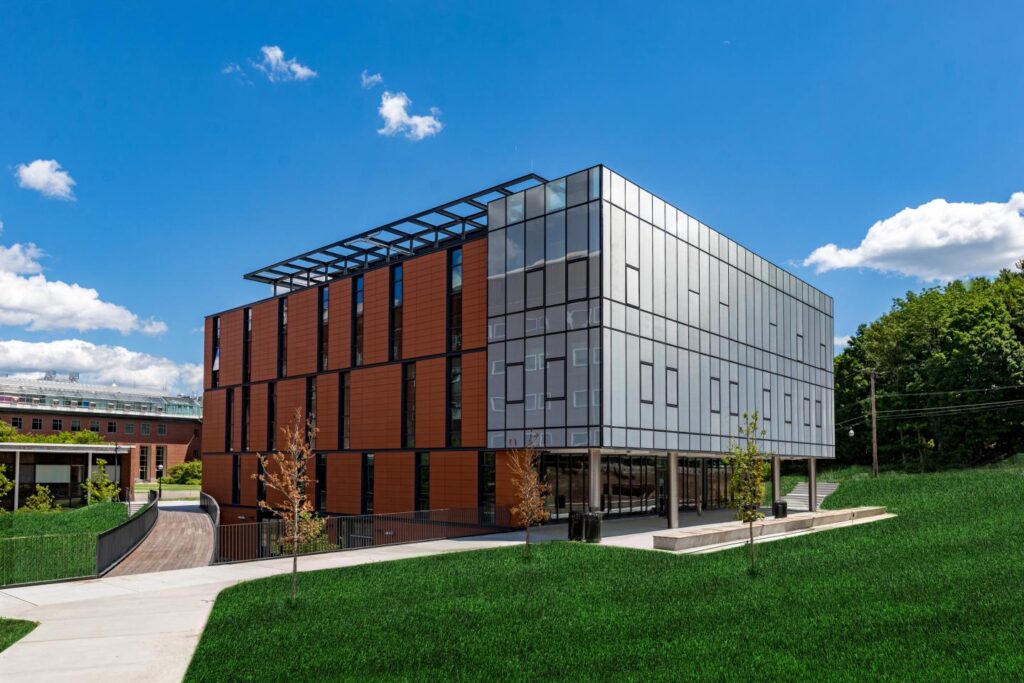
Our campus’s seemingly ceaseless state of construction has led me to ponder the virtues and shortcomings of our architecture. At a liberal arts college, the curriculum is important, but the buildings in which students learn those subjects are not some trivial afterthoughts. Beautiful buildings invite curious minds, and they encourage their inhabitants to enjoy the good things in life.
Unfortunately, campus leaders now seem more concerned with keeping up with the rapidly moving cycle of renovations than with creating a home. When one major project is completed, another one begins, in addition to all the side projects going on in between. During my freshman year, it was Dartmouth Hall that needed an update, and its completion was delayed significantly. Shortly after, the Hopkins Center for the Arts was the next victim of “improvement,” effectively closing it off for most of my undergraduate career. Like a snake, our campus routinely sheds its old skin. The new skin that replaces it, however, is hardly a fresher, more beautiful layer.
Without question, the buildings that make me love the Dartmouth atmosphere are its older ones. As somewhat of a New England supremacist, I feel at home while walking by the cozy Georgian styles. When one stands on the Green, which is itself a vital component of small college design, he sees not eyesores but powerful symbols of our rich history. It’s an experience that doesn’t get old no matter how long you’re here. I still find myself appreciating the beauty of Dartmouth Hall and her sister buildings. Baker Library’s tower is an austere and imposing symbol of our beloved institution. It pierces the otherwise uncrowded skyline, almost calling her alumni back home.
You’d be hard-pressed to find a single soul who shares such an emotional experience when walking by Anonymous Hall. Unfortunately, that ugly building’s completion was heralded by the College as a great achievement. It is “sleek,” they said in 2020, when it was unveiled. Steel, glass, and concrete are sleek and simple. They are not beautiful. International styles, which employ simple geometric shapes, colors, and materials, are passionless. As the critic Lewis Mumford understood, buildings are art forms that reflect the people who build them. They are expressions of local culture precisely because they connect humans to their homes and give them a sense of place. Nothing about Anonymous Hall says Dartmouth or New Hampshire. We could place it in any city in the world and it wouldn’t look out of place. That’s how you know it doesn’t belong here.
The architects of the new Hopkins Center similarly pray to the gods of glass and steel. They made no effort to add any touch of New Hampshire to its walls. The granite of New Hampshire is in our muscles and our brains, but not in our buildings. We’ve fallen victim to the whims and idiosyncrasies of an architect. The new Hop is interesting, but in the same way that a bad song stimulates the ear but not the heart. It’s not inviting. It doesn’t fit with the rest of campus.
The University of Virginia provides a good model for campus design. In Charlottesville, they are committed to Jeffersonian Classicism and to preserving the historic nature of their grounds. At Dartmouth, new buildings should always conform to the standards of the Georgian style, or at the very least to New England-inspired designs. This does not mean that every building must look the same. Two examples I can think of are the Sherman House and Wilson Hall. Both are unique, but both look like they belong. The fraternity and sorority houses are also good representations of unique but appropriate buildings. Alpha Chi Alpha’s green-shingled house is quintessentially Dartmouth in its own way, as is Phi Delta Alpha’s white building.
Some of the new design choices are informed by notions of sustainability. I have nothing against reducing the environmental harm of construction when necessary, provided it’s not done in a way to harm the aesthetic integrity of the building. I’m not a sustainability expert, nor am I an architect, but I’m sure there’s a way to build beautiful buildings while cutting emissions at the same time.
The College is in the midst of a building frenzy, with new dorms on their way soon. Too much harm has already been done by some of our newer buildings. While we shouldn’t tear these down, we can remedy their deficiencies by adopting a simple but sturdy rule: all future buildings must be beautiful, and they must evoke the Dartmouth ethos. This isn’t necessarily something that can be defined, but anyone who bleeds green knows it when they see it. As alumni come home this weekend, let’s remember to preserve what brings them back each year.
Be the first to comment on "The Buildings of Dartmouth"