
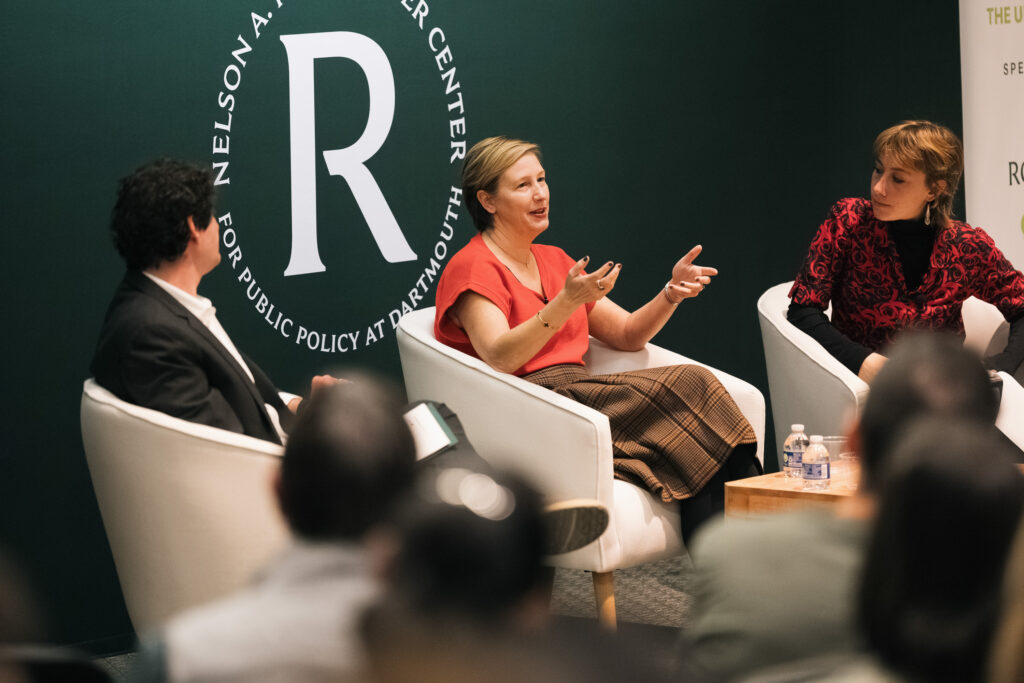
When The New York Times Opinion Editor Kathleen Kingsbury took the stage at Dartmouth last week, she came armed with anecdotes about inbox management, trust in media, gym habits, and the number of emails she receives before 7 a.m. Unfortunately, what she didn’t bring was much of a point.
The conversation, hosted by The Dartmouth’s Charlotte Hampton and government professor Herschel Nachlis, offered an hour of what might best be described as “content”: a mix of media platitudes, half-answers, and artful dodges polished to a Times-level shine. Nachlis repeatedly mentioned The Dartmouth Review—to polite chuckles and no acknowledgement from Kingsbury, who managed to dodge even that small nod to free campus discourse in between campus outlets. It was, in short, a master class in saying very little very well.
Kingsbury opened by sharing that she starts her day at six in the morning and faces nearly a thousand emails before most students have found a coffee. “On the world’s worst days,” she said, “I can do the most work.” The remark seemed to try to sound noble, but it landed closer to self-congratulation, the kind of sentiment that can mistake human tragedy for professional purpose.
She lamented that management was the least enjoyable part of her job, adding that she prefers “real journalism.” The term “journalism,” it seems, now means learning TikTok editing software because sometimes pieces are “just better” not written in text form. When asked about the perception of bias at The Times, Kingsbury assured the audience that the Opinion and Editorial sections are “very separate” before immediately confirming that both are “classically liberal.” She expressed pride in having “columnists who reflect the American electorate,” a bold claim for a publication whose idea of ideological diversity stretches from David Brooks to Bret Stephens. Sure, Brooks is a step, I’ll give her that, but still a far cry from representing the voices of conservatives in middle America.
Kingsbury, who proudly admitted she never worked for a student newspaper, nonetheless dispensed advice to those who do: “Be nimble,” “learn video,” and “understand the business model.” It was a curious set of suggestions for an audience that still has to ask for printer paper at Collis. Still, there was something sincere in her effort to meet students where they are, learning and growing today. She seemed to recognize, even if faintly, that the next generation of reporters will inherit a media landscape far more unstable than her own.
When a student questioned whether national outlets like The Times should leave local issues to local papers, Kingsbury solemnly declared that “the reality of local news is that it’s devastated.” She said this while representing the same institution that helped finish the job.
Pressed about political coverage, Kingsbury gave the usual reassurances: The Times Opinion Section employs “the largest fact-checking team in the world,” “supports a diversity of views,” and “reflects government.” Her comments on democracy—that “democratic norms and laws are being broken apart”—came prepackaged in the familiar tones of elite worry, just vague enough to avoid offense and just self-important enough to sound courageous.
She concluded with career advice: be willing to do jobs you can’t imagine, make phone calls, and learn the basics of reporting. It was the only truly concrete part of her talk, and also the one least reflective of the modern Times newsroom.
If Kingsbury’s visit proved anything, it’s that the national media elite are perfectly capable of filling an hour without saying anything real. The morning-person routine, the obligatory democracy lament, the polished mention of “changing media consumption habits”—it was all there, immaculate and hollow. And perhaps that’s fitting. In a world where The New York Times wants to be both the record and the opinion, the gatekeeper and the platform, Kingsbury’s performance was pure Times: meticulously curated, self-congratulatory, and allergic to candor.
Kingsbury’s visit revealed a profession still enamored with its own relevance, even as trust in media continues to erode nationally. The problem with media—not just The Times—is not a lack of the newest technology or “nimbleness,” but a lack of self-awareness. True journalism, even true opinion, begins with humility. It begins with the willingness to be questioned, challenged, and wrong. What we heard was instead the sound of an institution congratulating itself for existing, and “surviving.”
She may have ignored The Dartmouth Review, but in her silence, she said plenty.
Be the first to comment on "Kathleen Kingsbury Gives A Master Class in Saying Very Little Very Well"