
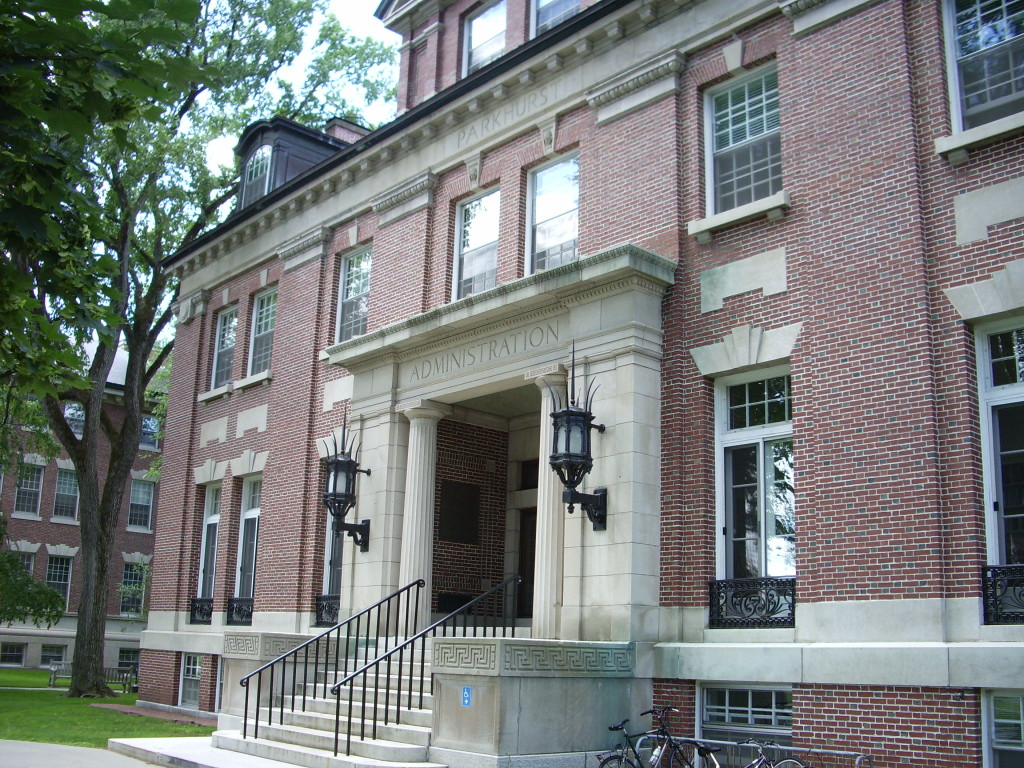
Each fiscal year, Dartmouth College, like all tax-exempt organizations in the United States, files Form 990 with the Internal Revenue Service. While often viewed as a mere compliance requirement, this document offers the public its most detailed financial window into the institution’s operations, listing everything from executive compensation to contractor fees. A longitudinal analysis of these filings from 2004 to the present reveals a persistent trend in the College’s cost structure: despite the widespread adoption of digital technologies designed to increase operational efficiency, the administrative overhead at Dartmouth has not decreased. In fact, the data suggest that the efficiencies promised by the internet era have been absorbed by an expanding bureaucracy rather than passed on as savings to students.
To understand the scale of the missed opportunity, we must look back to 2004. This was an era before the ubiquitous adoption of cloud computing, when “The Facebook” was a novelty and the iPhone did not exist. Administrative work was physical. It lived in filing cabinets, traveled through interoffice mail, and required a constant churning of paper. The 2004 Form 990 reflects this analog reality vividly: that year, the College spent $13.4 million on “printing and publications.” Adjusted for inflation, that is roughly $22.8 million in 2025 dollars. It was a time when a small army of administrators was arguably necessary to manually process the sheer volume of paper that kept the institution running.
Then came the digital revolution. The promise of the internet age was simple: efficiency. Software would replace paper, algorithms would replace manual sorting, and the cost of administration would plummet. Dartmouth embraced this transition wholeheartedly. The College now spends $21 million annually on “information technology” fees alone. We have automated payroll, digitized admissions, and moved everything from course registration to room booking online, eliminating the need for human intervention in all of these processes. By all economic logic, this massive capital investment in technology should have decimated the need for administrative labor.
Yet, the bureaucracy has not gone anywhere.
As of 2024, Dartmouth employs 3,555 staff members alongside just 1,052 faculty—a ratio that has remained stubbornly unchanged since 2004, when we employed 922 faculty and 3342 staff members. We have digitized and eliminated the workflow, but we kept the workers. The result is a bloated administrative state that has absorbed the productivity gains of the internet age rather than passing them on to students.
The financial toll of this stagnation is astronomical. In 2024, the College spent $663 million on wages. But the true cost of administration is even higher, hidden in a line item on the 990 innocuous labeled “Fees for services.” This category, often a hiding place for shadow employees contracted as external consultants, totaled $131 million. When you combine the wage bill with these outsourced service fees, the grand total for human capital at Dartmouth hits $794 million. To put that into perspective, with a total enrollment of 6,938 undergraduate and graduate students, the College is spending north of $110,000 per student just on personnel.
This is the scandalous opportunity cost of the bloated administration. If Dartmouth had simply kept pace with the general productivity trends seen in market-based administrative roles — using technology to do more with fewer administrators — the financial picture of the College would be unrecognizable. Consider the alternative: The $794 million we currently spend on this workforce is enough to fund a revolution in access. The total tuition revenue for the entire college is roughly $500 million. If our administrative costs had tracked with productivity, we could neraly cancel tuition for every single student and still break even. Alternatively, we could have taken the $265 million we currently spend on financial aid and increased it several-fold, effectively making a Dartmouth education free for all but the wealthiest families.
Instead, that money feeds a machine that runs no faster than it did twenty years ago. We have traded the $13 million printing budget of 2004 for a $21 million IT budget in 2024, but we kept the administrators who used to push the paper.
One can only wonder at the Dartmouth we would have today had administrative costs actually decreased with the productivity explosion ushered in by the software age. It would be a place where resources were poured into the classroom rather than the cubicle, where tuition was a fraction of its current cost, and where the endowment served the students rather than sustaining the staff. The Form 990 tells us that future was possible; it also tells us exactly how we squandered it.
Be the first to comment on "The Paperless Paradox of Dartmouth"