
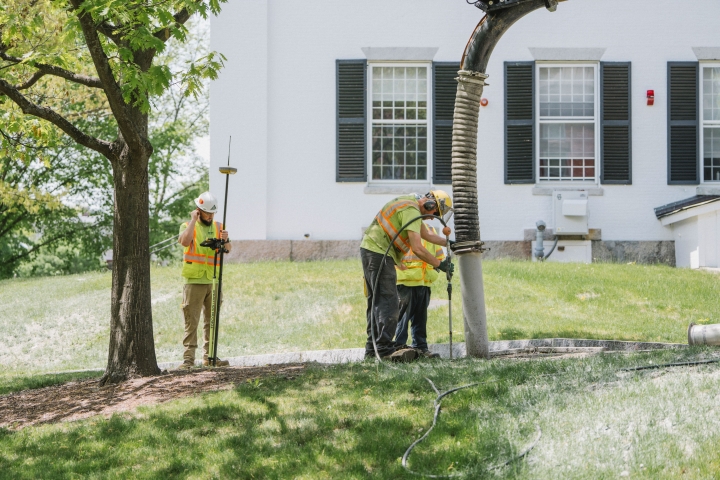
On April 22nd, 2024, President Beilock doubled down on her environmental commitments, pledging over $500 million toward the “Dartmouth Climate Collaborative.” The administration’s goals are sweeping: cut campus emissions by 60% by 2030 and create a fully renewable campus by 2050. On paper, this massive investment looks like a valiant crusade to slow global climate change, but as details started to emerge on the program, its true priorities became clearer.
The main goal of this transition doesn’t actually seem to be fighting climate change in the most effective way possible. Instead, it acts as a highly expensive way to make the college “feel good” about visibly standing up to the issue right on our campus.
To understand why Dartmouth’s strategy misses the mark, you have to look at how greenhouse gases actually trap heat on the Earth. The Earth’s atmosphere is a shared, borderless system. It does not care where, specifically, carbon dioxide is emitted from, and it doesn’t care where on earth emissions are lessened. CO2 emissions halted in Sub-Saharan Africa or rural India have the exact same cooling effect on the global climate as a reduction in CO2 emissions in Hanover, New Hampshire. Therefore, if your genuine goal is to slow climate change, you should spend your money where it buys the absolute most carbon reduction per dollar.
Dartmouth’s solar project is a perfect example of ignoring this basic logic. As the college proudly states: “With its goal of reducing carbon pollution by 50% by 2025, Dartmouth College is taking a strong leadership position to help solve one of the region’s most difficult environmental problems. ‘Eventually, we would like to get at least 20% of our electricity from sunshine,’ said Abbe Bjorklund, Dartmouth’s director of engineering and utilities.”
The problem with this plan lies in oversights regarding geography and the power grid. Hanover is notoriously cloudy, and our winters mean panels are often buried under snow, making them useless many weeks of the year. A solar panel installed in the sunny South would generate nearly twice the electricity. On top of that, the New England energy grid is already relativiely “green,” relying mostly on natural gas and nuclear power, with very little reliance on coal. Using solar panels here merely swaps clean energy for clean energy. If we were to construct these same panels on a Southern or Midwestern grid, they would replace highly polluting coal power, doing exponentially more to help the planet. The value of a solar panel depends on climate, grid composition, and the source of power it is displacing.
This local blind spot extends deep underground, too. Dartmouth’s multimillion-dollar geoexchange system is a staggering misallocation of money (assuming one’s goal is to fight climate change). New Hampshire is called the Granite State for a reason; boring hundreds of 800-foot wells into this ancient, highly compressed bedrock is painfully slow and astronomically expensive compared to drilling through softer earth elsewhere. Furthermore, the local geology offers practically zero natural energy. The crust beneath Hanover sits at a lukewarm 50 degrees yearround, just enough to mildly assist a heat pump. If the true goal was to maximize green energy, that exact same funding could have been deployed to regions like the Great Basin in Nevada, where the Earth’s crust is thin and naturally boiling groundwater can be tapped to generate massive, grid-scale renewable electricity. Instead, Dartmouth is sinking a fortune into chewing through solid rock just to pull 50-degree dirt heat for a single campus.
Ultimately, it is clear that Dartmouth’s energy transition is more an exercise in optics than anything else. Securing a supposed environemntal victory is an impressive factoid for tours guides to mention to prospective families, but it fails to actually do the most good for the planet, especially given Dartmouth’s extensive financial resources and conenctions. It is not surprising that a project such as this is front and center of Dartmouth’s website and social media. College administrators of any institution are naturally inclined to pursue projects that can be announced, photographed, toured, and touted as tangible victories. Considering our findings, these supposed accomplishments warrant serious scrutiny.
Be the first to comment on "An Expensive Shade of Green: Facts about the Climate Collaborative"